Just a quick update on my language learning adventure before I move into some new topics. I am still very comfortable with my decision to stop using Duolingo. I’m trying to be fair in saying that it has a place in the language learning landscape. If I was stuck with limited financial resources and needed to get the basics of a language, plus build a daily study habit, then certainly Duo fits the bill. The user data I have seen shows that it is massively successful in teaching English to people who will see a massive economic benefit of being able to find work in English-speaking communities, or in their own communities. While traveling I have stuck to a rule that if you needed to find an English speaker, walk into a hotel lobby. In many countries the people there got the job precisely because they speak English. In Mexico, Central America, and South America, learning English makes a lot of sense as a career builder. In the USA the same can be said of learning Spanish which is very much the second language in most of the country. It also might be useful to be learning Japanese or Cantonese/Mandarin if you are looking to work in those countries or with companies from those countries.
I’m a guy with an Italian ancestral background who decided to make sure I could manage the basics in the Italian language. I’m also old and currently retired. My tolerance for nagging from a cartoon bird is minimal. I also found Duo to be a poor fit with my approach to learning a language, and with the other tools I am using.
The good news is I gave Busuu a try, and it is a much better fit. It keeps some of the features of Duo like streaks and daily goals, but it does away with almost all of the game elements. Another improvement is the voices used in the spoken examples. Where Duo can sound very artificial and cartoonish, Busuu uses actual people speaking naturally. My comprehension has improved greatly thanks to that feature. It also has a very robust social element where you can correct other student’s work, and have yours corrected. Having a native Italian speaker correct my work is fantastic. I try to return the favor as often as possible. If I see someone learning English and their written/spoken example needs a tweak, I can give them feedback.
Another area where Busuu clobbers Duo is in practice mode. You can pick Vocabulary or Grammar, and work on only words you have had trouble with, for example, or only a specific grammar topic. In some cases you can engage with either voice or writing. It’s a great way to review and isn’t any more complicated than Duo’s, but it is much more effective.
I’ll leave that right there. Check out Busuu if you are in the market for a daily language app.
Here are links to a few more resources I have found useful/essential:
itakli spoken language platform. The UBER of language learning (minus the strong smell of Axe Body Spray)
Deep-L AI-assisted language translator app. Better natural-language translations.
WordReference Dictionary/Thesaurus/Conjugator. The interface is terrible but the value is immense.
Collins Dictionary is a WordReference alternative. Better in some ways, worse in others. Some day one of these will get a modern makeover. Until then have both ready to use.
Memrise enhanced flashcard platform. Some features of an app, in flashcard form. Great for quick-hit learning.
Language Reactor translator plugin for Chrome. A learning platform based on translating foreign language closed captions. Amazing.
This is a companion to my previous post about my experience with Duolingo (actually Super Duolingo paid service).
First off, I’m just a “punter” when it comes to Duolingo. Please check out the Duoplanet Blog, which is an excellent resource and answers questions more thoroughly and objectively that I have. I’ve linked directly to their review of Super Duolingo, but just go to their homepage and check out their excellent content.
This just in
I am “tapering off” on Duo but as soon as I started the next level there were new types of exercises. I don’t think any of them are groundbreaking, or even that useful, but they are better from an engagement perspective. One is sentences with two blanks, one for a singular expression and one for a plural expression. It sucks that they give you both answers and you just chose which goes first and which goes second. It would be better to give the user the word in English (or other native language) so they can answer on their own, but at least you get to jab at buttons. The other exercise is worse. Much worse. You get a voice prompt and two possible words. They aren’t difficult but it is a basic listening exercise. So you pick the right answer… AND IT DOESN’T TELL YOU WHAT THE WORD MEANS IN ENGLISH! WTAF. There are other exercises with the same problem. You complete the challenge but Duo doesn’t provide a translation. Massive fail.
So Duo continues to disappoint. I admit that it is a quick way to complete some exercises and feel like you came away having improved. I don’t hate that about it. But it can and should be much better at teaching a language.
A Variety of Resources
One thing I can’t stress enough is how many other great language learning resources are available on the internet, and through local libraries. Even if you are a die-hard Duo user you can amplify those lessons with some videos or podcasts on basic grammar, usage, phrases, and expressions. Here are a few of my favorites:
A surprising and maybe under-known resource is this Learn Italian program from UNC. It’s more of a grammar and usage resource, but it is well written. The content is very direct and thorough as you might expect from a university resource.
I also use a ton of YouTube video content, and here are my favorite YouTubers:
Easy Italian – This YouTube Channel is where I started with video resources and I still think Katie and Matteo are the best. They have a great mix of instruction in English and in Italian, the content is fun and enjoyable, and they do a great job of presenting it. Their Super Easy Italian series is an excellent intro to the language and you will have fun doing it. Their man-in-the-street videos let you hear actual Italians speaking Italian in an informal/candid setting. They also have a subscription plan through Patreon and it is worth looking into (I have a supporting subscription). The material can be a little difficult to find as it is spread around on JoyOfLanguages.com, Youtube, and various podcast sites. Their Grammar Bank and the exercises/transcriptions for each video are very good. One glitch: Grammar Bank is full of broken Soundcloud links (they should definitely fix this) but the episodes are likely available on the podcast service of your choice.
Learn Italian with Lucrezia – Lucrezia is more direct than Katie and Matteo, but also delivers excellent lessons in an engaging manner. I often turn to her lessons on specific problems I am working on and they have been very helpful. She has many informal travel-style videos as well as her excellent language lesson episodes.
Italian in 7 Minutes – Simone is my kind of teacher. His approach of “slow learning” has been very helpful. Spending less time jumping between material and getting closer to doing one thing per day (reading, writing, listening, researching grammar and verbs…) has made a great difference in how I feel about my progress. His specific lessons are also very good. Specifically, his lessons and videos have changed my learning approach from “grammar first” to “speaking and listening first”. I am able to read basic Italian and it is great for learning usage and vocabulary, but my real goal is comprehension and speaking. It’s the part of the process I struggle with, but that is because I never made it the focus of my learning. I’m working to change that after 3 months of “spray and pray” learning.
Learn Italian with Teacher Stefano – Stefano is the Energizer Bunny of the group. His energy and focus is only matched by the ferocity with which he rrrrrrrrolsssss his rrrrrrrrrrsss. Time spent with his material pays dividends, even though it can be a lot to take in for a beginner. Watch a video a few times in one session and it makes a lot more sense.
Un sacco di lezioni
I quickly found myself adrift in a sea of learning material. I found that many of these resources expect that you either have set a goal, or you are in a scholastic setting and are learning *everything* at once and are looking for an assist on certain topics. It isn’t a matter of using fewer resources, but of using the most important ones more and the less important ones less.
In my case I am shifting from a reading/grammar focus to a speaking/listening/writing focus. I will continue to read and continue to work on grammar, of course. But I am prioritizing putting the language into use and developing my ability to think in Italian, and speak in Italian. In my case that is not my comfort zone, but I think that is self-imposed. If I worked on it more I would be more comfortable.
I’ll end with a quick story about a conversation I had with my late-great friend Luuk. I am a musician and I had the immense pleasure of performing at the Zappanale Festival in Bad Doberan, Germany. It is, as it sounds, a festival dedicated to the music of Frank Zappa. After a performance we were having a beer and talking about the bands we had seen, and he said “I don’t know how you get up on stage and do that. I would be shitting myself!”. And my reply was that I put in a massive amount of practice time so that I don’t have to worry when playing to an audience. I had already made all the mistakes! So that is my inspiration as I progress in my studies.
I gave Duolingo a real chance to teach me Italian and these are my thoughts and observations after three months…
NOTE: Please read/skim to the end and maybe follow the post. Not only is this long and sprawling, but I know I will be making edits, adding images, and adding links to specific resources over the next week or so. I am not telling anyone not to use Duolingo. This is my reaction to three months of using Duo at least twice per day, for between 30 and 60+ minutes per day. Thanks for reading.
Introduction
As you might glean from the name of this page, my name is Peter Brunelli, born in the USA to American parents of Italian descent. While I am at least two generations removed from my ancestral homeland of Italy, I have been surrounded by Italo-American culture since birth. Nobody in my family has ever hid from their ancestry. Italian culture continues to be the center of how we see ourselves and our families, how we celebrate and mourn, and how we see the American experience.
Italian-Americans are their own people with their own culture. We are typically very proud of our Italian ancestry, but also proud of how our ancestors managed to assimilate into a strange culture where many were not initially welcome. Sure, we do not do things the way they are done in Italy. But my friends from other cultures are in the same exact boat. Their cuisine has adapted to the North American climate, food supply, and employment opportunities. Imagine leaving Napoli, the home of the San Marzano tomato, and landing in New England, home of the potato. It must have been a shock. I’ve travelled in China, and they are committing Crimes Against American Cuisine that are on par with how badly their cuisines are treated here in the states. Our country is strewn with the criminality of restaurants putting peas and other garbage into their spaghetti alla carbonara. But I know there are Italians putting strange stuff on hot dogs. What goes around comes around.
As much as I embrace the Italian culture there has always been one missing link to the “old country” and that is the language. I never heard Italian conversation used in my family’s homes. I heard exclamations, interjections, aspersions, random phrases… but nobody spoke Italian. I am a descendant of Italians who arrived in the US at the end of the 19th and early 20th century. There is a 120-year gulf between their arrival and where I stand now. That means it is not very surprising that I speak American English, especially in light of the assimilation pressure my ancestors faced in the early 20th century.
Why was no Italian spoken for about three generations? My “a-ha” moment come when I was a teenager and asked my paternal grandfather why nobody in his family spoke Italian. His response was, as I remember it “because I didn’t want to get a beatin’.” His family hadn’t left their homeland to raise Italian children. They were here to raise American children, speaking the English/American language well. For him it eventually meant not being turned away from work because of a thick Italian accent. He actually had a New Haven (Connecticut) accent. Which is a thing.
Despite not hearing much Italian, I was always seeing/hearing it used in relation to food, travel, cars… I could read enough to make sense of a cookbook, or a menu (yes, the food obsession runs deep). Italian and Italo-American cuisine has been my main link to the culture of my ancestors’ homeland. I cook like both of my grandmothers as a result. Maybe as I progress in my studies I continue to find ways to treat Italian recipes better, and appreciate both sides of the equation more fully.
I also have many bad Italian-American habits like swallowing the vowels at the ends of words, or using the plural incorrectly like “a biscotti”, or “a pannini” because that is something we see all the time in the USA. I don’t feel too bad because that is how language works. Italians make a hash of English the same way Americans abuse Italian.
Learning Italian has always been something I wanted to do but didn’t follow through on. Over the years I have made a few weak attempts to improve my skills but it never went anywhere. This summer I set out to change that. Now I’m off for a nice gabbagool sang-weech.
Learning Italian from the Interwebs
Before I address the Owl In The Room, here is a quick breakdown of the tools I have been using and how I use them:
Translating resources: Wordreference and Google Translate have been very helpful. The Wordreference iOS app is garbage, but the website is better. I use Google Translate as a study tool. I type a sentence in Italian, and I will get a functional translation. Then I hit “reverse” button and it will show me a better Italian version of the translation. I can take that and then try using indirect pronouns or changing the gender/number. I think it is more helpful than it sounds. Try it!
YouTube Instructional Video: There are dozens of language educators making great content on Youtube, and many have podcasts and lesson material available to supplement the videos. They have been a great way to improve my listening comprehension and learn key concepts in a mostly passive manner.
Video/Film in Italian: I was already watching Italian cooking shows, and have been for years. But I wanted to do more than catch a few words or try to turn on translated subtitles. Finding a way to watch The Simpson in Italian was great, but it is not easy at all. The pace is very fast! Just like the English version.
Easy-Reader material in Italian: Between my local library and Kindle there are many low-cost of no-cost books with beginner-level short stories and conversational dialogues in Italian. Reading is my comfort zone so these have been great. Resding lets me see a variety of tenses, vocabulary, and idioms in a comfortable environment.
Conversational Italian: I am just starting to use italki to schedule conversations with native Italian speakers. This is very much outside my comfort zone and I need to do more of this.
I will expand on how my use of these tools later, but you get the idea. I am not using just one tool. In fact, I use these other tools more than I use “the bird”…
l’Ucello
Yes, the bird, the owl, the emotionally manipulative taskmaster you love to hate. I had used Duolingo previously but never really dove in. It looks like I first opened an account in 2015, and that was most likely in an attempt to improve my French language skills (I live four hours from the Quebec border and have friends in Quebec). I took away several important reasons why that (mostly) failed and am trying to avoid those problems this time around. Aside from diversifying my learning materials, and putting in more time on a daily basis, I decided that I was going to see what the Duolingo app could really do. I started by purchasing a one-year Super Duolingo subscription so I had no ads, less dopey gamification (not really), and a less distracting experience. Or so I thought.
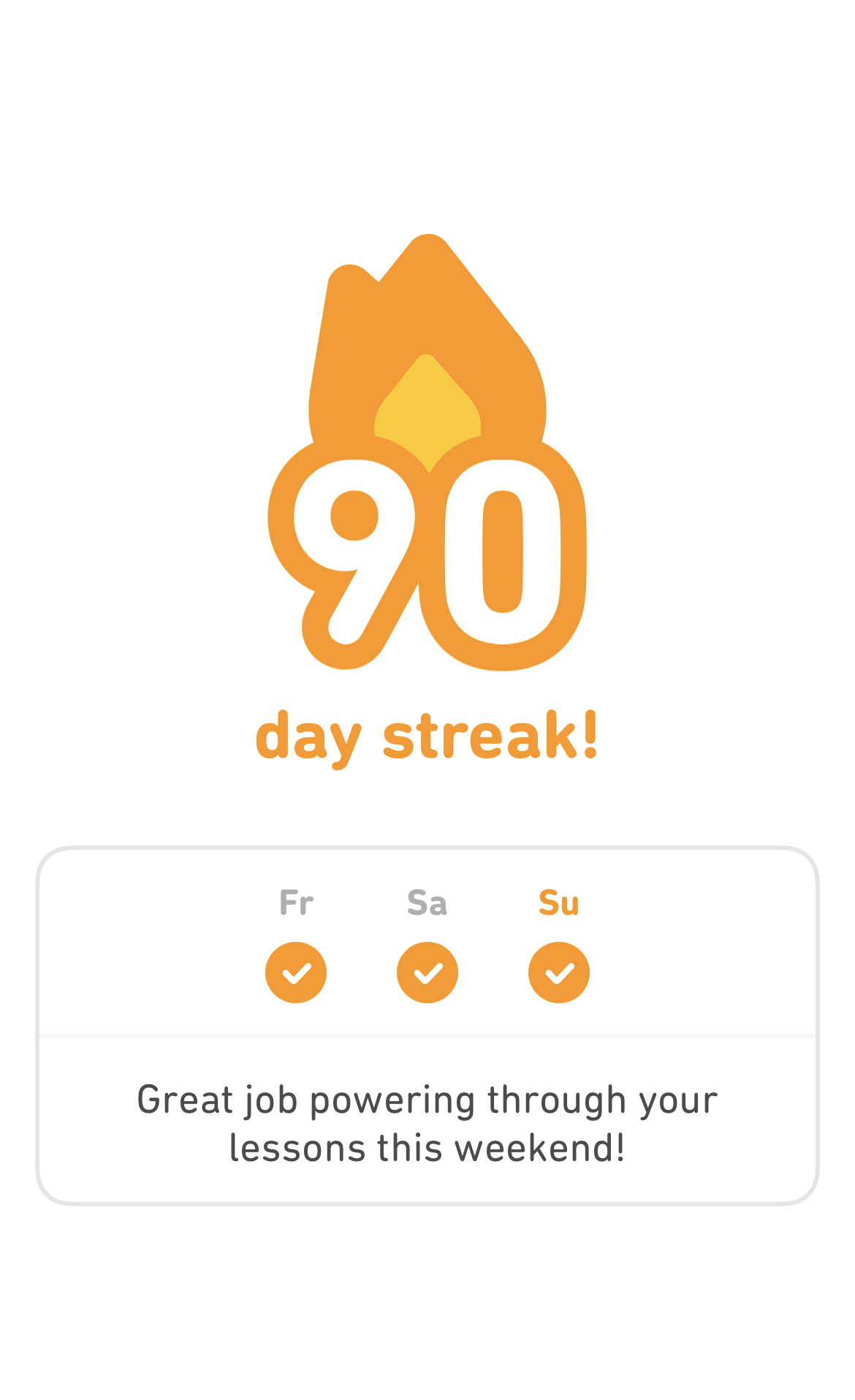
After 90 days (plus a few as I taper off) I am on Section 2, Unit 6. Let me tell you. It was the Section 2, Unit 5 that really did me in. I felt like I was doing ok with indirect pronouns, but Duo is all over the place. Not only am I not learning more, but I became more frustrated and felt like I was backsliding. I was trying to please the app and it wasn’t teaching me how to correct my mistakes. That is my one major takeaway. The only way you progress in Duo is by failing a lot and using outside resources. It will NEVER tell you why you are getting it wrong or pop up a message with a tip. For an app that sprays notifications at you like an enraged ex-girlfriend on Ladies Drink Free Tequila Night, it is mystifying.
I started by using everything: Lessons, word matching, phrase matching, league points, gems/lingots… I wanted to see what it was all about. What I figured out in the first week was that much of Duolingo is about getting you on a treadmill of buying lingots to get enough time to finish word matching games or extending 2X points sessions. It didn’t take long for that to grow tiring. When I searched the web for discussions about how people were completing the 2nd and 3rd level word matches without buying extra time I found that they were using pattern matching! Users had figured out where the app puts the new words and then sped through the pattern, not reading and matching. That’s garbage. That’s how you get past levels on a game console, not how you learn a complex language.
Pay once, Pay again: There is also a huge disparity between the rate at which you earn lingots and the cost of buying an additional minute of time to complete a challenge. 450 lingots for a minute, and if you only use 15 seconds you lose the rest of the minute. Must be nice… [this is an example of a predatory business model] If you are working your way through the lessons you might amass that 450 lingots in two weeks. The imbalance is shocking. But hey, in-app purchases are staring you in the face. Just buy your way to excellence. So immediately I stopped using that part of the app that I refer to as “Chump Central”.
Weak Workouts: There is an exercise module with options to practice what you got wrong (Mistakes), vocabulary/words, stories, listening, or speaking. Being able to go back to the mistakes I made, review them, and get them right is very useful. I do that immediately after a session. The “Words” section is terrible. It is still showing me words from week one, and putting maybe one or two newer words into each exercise. A large percentage of your time is spent letting the app know you still know how to say “bread” in Italian. The other modules are similarly frustrating. So there is another large chunk of functionality I take a pass on.
A League of Your Own: The league scoring concept is useful to let me know how much I am using the app. Other than that I am not driven by matching points with users who are doing “more”, especially now that I know how bad/easy/gameable many of the modules are. But, here’s a HOT TIP: Do 15 minutes early in the day to get the Early Bird chest, and then again in the evening to get the Night Owl chest. Both give you 15 minutes of double points. So you can care a little about points without needing to think too much about it. That kind of usage will keep you out of the “drop zone” in whatever league you are in. It would be nice if these lasted until the next day but Duolingo uses them to drive engagement. You can use that technique to keep you from slacking. But beyond that it is pointless (IMO). I’d trade it all for better language resources (more than zero) and better practice modules.
I’ll get to the important part now: At this point I am using maybe 25% of the functionality of Super Duolingo. Is it worth the $80-ish annual subscription? I’ll admit to being on the fence now that I have the subscription, but If I knew all of this going in I would not have spent the money. I and now only using it as a study aid which is reasonable once I found a way to skip all the filler. I am about to take a break from the my daily Duo routine after 90 days of continuous use. I will turn off all notifications and give the bird to the bird. I’m sure I will pop in for an occasional lesson and it is possible that I will be back at some point. I have read many reviews from advanced speakers who use it as a “tune up” or daily exercise. That makes sense. Time will tell
The Bad, and it is bad…
With that out of the way, I’ll tell what parts of the app are the worst:
Voice Recognition: At least half the time the app tells me I recited the sentence correctly before I am finished speaking. Sometimes it just tells me I got it right before I have said anything, maybe only uttering one syllable. That tells me the app is both poorly put together and the developers don’t care if you actually do the work. The voice recognition is shaky/garbage. Also, you can be wrong to an alarming extent and it still passes you. I found myself just jabbering and trying to make it sound right and it would say YAY! You Are Amazing. WTAF.
Gamification: Look, if you are a Candy Crush player who wishes you could feel less like a sloth while punching your phone’s screen, this app is your huckleberry. It has all kinds of ways for you to spend money, get bling, compete with strangers, and otherwise create a virtual social bubble. You will also have some basic foreign language skills. I don’t think it makes for a better learning environment.
Extreme Active Learning: Duolingo is almost 100% “experiential”, as opposed to learning from textbooks in a teacher-led setting. So if you are looking to know WHY you are using a word or structure you are out of luck. Duolingo just clobbers you with repetition, and you find a way to get it “right” but you will likely have no idea WHY. Duo provides virtually ZERO conjugation tables, examples, discussion, etc… There is a one-page summary at the top of each module. It is pretty useless. Traditional language learning support is not part of the Duo world. You will be learning things like indirect pronouns by guessing and making a lot of mistakes. Maybe it motivates you to find resources outside of the app. So you might progress, but your ability to THINK in the language is not a priority.
Emotional Pressure: Yes, the little characters are annoying. But you will be presented with Duo crying, the little characters in the side-challenges acting petulant or bored if you don’t use them, and the nags/notifications can be manipulative. If you have a well developed sense of DGAF you should be ok. But this backdrop is off-putting. I feel awful knowing that some users are succumbing to this and not being motivated by their own sense of self-education. It’s manipulative in the way only a candy-colored feeder-bar app can be.
Non-Functional Sync between devices: I have the iOS app installed on a phone and an iPad. The iPad never shows the chests from my twice-daily sessions. I can only see them on the phone I used on those sessions. I have tried a resync, logging out and back in, and reinstalling the app. Nothing works. Here is where I admit that my trust level in the app is so low I can’t imagine dealing with whatever passes for user support over at Duo. Pick a device and only use that device.
The Wrap
So that’s my three months of Duolingo fun. I’ll say this: there are worse ways to kickstart your language learning. I don’t know that a one year subscription is worth it, especially considering other available resources. It is one of the least expensive 12-month plans, especially if you don’t make in-app purchases during the year. You might also be the kind of learner who is a hand-in-glove fit for the Duo learning model. It is obvious to me that I am not a great fit for Duo. I suggest running a search like THIS ONE and checking out a few pages worth of links before committing to Duolingo. There is a lot of excellent analysis, and some other writers have analyzed the language model vs the business model, which I have been doing since the first day of this three month journey. I don’t think the learning model is without merit, but I do believe their business model is much more sophisticated.
Whether it is a credit card, social media, or any time I engage with an aggressive cash-extraction business model: Be A Bad Customer. Be A Great User. Get what you want out of the experience and be on alert for manipulation and hidden fees. DUOLINGO is a publicly listed for-profit enterprise. Users spending money is THE POINT. Users learning a language is not a revenue stream, it is the enticement. So bear that in mind as you decide whether to spend, and how much to spend, with Duo.
Whew! That’s a lot and thanks for reading any of this, never mind the whole thing.
 petebrunelli