This is a companion to my previous post about my experience with Duolingo (actually Super Duolingo paid service).
First off, I’m just a “punter” when it comes to Duolingo. Please check out the Duoplanet Blog, which is an excellent resource and answers questions more thoroughly and objectively that I have. I’ve linked directly to their review of Super Duolingo, but just go to their homepage and check out their excellent content.
This just in
I am “tapering off” on Duo but as soon as I started the next level there were new types of exercises. I don’t think any of them are groundbreaking, or even that useful, but they are better from an engagement perspective. One is sentences with two blanks, one for a singular expression and one for a plural expression. It sucks that they give you both answers and you just chose which goes first and which goes second. It would be better to give the user the word in English (or other native language) so they can answer on their own, but at least you get to jab at buttons. The other exercise is worse. Much worse. You get a voice prompt and two possible words. They aren’t difficult but it is a basic listening exercise. So you pick the right answer… AND IT DOESN’T TELL YOU WHAT THE WORD MEANS IN ENGLISH! WTAF. There are other exercises with the same problem. You complete the challenge but Duo doesn’t provide a translation. Massive fail.
So Duo continues to disappoint. I admit that it is a quick way to complete some exercises and feel like you came away having improved. I don’t hate that about it. But it can and should be much better at teaching a language.
A Variety of Resources
One thing I can’t stress enough is how many other great language learning resources are available on the internet, and through local libraries. Even if you are a die-hard Duo user you can amplify those lessons with some videos or podcasts on basic grammar, usage, phrases, and expressions. Here are a few of my favorites:
A surprising and maybe under-known resource is this Learn Italian program from UNC. It’s more of a grammar and usage resource, but it is well written. The content is very direct and thorough as you might expect from a university resource.
I also use a ton of YouTube video content, and here are my favorite YouTubers:
Easy Italian – This YouTube Channel is where I started with video resources and I still think Katie and Matteo are the best. They have a great mix of instruction in English and in Italian, the content is fun and enjoyable, and they do a great job of presenting it. Their Super Easy Italian series is an excellent intro to the language and you will have fun doing it. Their man-in-the-street videos let you hear actual Italians speaking Italian in an informal/candid setting. They also have a subscription plan through Patreon and it is worth looking into (I have a supporting subscription). The material can be a little difficult to find as it is spread around on JoyOfLanguages.com, Youtube, and various podcast sites. Their Grammar Bank and the exercises/transcriptions for each video are very good. One glitch: Grammar Bank is full of broken Soundcloud links (they should definitely fix this) but the episodes are likely available on the podcast service of your choice.
Learn Italian with Lucrezia – Lucrezia is more direct than Katie and Matteo, but also delivers excellent lessons in an engaging manner. I often turn to her lessons on specific problems I am working on and they have been very helpful. She has many informal travel-style videos as well as her excellent language lesson episodes.
Italian in 7 Minutes – Simone is my kind of teacher. His approach of “slow learning” has been very helpful. Spending less time jumping between material and getting closer to doing one thing per day (reading, writing, listening, researching grammar and verbs…) has made a great difference in how I feel about my progress. His specific lessons are also very good. Specifically, his lessons and videos have changed my learning approach from “grammar first” to “speaking and listening first”. I am able to read basic Italian and it is great for learning usage and vocabulary, but my real goal is comprehension and speaking. It’s the part of the process I struggle with, but that is because I never made it the focus of my learning. I’m working to change that after 3 months of “spray and pray” learning.
Learn Italian with Teacher Stefano – Stefano is the Energizer Bunny of the group. His energy and focus is only matched by the ferocity with which he rrrrrrrrolsssss his rrrrrrrrrrsss. Time spent with his material pays dividends, even though it can be a lot to take in for a beginner. Watch a video a few times in one session and it makes a lot more sense.
Un sacco di lezioni
I quickly found myself adrift in a sea of learning material. I found that many of these resources expect that you either have set a goal, or you are in a scholastic setting and are learning *everything* at once and are looking for an assist on certain topics. It isn’t a matter of using fewer resources, but of using the most important ones more and the less important ones less.
In my case I am shifting from a reading/grammar focus to a speaking/listening/writing focus. I will continue to read and continue to work on grammar, of course. But I am prioritizing putting the language into use and developing my ability to think in Italian, and speak in Italian. In my case that is not my comfort zone, but I think that is self-imposed. If I worked on it more I would be more comfortable.
I’ll end with a quick story about a conversation I had with my late-great friend Luuk. I am a musician and I had the immense pleasure of performing at the Zappanale Festival in Bad Doberan, Germany. It is, as it sounds, a festival dedicated to the music of Frank Zappa. After a performance we were having a beer and talking about the bands we had seen, and he said “I don’t know how you get up on stage and do that. I would be shitting myself!”. And my reply was that I put in a massive amount of practice time so that I don’t have to worry when playing to an audience. I had already made all the mistakes! So that is my inspiration as I progress in my studies.
Much like my interest in radio I’ve been playing musical instruments almost my entire life. We just used to be somewhat obsessed over the guitars, keyboards, amplifiers and eventually software that we saw on stage (on air) and in magazines. Eventually that got its own acronym G.A.S. for Gear Acquisition Syndrome. What I learned from years of horse-trading equipment via selling, buying, swapping, upgrading, downgrading… is that at some point I was very happy with my equipment and changing it around was a distraction. I play electric bass and usually am playing one of the four basses I own to the exclusion of the others. It might be a holdover from the many years when I had one bass, one amp, and not much else. Honestly I am a relentless pragmatist and mostly look for a piece of gear with certain capabilities. There have been… exceptions. Nuff Said.
It has become the same thing with ham radio equipment. I moved around between many different radios and antennas in my first 10 years of ham radio operating. Mostly it was a need for a specific capability, like UHF all mode, or QRP HF with great CW chops. It was messy, and most of that gear is gone, but I learned a lot about what I do and do not like. I do still buy and sell things, but in the main I use the same gear for a long time. Time in the hobby helps you think “into the future” a bit and you can identify gear that will be junk soon, is junk now, is highly functional junk (heck yeah), or is the real deal. Spending time at hamfests is like a crash course. When I was an organizer for a small hamfest in Connecticut I was perusing somegrar at a table and one of the club “Elmers” buttonholed me and said “That rig was junk when it was new, and it hasn’t gotten any better. Talk to me later, but don’t buy it!” And we lear to sepeate the good from the bad (for our particular needs). There are radios that have very long useful lifespans (The FT-817/818, for example. The cockroach of the ham radio world.) and others that either have not or probably won’t.
Warning: The G.A.S. Monster is devious and does not sleep! Even as I started devoting more and more time to satellite operation I had resisted selling my FT-991A. It is a great radio. The ICOM IC-9700 is the only in-production V/U all mode with full duplex capability. That’s rare. There is usually competition in any given product segment. QRP radios, HTs, 100W entry level, Contest-focused rigs, HF linear amplifiers… There are choices. Not so in satellite ground station equipment. As I said in the last post, “One rig. That’s the list”. Meanwhile I am using my FT-817/IC-705 portable rig with a handheld antenna for all my sat work except for simplex digipeaters like Greencube/IO-117. I don’t know if I will ever put up a computer controlled alt-az antenna mount, preamps, etc… but I am interested in the capability. It was only a matter of time until I would decide to cut bait and obtain an IC-9700. May 2023 was that time.
After a short flurry of sales activity on QRZ.com I had moved my Yaesu FT-991A and backup FT-817ND on to new loving homes, and had squirreled enough cash to blunt the not insignificant cash crater the purchase of a new IC-9700 would create. It’s the only game in town. There are no sales, incentives, or promotions worth mentioning. You want it, they have it, and if you don’t buy it someone else will. That, friends, is Scarcity Economics in action. So on to my preferred enablers at DX Engineering I went and plunked down the plastic for a IC-9700, a headset adapter, and the Icom/Electret variant of the dynamic-mic Heil Sound Proset 6 that I use on my portable rig (FT-817 is my uplink rig). The Pro-7 would give me better isolation, but I will take a lighter headset with some bleed when operating out in public. I can hear someone walking by or asking a question. That’s not a bad thing.
It arrived quickly since DX Engineering is the king of getting the gear to your doorstep, pronto. First reaction: It’s a beautiful radio! I already had most of the power cabling I needed, along with N-Connector adapters, and it didn’t take me long to connect it to a dummy load and run through some menus. As I expected I felt right at home in the menu system. It is very similar to the IC-705. I also quickly noticed that the front panel is a bit cramped. Most modern radios have the same issue but I was thinking about using this radio outdoors, portable, and hitting the wrong control is something that just happens (foreshadowing).
Some of the questions I had about operating this radio would only be answered through use. I have picked the brains of some very helpful satellite operators, and scoured the web for videos, but nothing gave me a clear idea of how this thing worked in comparison to my FT-817/IC-705 satellite rig. I am fully manual with that setup, tuning the uplink rig (817) and the downlink rig (705) separately. The waterfall display on the 705 makes finding myself on the downlink easy with little need for a cheat sheet. I know the transponder ranges and centers, and get within a few KHz right away. QSY is as easy as tuning the RX, having an idea of how far away I moved, then adjusting the TX the same amount (in reverse on a sat like RS-44. RX up 3, TX down 3…).
The IC-9700 is different. It has a dual-VFO split mode and you can A/B between the two VFOs with dedicated touch screen buttons, using the main tuning knob to adjust each VFO one at a time. There is no sub-VFO control. There is RIT, but I am still not a fan of RIT for satellite work. My OCD tells me to just tune it correctly. I also won’t forget my RIT setting is on and waste time trying to figure out why I am out of band! That is similar to running two radios, but you only have one VFO knob.
Then there is SAT mode. I figured this would be the “killer app” for tracking frequency on sats. You can activate either VFO, and there is a NOR (normal)/REV (reverse) button between the VFO buttons on the touch display. Sweet! (Reverse is where the input of the transponder and the output are reversed. The bottom of the uplink puts you on the top of the downlink, and as you tune the uplink higher your signal on the downlink tracks lower, and v-v)
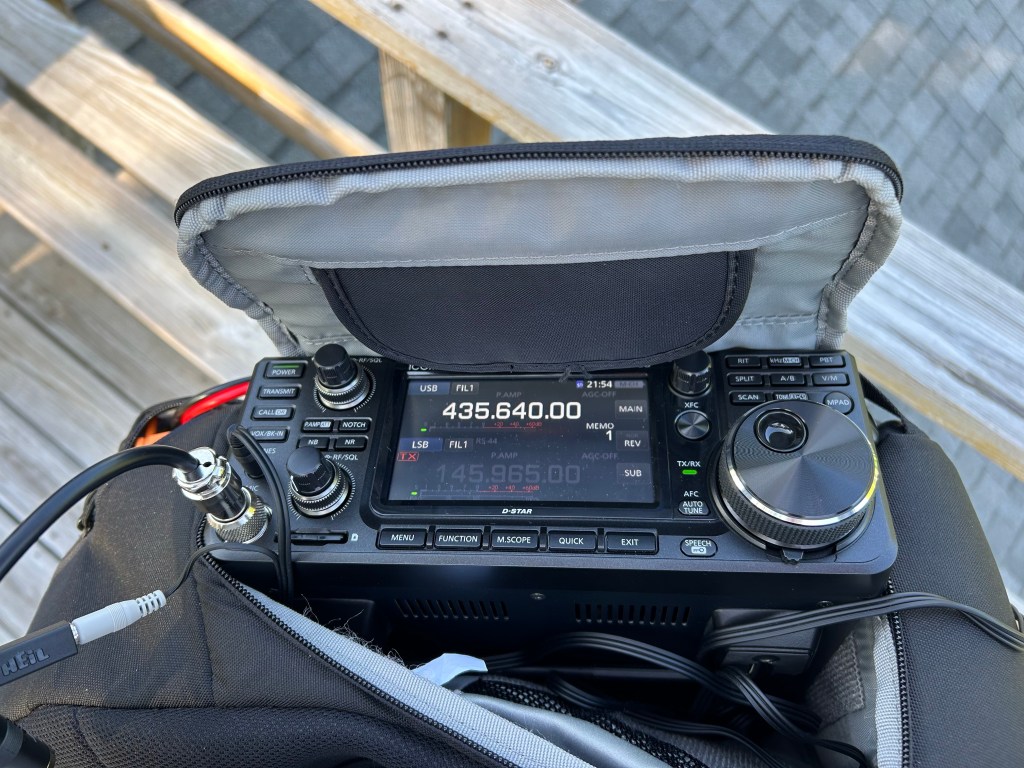
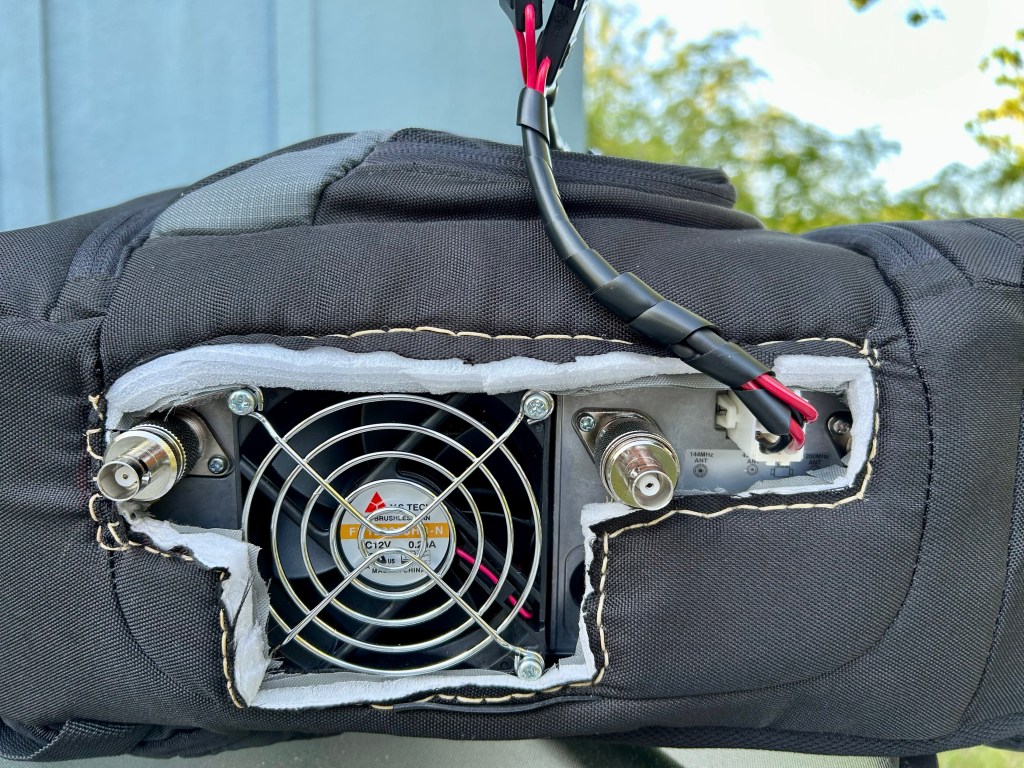
IC-9700 in a modified LowePro sling bag Rear Panel Access
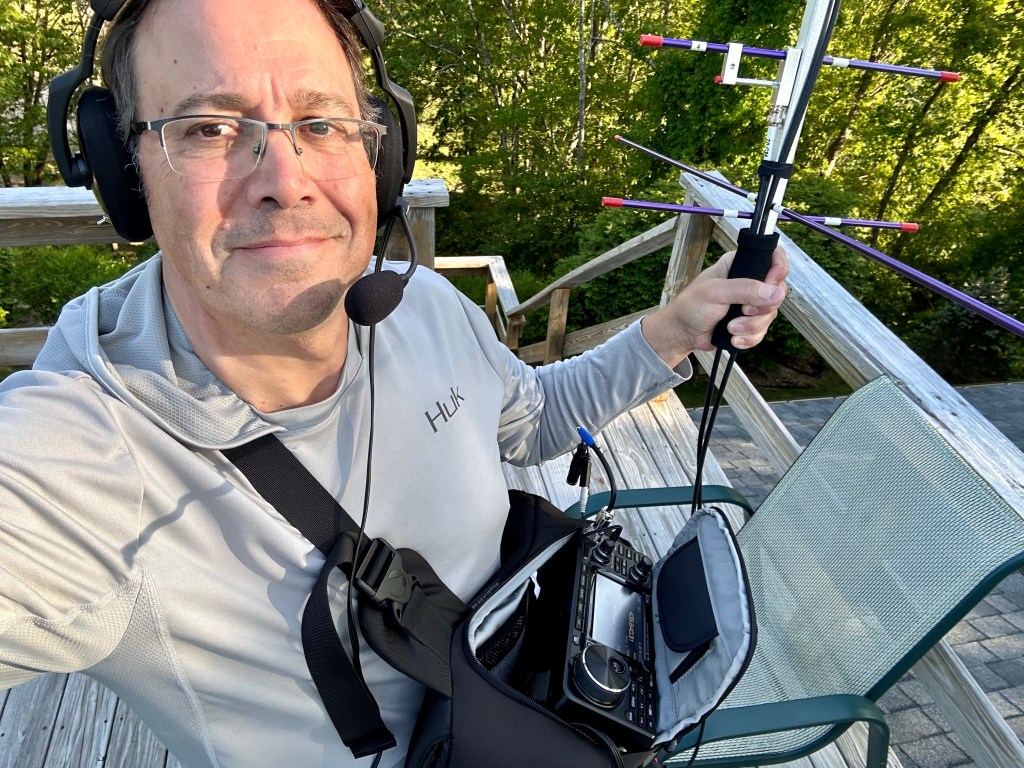
I still use a handheld Arrow II antenna so operating sitting down is not a great option. Much like I did with my camera bag holster for the 817/705 rig I turned a LowePro sling bag that I had bought for a full-sized DSLR kit (and the bag was not great for that) and carved it up to allow me to wear the IC-9700. A Speedy-Stitcher made it easy to neaten up the cutouts I made for the rear connector access. I had to punch a hole through the side of the top compartment to snake the power lead out to the radio. Done. It worked and the rig only feels heavy, not unbearable. I hooked it up and went out to try a RS-44 pass. That’s a bird I am very comfortable on.
I put the radio into SAT mode, set the VFOs, and off I went.
Me and my Arrow
Let’s just say it did not go well. I’m going to bullet list the things I tripped over because I think it will make it easier to convey:
Seeing the display in sunlight is very difficult. I will need t make a shade to use this reliably in this configuration.
Changing between VFOs is not as intuitive as I expected, and not hitting the NOR/REV pad by mistake is even harder.
If you press on one of the frequency displays the frequency is highlighted making it easier to see, but that does not select the VFO for tuning.
If you use the VFO Select pads you can select the correct VFO, but it doesn’t highlight the associated VFO display. There is also that NOR/REV button waiting for you to step on it like Sideshow Bob on a rake. So switching VFOs and being able to see the display in daylight is a two-press and check the status of the NOR/REV before proceeding. Every time.
Then there is VFO synchronization where neither VFO is selected and NOR/REV tells the rig how to sync the VFOs. Yes, it works. But as you QSY the tracking isn’t great and once you have the RX on frequency you now have to retune the TX VFO (or v-v) to get yourself back on frequency. So it works, but not well enough to just retune and hit the PTT.
Admittedly I made it hard on myself by not doing more than a quick dry run before trying to make contacts with this radio. But I hope I am making the point that while the radio is a fantastic performer it seems more at home in a shack than hung around my neck. At the very least it will take practice to get to the point where manual operation is as intuitive as a dual-rig setup.
My next mission was to get active on Greencube/IO-117. This turned out to be much more straightforward. Because the IC-9700 presents two virtual COM ports over USB I was able to run CI-V control on one and trigger PTT with the other. I use SATPC32ISS for the CI-V (CAT) control, and UZ7HO Soundmodem controls the PTT by directly addressing the higher-numbered of the two ports. I was able to get rid of the VSPE Virtual Port Splitter app I was using, and SATPC32ISS instead of HRD/HRD Satellite. That’s three open apps as compared to five which is a better place to be in the field when things inevitably go wrong.
Greencube Portable Setup
It was as easy as the previous attempt was difficult. Using the same 70cm WIMO X-Quad I used with the 991A I was hitting IO-117 easily at 25w and made a few contacts immediately. Then “Greencube Hell” broke out and I wasn’t able to break in over the big signals is Europe and Russia. But it wasn’t due to a problem on my end. SUCCESS!
After a few tries I was able to make SSB and FM LEO contacts with the IC-9700 in my portable setup. I was still getting tripped up a bit, but having the sats in memory banks and being able to switch between them that easily is very cool. I am still occasionally hitting NOR/REV by mistake and my next step is to just run it in dual-VFO Split Mode and see if that is easier. I think it will be.
The performance of this radio is superb. Compared to the Yaesu FT-991A the receive sounds more sensitive and cleaner on weak signals. The 991A has a very good receiver, but there is something more “contrasty” about the RX on the 9700. The TX audio is levels above the TX audio on my FT-817ND. It is much punchier and clearer. You can pretty much tell a 9700 on the birds once you have used one. That is not a small detail when trying to make difficult contacts. Neither is the ability to dial up a few more watts when needed.
One last thing before I close this and start thinking about Part 3:
Even though the IC-9700 looks very much like the IC-7300 and IC-705 it is an older design and does not have features like Bluetooth Audio that I use all the time on the IC-705. Even if it was available I wouldn’t be surprised if it was left out to have one less RF source causing problems inside the IC-9700 chassis. It doesn’t feel as “fresh” as the IC-705 but maybe that is because I have a few years of 705 operation to rely on.
Nobody has ever said the IC-9700 is a “field radio”. It is meant for the shack and if you take it into the wild there will be compromises. Little buttons, crowded display, not designed for cold fingers or no-look operation… But once it hooks up on a satellite it doesn’t matter. If we have only one choice in this category I am glad it is the IC-9700.
Here’s the deal on not having the Yaesu FT-991A in my shack. I could easily see myself owning one again. It is a lot of radio for the dollar, epecially at the prices on the used market. As I have said on this blog, many people complain about the menus but how much time do you spend in the menus? The quick access menu takes care of day to day adjustments. I only had to go into the full menu to make major changes for data modes or filter ranges. The actual radio (not the feature set, the radio) is brilliant. It is a standout 100W HF rig with a great receiver, great on 6M, and the V/U performance is very usable. It isn’t a V/U thoroughbred like the 9700, but for most weak signal operation it is very good. I don’t work a lot of QRO HF, especially since getting set up for satellites, but I will miss a 100W HF rig at some point. The bigger miss is 6M. I like working 6M and this is a bad time of year to be without a 6M radio. My plan is to pick up a Yaesu FT-891 eventually and fill that void and have a portable QRO HF option.. Until then 10W on the IC-705 has been a good HF setup for me since I bought it, and it is still a great choice.
2019 has seen two very promising releases in the Zappa Influence/Tribute genre, and it is only March! On one hand it is Liverpool’s Finest, The Muffin Men, aka the “Flab Four”. On the other is Michel Delville and The Wrong Object, Belgium’s answer to “What if you were very good at pretty much everything?” Both groups have been working at a high level for quite some time, and they both deliver the goods.
Roddie and the boys go first:
The Muffin Men have been at this game as long as anyone I can think of. They have hosted Jimmy Carl Black, Ike Willis, Denney Walley and many other guests at their tours and live shows. I was lucky enough to see both of these bands at the Moo Ah Festival in Corby, England, and I have seen the Muffinz at Zappanale as well. Both bands deliver an excellent live experience, but what about on repeat listening?
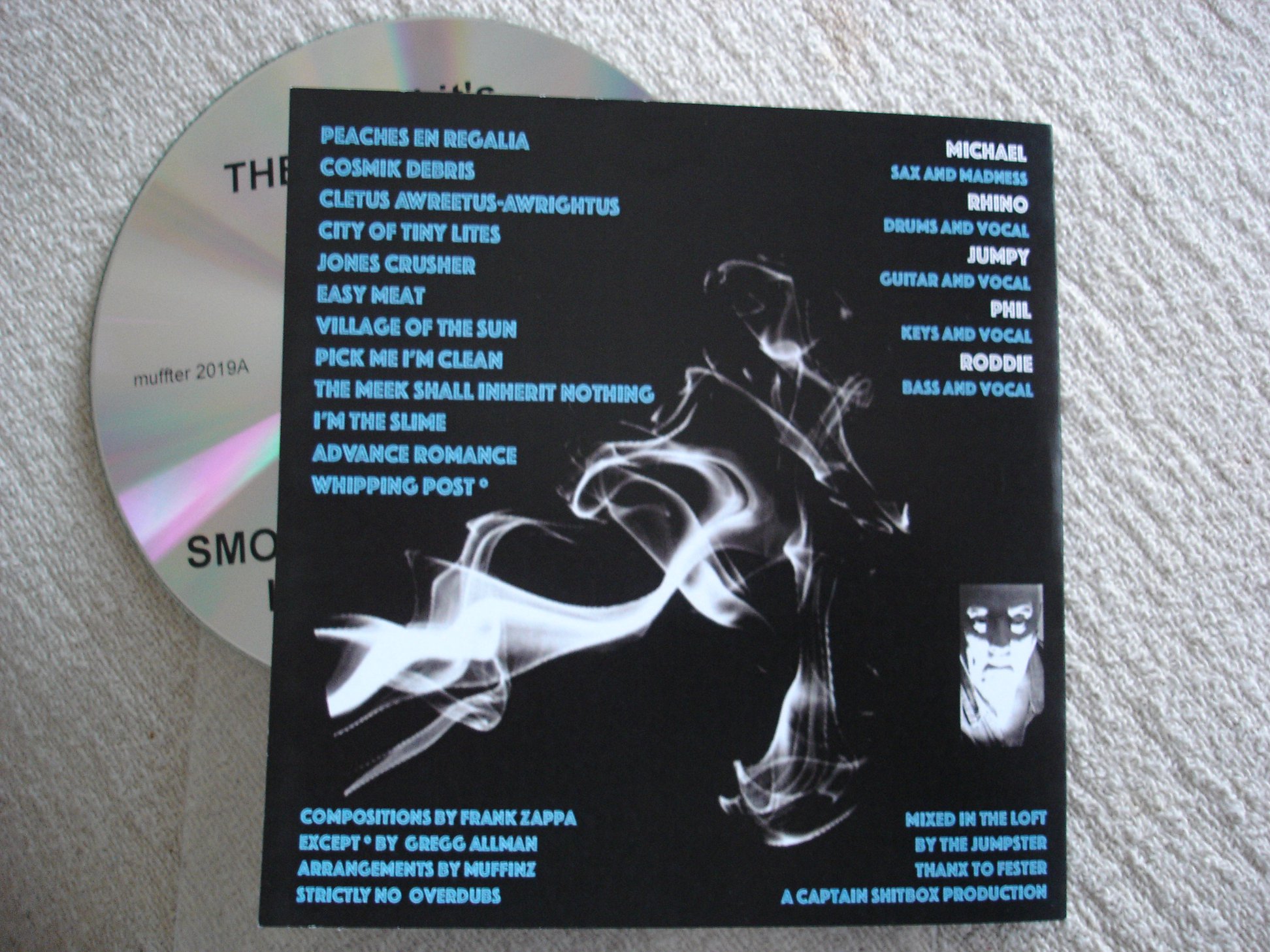
I sent some e-cash over to Roddie Gillard (£5 plus £2 P&P for UK, £2.50 for Europe, £3 for USA. paypal roddiemuf@hotmail.com and don’t be shy to round up that conversion for international shipping. That’s a steal.) for a copy of “(It’s All) Smoke and Mirrors – Live in the UK 2018“. What I got back was worth it, and then some. I know the Muffinz are heavy, as their incredible Fairies Wear Boots / Brown Shoes Don’t Make It mashup has proven to me already. This rekkid is heavy business in the same way. The band is tight, powerful, and funky in the way Zappa’s 1988 band would understand. They also sound like a much larger ensemble by keeping the arrangements tight, especially between keys and horns.
Opening with a super-tight Peaches is a good sign, and the album seems to just keep geting better (is that possible, I thought). The arrangements are more direct than some of the Zappa versions you might be familiar with, delivering a little more instant gratification. That is not a bad thing. As you stick with it you get to the meat of the CD which to me is Easy Meat / Village of the Sun / The Meek Shall Inherit Nothing… If you aren’t cranking the hell out of that I can’t help you. Nobody can. This is to my mind a benchmark of how it is done. In a world where shows are often poorly paid, poorly attended, and the travel is cramped and tiring, the Muffinz hit the stage with the goal to sound like they are playing Wembley (Anfield, actually!). Jumpy, Rhino, and Roddie have been the stable core of this band for so long that I have come to expect this kind of performance. Hearing them deliver on it, as I was not in the UK in 2018 [damn], is almost like being there. Some of the nuances are straight out of the Zappa catalog, while others are nods to the classics, often winking at the greats of the UK rock scene and beyond. It makes for a great record, especially cranked up as the soundtrack for a long drive. If you are still on the fence regarding what passes for bands playing the music of Frank Zappa this should burn the fence down. Get on with it!
Next up is a Mother of a Different Color, The Wrong Object’s Zappa Jawaka(order info at link) Michel Delville is the kind of guitarist I love to listen to. He can wear his influences on his sleeve and still sound like himself. His preference is to be in the ensemble unless coming to the fore is necessary. When he does he straight-up shreds. The Wrong Object is a powerhouse group, and while I am not genre/idiom dropping, they opeerate where eagles dare. Where many bands switch gears with a magician’s flourish, the Wrong Object method is more seamless, more compositional. The stylistic shifts happen at full tempo, on the beat. This is the kind of precision and composition I have heard in this context from Corrie van Binsbergen (Look her up, do it now) and very few others. All of that is on display with Zappa Jawaka, an homage to Zappa in a very progressive and modern fashion.
The Wrongs can drop your jaw with Zappa-authenticity, but they are also free to do that in many other ways. That freedom allows the band to play to their strengths and use the compositional framework as exactly that. There is an intent and a precision to this band, without sounding stilted or over-rehearsed. Make no mistake, this album gets very heavy. Not that I should have been surprised. Michel’s work with Tony Bianco in Machine Mass is not for the soft-prog-wallpaper crowd (pro tip: Machine Mass Plays Hendrix is a great disc).
Not unlike The Muffinz “Smoke and Mirrors“, there is gold right in the heart of this disc. “This Town is a Sealed Tuna Sandwich” gets the respect it deserves, which is much. And did I say Zappa Authenticity? Hell yes I did. This rendition is worth the price right there. The Wrongs gave me reason to do a double take with the spot-on vocal and arrangement. It also sets the stage for a divine and sublime Apostrophe / Chunga’s Revenge mashup. This recording is heavy where it needs to be, free where it needs to be, and frankly klezmer-esque where it makes all the sense in the world. While this album is a studio effort, it has the open feel and flow of a live recording. I don’t hear any telltale overdubbing or looping or effects. It is the sound I recognize from their live performances.
These two recordings display the Zappa legacy on two different stages. The Muffinz rock those small club stages across the UK and elsewhere. The recording needs to be played LOUD. It has that rock-club-recording grit to it and to my ears it just makes it better. The performances are not, however, simplistic and dumbed down. They are full of all the “eyebrows” a Zappaphile demands. There is no velvet glove, just the iron fist of power and precision. While it might sound like I am setting the Wrongs up as a more delicate Object, I am certainly not. This band delivers in a different manner, but not a less effective manner. You feel it in the way they game the Zappa system, lulling you into a feeling of comfort then dropping the hammer with something unexpected. Possibly more to the point: The Wrong Object sounds like The Wrong Object playing Zappa (I’ll be reviewing their new release Into The Herd very soon), where the Muffinz sound like Zappa and more Zappa!
You really want to see both bands live, and if that is not possible, listen to both records. [Updated for spelling and clarity on 19 March 2019. pb] Here are the lineups:
The Muffin Men – (It’s All) Smoke and Mirrors – Live in the UK 2018 – Ian Jump (Jumpy) guitar, vocals; Roddie Gillard – bass, vocals; Rhino – drums, vocals; Phil – keys, vocals; Michael – sax, vocals. Peaches en Regalia, Cosmik Debris, Cletus Awreetus-Awrightus, City of Tiny Lights, Jones Crusher, Easy Meat, Village of the Sun, Pick Me I’m Clean, The Meek Shall Inherit Nothing, I’m The Slime, Advance Romance, Whipping Post
The Wrong Object – Zappa Jawaka – Michel Delville – guitar; Pierre Mottet, bass; Laurent Delchambre – drums, percussion, samples; Marti Melià – tenor sax, clarinet, vocals; François Lourtie – tenor and soprano sax, vocals. Wonderful Wino, Mr Green Genes / King Kong, Big Swifty, This Town is a Sealed Tuna Sandwich / The Sealed Tuna Sandwich Bolero, Apostrophe / Chunga’s Revenge, Sleep Dirt, Wedding Dress Song / Handsome Cabin Boy, I’m The Slime
I’m not a music journalist. Thank me later. I detest the trend of comparing every band to some other band. It’s lazy. It is shorthand. It lets the writer off the hook, bypassing the need for deep thought ot deep listening.
What I write is largely reviews of music I have purchased directly from the artist. I know some of these folks personally, but I pay for the music whether it is downloads, CDs, concert tickets, whatever. If I think a recording is off, I’ll say so, but if I don’t like it I probably won’t waste my time writing about it.
Same for photography, food, travel, and anything else. Life is too short.
This blog has been dormant for quite a while, but my plan is to start putting up music reviews, and some longer-form pieces on learning, performing, and experiencing music.
I have a gig coming up and am taking time each day to get up to speed. Prepping for a gig can be as much or as little as you make it. Want to be uber-prepared? Get busy about two weeks ahead, daily work. If it is very charty, that would be 2 months. Metronome practice, and a lot of it. Until the metronome sounds like Zig. Or Danny Richmond. and so on.
Meh. Point is: at least I have a plan.
And the improbable situation I find myself in is that I have become a person who is all about planning. Planning in the sense of structuring activity and time in a way to get things done. I also find myself at the a very weird crossroads in life. A place where I have hit a lot of strong numbers. Turning 50. 21 years on one job. Two amazing nephews turning 21. 25 years with an amazing partner who was suggestible enough to agree to marry me, baggage and all. My main man Wylee kicking ass at 11 years.
There is a rising drumbeat reminder of how tenuous it is and how things change. How much change I have seen. Who, and how, and when, and occasionally why. Rarely why.
There is a certainty that the present is a testament to how well or badly we have measured the past. The successes and mistakes form the ripples and eddys. It might be that the most important human mental tool is that we learn from mistakes. If we are especially aware we can learn from others’ mistakes. The humor in the idea that we are better off learning from the mistakes of others is that it is just not the real thing. Yes, you can learn from someone else’s mistake. But you won’t learn as much.
Nothing will get worn smooth by your mind like rehashing your very own gnarly, craggy mistake. Don’t pass up that juice. I realize that I’m a big fan of mistakes on the simple premise that mistakes are an essential tool. Throwing their value away is a monumental waste.
Mistakes are a huge part of preparing for a gig. It is all about making the mistakes before you get to the gig. My wife just sat through a week or two of me working on audio mixes for a project. Essentially it is repetitive listening to eradicate mistakes or make incremental improvements. Nobody wants to hear that except one person. And that person is always looking for ways to have to hear less of it. The continuous quest is to get more efficient. Not that inefficiency is all bad, it just is not as good. Being inefficient is its own, lesser, learning tool.
And you would be wise to ask why someone would put themselves through all that. All those mistakes and slop and frustration… Simply: At any moment you either decide not to suck at something, or you decide something else, anything else. So the odds are stacked against that decision. To make it, and make it regularly, you have to be motivated by something. Formal education is all about someone else providing enough structure to make that work compulsory and fairly evaluated. Otherwise you would be going all Huck F. Finn on your schedule. Without that external structure you need to do it because you want to do it. Your plan depends on it. Internal or external, that structure is essential. Huck was not going to ride that raft forever. He had a plan.
You have a plan of attack. Good. You can treat it as a formula like I did up top in the gig prep. I need two weeks to make all those mistakes. It is an inefficiency, but like friction generates heat, actions generate a voice. In music there are many variables. How you listen. How you feel time. How well you read. How well you can translate your inner voice with your instrument’s voice.Your voice becomes a product of your process. Your product will bear the fingerprints of your plan.
You decide, you act, you observe, you hopefully learn, and you apply the lesson. Done.
In a few days I play some Miles Davis, and Herbie, and Nick DeMaria (fer crissakes) and the questions all get answered. Musical questions, and some others too. And there will be more mistakes to provide the grist for the mill.
Miles’ “It’s about that time” is in the setlist, and each time I hear it I laugh at Miles playing with the words in a way James Brown or Sly Stone would immediately recognize. It is all about “that time”. Miles was always the man with the plan.
[this post is dedicated to my nephews Nick Charlton and Chris Gonzalez]
It sums up a lot of the feeling that I have had, and shared, for a long time. Sure I love the sound of a good jazz band. But the real deal is that when, in conversation, I have compared it to a Society for Creative Anachronism event, or to Civil War reenactments, Those statements bought me plenty of hairy eyeballs, but that is what I feel. As much as I love the music I could never throw myself into the act of learning jazz standards. Lord knows I have tried. I don’t have a problem with other people doing it, but I am not the man for the job. I want to act on my musical impulses, whether they are informed by jazz or not.
There have been many efforts to adjectivize the art form. The New Thing. Electric Jazz. Hard Bop. Smooth Jazz. Euro-Jazz. Afro-Jazz… For more than 60 years the focus has been on “modern jazz”, and I think there is a case to be made that “modern jazz” is/was a label to keep the form from truly advancing, or was instantly an extinct idea. Maybe both. I still use “jazz” and “free jazz” when tagging my music when I publish on sites like Bandcamp. I use the label cautiously, but I use it because it is a known concept and can be helpful for listeners. But when you listen to one of my tracks, brother, it ain’t jazz, free or otherwise. I am informed by Jazz, and educated by jazz. But the music is hopefully a music of the present.
My exposure to Jazz goes back to infancy, if not the womb, and much of that early exposure was crossover jazz, like Bird with Strings, or Jamal at the Penthouse. Name players in front of a string section. It was a lot safer for suburban whites to consume than something like Monk or Art Tatum. When I started to check out “jazz” I immediately gravitated to the harder-edged, bluesy, emotional music of the early 60’s. The Hard Bop scene, especially Mingus and his circle of players and composers, has been a huge influence on me. Much of that was recorded from 1960 onward, and that is at least an anecdotal support for Payton’s premise. These musicians were taking jazz forward by bringing it back to the roots of blues. Moving the forms away from the conceit of advanced european harmonic concepts (i.e. “birth of the cool”) and toward the I-IV-V, the funky cousin of the ii-V-I. This pushed open the doors for modal approaches, and other less restrictive platforms on which to improvise. Jazz was dead, but there was no stomach for a new genre or label. They would be marketed as jazz, then as now as forever.
There is an even darker side to that exposure. The more I learned about Charles Mingus, and how he was “angry” and “volcanic”… the more I was convinced that the roots of his mania were planted in being shut out of being a classical cellist as a youth. He could have been one of the greats in American classical music. Why wasn’t he? There was no place for a black classical cellist in 1940’s Los Angeles (and there was no other venue for cello, truly). He switched to bass, and focused on Jazz, because it was accepted. While he had an amazing career full of powerful music, I can’t help thinking that his stature as a “third stream” artist is a way to put a happy face on the racism that pushed him into “jazz”. Jazz may have been dead much earlier than 1959. It could have been dead in 1941 if you want to push the concept.
The argument about what, and who, is “jazz” stretches into the Jazz-purity quest of Wynton Marsalis, and the sneering of Stanley Crouch. They want the body kept alive by any means necessary. They have the right, and they have the platform, and even the funding, to pursue that goal. But the story as seen in an objective light might accurately be that they were performing CPR on a corpse. Crouch lambasting Miles for not making more Kind of Blue is an apex example. Miles was not an observer, he was a participant, and had been present at the funeral. He knew it was dead. Crouch was looking to preserve his domain at the expense of an artist. “Sell Out”, he hissed.
The deal is that the 20th century is chock full of artists who have tried to use jazz as a launchpad and not a crashpad, and they have been routinely marginalized and misunderstood on purpose. Monk. Ornette. Sun Ra. Cecil. Pharaoh, Roland. They were all held up to the light of Pops, or the Hawk, or even Bird (who was punk to the core, trying to blast jazz free by brute force). They were never allowed to occupy the next plateau, the next “jazz”. They were tethered to a pyre no less real than Jean D’Arc. And all the while jazz has been dead.
Name the most successful “jazz” artist today. Where can you hear their music? Where can you see them play? Is it truly the fault of an entire society that jazz has lost its relevance? Can it be, in an age where music and information are more available than ever, that this American art form from the cusp of the 20th century could be so roundly ignored and unprofitable? Or is it like trying to sell crystal radios to the iPhone generation? An anachronism, as beautiful as a tintype and about as relevant.
Enjoy jazz. It isn’t going away. I spent some time digging Angelo Debarre playing gypsy jazz in his hard-hitting and direct style just last night. It was beautiful. It still is today. It still will be forever. But it isn’t new. It is a photo of a corpse. A beautiful, romantic, hard-won, photo of a corpse.
I know where and when I was hit broadside by the realization that I was a bass player. I was taking bass guitar lessons at Creative Music in Wethersfield, CT. It was a big deal for me. Bass was the only instrument that I enjoyed playing. I had washed out of playing both guitar and drums, but it was pointed out to me that I played guitar like a bass. After taking some local lessons with a guitar player/teacher I got a chance to take a block of lessons at Creative Music in Wethersfield, CT, which was where you wanted to study if you were into jazz, and especially electric jazz. I had been playing a bad P-Bass copy for a year or so, and had a loaner double bass from the school system. Creative was a great shop with great teachers, but next-door was Integrity ‘n Music, an amazing record shop. It was there, waiting for my lesson slot, that I saw the self-titled Jaco Pastorius album. I knew his name because he was on the credits for my favorite Weather Report album “Black Market”. That album blew the top of my head off.
Within a month I had ripped the frets out of my bass, filled the slots with glue (aided by the use of a heatlamp), and I have been playing fretless bass ever since. That was about 1979 and was as close to my predecessor’s “saw the Beatles on Ed Sullivan” apocrypha as I will ever get. I had a similar experience with Mingus’ music but I had neither the skill or the patience to do more than listen to those compositions. But Jaco, there was a cat you could get down with. I still have not a single Jaco-like lick in my bag. I never learned PoT, I never developed a harmonics workout… but I knew that you could play fretless electric bass and make it somehow your own.
Lately there is news afoot that bassist Robert Trujillo is producing a biographical film about the life of Jaco Pastorius. I am totally behind that concept. Recent movies like Standing in the Shadows of Motown have been heavily influential on both me and the music world at large. I just saw the HBO film about James Brown, Mr. Dynamite, and it was as good a 2-hour course in funkology as you will find. If a Jaco movie does nearly as well it would be a huge success. Jaco is undeniably a one-man genre and deserves this kind of recognition in spades.
My issue is not with the movie, but with Robert Trujillo’s place in the pantheon of bassists. He has been remarkably successful as a musician. He has played with the top names in heavy rock, and is immediately identifiable by look of not by sound. But he was at the center of one of the great scandals of modern rock history, and I can’t help thinking that it damages the concept of a homage to Jaco.
In 2002 Trujillo was the bassist for Ozzy Osbourne, and the event was the 20th anniversary of the Blizzard of Ozz and Diary of a Madman albums that put Ozzy back on the map after leaving Black Sabbath and then not having much to say. Ozzy was never much of a songwriter. He may have had a few lyrics to his name but he was a rock frontman first and forever. While the Sabs were inventing the power-ballad with Ian Gillian as vocalist (Born Again, underrated jewel), Ozzy was looking for a new band. What he had was guitar prodigy Randy Rhoads, and bassist Bob Daisley who were working on writing songs and finding a drummer. They found Lee Kerslake, a journeyman who fit like a glove. The albums they produced are still staples of rock-radio airplay. Randy Rhoads became a guitar superstar. Ozzy was back, with albums that were successful beyond his wildest dreams. You would think that he would have been kissing Bob Daisley’s feet…
No. When the 20th anniversary of those albums came out, Ozzy, with his wife Sharon holding the whip, decided to photoshop Bob Daisley and Lee Kerslake out of the picture in both artistic and financial terms. Robert Trujillo along with drummer Mike Bordin recorded new bass and drum parts for both albums, effectively eliminating the contribution of Daisley and Kerslake, and with Randy Rhoads dead, left all the credit and royalties to Ozzy/Sharon. Unsurprisingly the oblivious Ozzy can’t even decide if he knew about the decision. Sharon Arden Osbourne thinks she was at the Blizzard recording sessions, when she wasn’t, and denies making the decision to do this while everyone else says it was her idea/mandate. Her father was rock promoter/magnate Don Arden, so you can be forgiven for thinking that she has a feel for the darker regions of the music business.
I am not a huge fan of that genre, and have never been a big fan of Ozzy, but I feel like I know a good rhythm section when I hear one. Those albums had the power and swing to match heads with any Iron Maiden track or any Van Halen, Black Sabbath, etc… That band had a great sound. It was due to some excellent songwriting and excellent execution by the band. For Trujillo to have knowingly taken part in shanking a fellow bassist is, to me, unforgivable. In what should have been a victory lap for the songwriter behind two of the biggest selling rock albums of all time, it was a deeply shameful episode in a business full of shameful episodes.
SO while I think a Jaco movie is a great idea and hope for the best, I can’t help feeling that the project is tainted by this backstory. I have had feedback that Trujillo was just doing his job, just earning a paycheck, just a sideman, just, just, just… But he had a decision to make. He took the paycheck at the expense of the original artist. It makes me queasy just typing that. I hope the project succeeds, but while Trujillo is out looking for crowdfunding dollars to float the project, he won’t be getting penny-one from me. I should be breaking my wrist getting my wallet out of my pocket to help fund this, in the same way that I have for other projects ranging from the recent Wrecking Crew movie to a time many years ago when I contributed to a fund for Rocco Prestia’s health care (a situation that is re-appearing after many years, and I am sure I will help again). But I am reluctant, actually refusing, to support the producer of a project I would otherwise be all-in for, and it is not a good feeling. Jaco deserves the recognition, but I still think he deserves better than this.
A quick update on the adventures of Fuchsprellen. If this band is wrong I don’t wanna be right…
We secured a date at Cafe Nine in New Haven, on very short notice, and played a double bill with Light Upon Blight on November 9. LUB is Jeff Cedrone’s project, and I have been playing bass along with Peter Riccio on drums. Normally we would have Neil McCarthy on alto sax but he couldn’t make it for this gig. This means that the Fuchsprellen rhythm section opened as a trio under Jeff’s direction, then we switch back to Fuchsprellen mode with the Fuchsprellen Horns. This could go horribly wrong, but so far it has not. Jeff’s concept with LUB is heavier, darker, and more brutal than 90% of anything Fuchsprellen does. The result is improvised “doom jazz” in power trio format.
Note: this is an expanded version of the “Mother’s Day Debacle” show where LUB and Fuchsprellen played trio sets in the same way: LUB trio, followed by Fuchsprellen trio. Just as a musician can train for sight reading, or chord chart reading, or soloing over set forms, there is a strong New Haven area improvisational tradition that has New Haven Improvisor’s Collective at its core. All of the musicians I have been involved with through NHIC have improvisation backgrounds and ambitions, but the formalized work done at NHIC has helped with both vocabulary/skill building as well as providing context for musicians to launch their own projects, like LUB, and Fuchsprellen, among many. But I Digress…
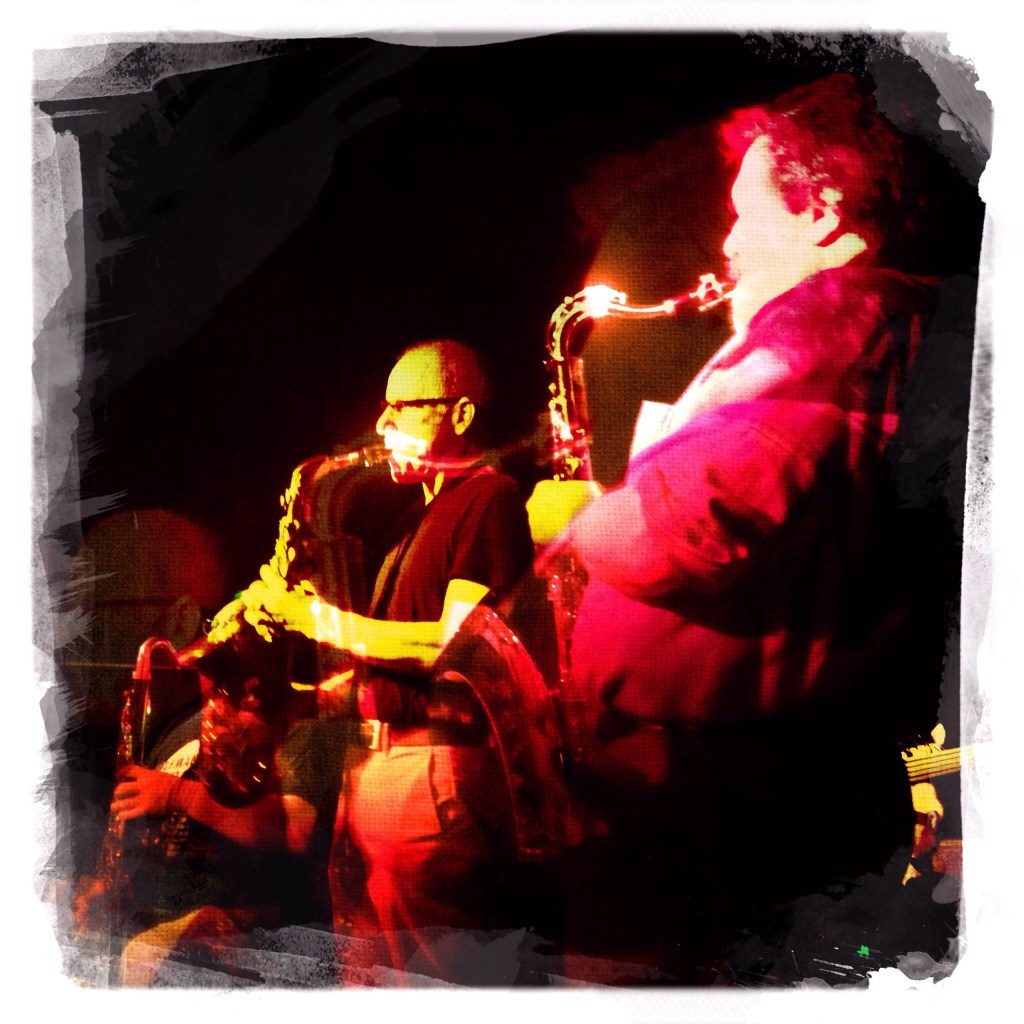
We had a trio of reeds for the Fuchsprellen set: John Venter on tenor sax, Richard Brown on Alto, and Steve Chillemi on bass clarinet. The rhythm section is there to provide support for the horns, and keep them flying for the entirety of the set. One thing is for sure, these guys are ready to rock from the downbeat. The hardest thing we face is giving the rhythm section a chance to settle in before the horns get down to bid-nezzzzz. We did a great job at finding balance at this gig (audio to come, real soon now, and maybe video too).
Huge thanks to Michelle and the good folks at Cafe Nine, and all the people who turned out for the gig. We had an excellent crowd for a Sunday , and I expect that we will be back at the Nine over the winter. Hooo-Yeahhhhh!!!!
Over the past two years I have been pursuing my musical goals with more focus, specifically on my commitment to “free music” and improvisation. I caught the free jazz bug early in life and it has continued to be a fundamental force in my musical life. One of the things that has become more clear as I continue to perform music is the gradation within any artistic medium or genre.
An example is “painter”. You meet someone, it turns out that they are a painter. Once you determine that it is “artistic” painting, not house painting or interior painting (an art in itself), what do you really know? Do they work in oils, watercolors, acrylics, natural pigments…? Do they paint people, landscapes, futurist fantasy, naturalist tableau…? Are they working in an established tradition, or school? Otherwise all you know is that they apply paint to a substrate and consider it to be their art.
Music is the same, and might be even harder to pin down. When people hear that I play music they first ask if I am in a “band”. At any time that answer could be “no”, “several”, “yes, kinda”, or “I am a band”. Either way, it is almost never the kind of band they are thinking of, rocking out Mustang Sally to beer-soaked Hartford fratboys. Even if they have a broader conception, they might not get that my band does not have “songs”. In many ways each artist can be considered their own genre. Even if I have been highly influenced by Zappa, Art Ensemble of Chicago, Sun Ra, Last Exit, and Charles Mingus? Those artists have produced an incredibly broad variety of musical art (OK, maybe not Last Exit 🙂
I have made this statement as a idee-fixee regarding musical influence: “I love what Mingus was doing in 1964, but he never had to worry about being influenced by Led Zeppelin or Jimi Hendrix”. And he didn’t. I do. All the time.
As a result I spent most of my life playing improvised music and avoiding those influences. Starting in the late 90’s I began to examine and embrace those influences, and act out on them in live performance. I took advantage of an opportunity to play the music of Don Van Vliet (Captain Beefheart), and that led to opportunities to delve into the music of Frank Zappa from the performance end of the operation. In there was the opportunity to play “indie rock” with The Sawtelles, and get exposed to a huge array of “indie rock” music that was incredibly diverse. All through that period I was digging deeper into my early influences. The huge array of “unreleased” and “re-issued” Sun Ra recordings continues to be a wonderland of freaky jazz. Getting my ears around the music of Kawabata Makoto and his various Acid Mothers Temple projects was equally revelatory. Stuck in the middle of this period was a seven year string where New Haven Improvisors Collective was my primary outlet for improvisation and structured chaos in music.
I also found out that I have certain skills and priorities that can conflict with musicians at the more “laconic” end of the spectrum. One way in which I have found myself separated from my peers is in my insistence on urgency and timelines. I will literally lay out rehearsals in terms of “we have X rehearsals, totaling Y hours, until date Z to prepare this band”. I believe that results do not happen accidentally, especially when learning to play the work of other composers. Nailing a version of a Frank Zappa composition is not done by accident. Jamming and getting “close” will not suffice. It is my inner Project Manager reaching into my artistic life and getting all pragmatic on the process.
As well, I am aware that each musician I have met and worked with has a very personal set of motivating concepts. Some want to be “the guy”, in the spotlight performing technically difficult material with seeming ease. Some want to validate their love for the party lifestyle. Some want to control others’ actions and occupy the head chair of their personal musical fantasy land. Those motivations are always underlain by other needs, experiences, compensations… And, for better and worse, exposure to those people has allowed me to better understand my own desires and motivations.
That decade of self-education was the densest and most exciting I have experienced. It allowed me to expand my performance opportunities and abilities, and develop a small but exciting network of like-minded muso nutjobs. It allowed me to do something I have done on a regular basis since I was a boy: throw it away and start over.
Not unlike the abstract painter, I feel like there are plenty of other people to participate in the music equivalents of hyper-realism, landscape, portraiture, pop-themes, etc… I have the desire to make music “on the spot” and leave the world of highly structured compositions to other musicians. Following this approach is not easier, at least not in my experience. Just as a Motown band needs a bass player versed in Jamerson, a free music ensemble needs to have members who are versed in the confidence of their ears and reflexes. That is much easier said than done. It is definitely not “easier”.
My current attempt at this musical pathway performs under the name “Fuchsprellen“, an old German word for “Fox Tossing”. You can look it up, or take my word for it that it was a blood sport of 16-17th Century royalty in which small woodland creatures were introduced to a walled compound where royalty would use cloth straps to launch them into the air. This was typically fatal for the animal. But the sheer absurdity of it struck me in a way to use it as a name for my band. It also sounds bad-ass.







 petebrunelli