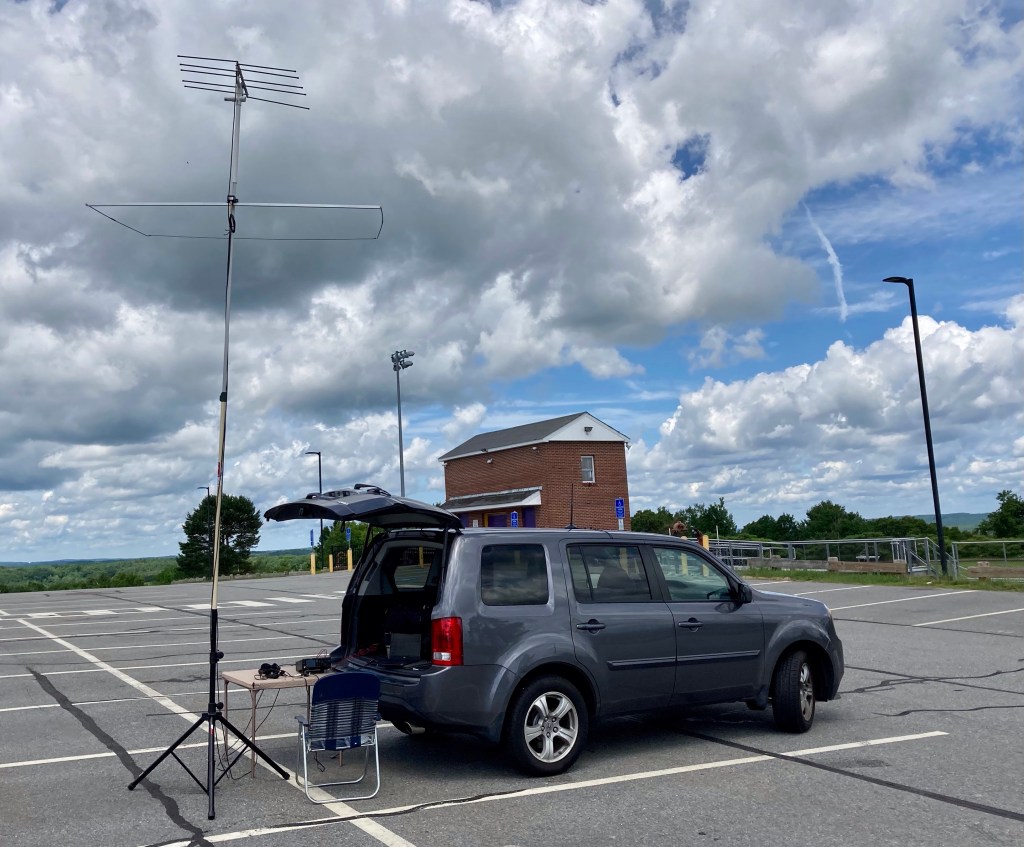
Category: radio

  • The Resonance

    The Resonance

    The reason why I would bother with this topic is twofold: One: I think better antenna systems are actually better; and Two: Technical concepts are central to amateur radio and should be understood and employed as often as possible. I’m discussing these antenna concepts in simple terms in the interest of keeping it accessible. Hopefully it leads to some further investigation and a different way to think about antenna systems.

    WHAT IS RESONANT?

    In the Venn Diagram world it can be said: Not all 50 Ohm feedpoints are resonant, and not all resonant radiators present 50 Ohm feedpoints. I have seen much confusion between “resonance” and “impedance match” on internet forums/platforms/videos. This what drove me to churn out this post.

    Resonance in an RF radiator actually does make a difference. I’m a fan of Hemholtz and resonance is a real thing. When I assess a antenna design I start at the radiating element or elements. If that element is not a known and desirable harmonic relation to the fundamental frequency of interest I consider it a non-resonant design. If there is a matching unit connected to a non-resonant radiator I consider it a tuned circuit. When the goal is efficient and predictable RF radiation you have resonant radiators, and then everything else.

    Recently there has been an explosion in the use of end-fed wire antennas. I use a few of them and they are an easy way to get on the air, usually on multiple bands. I have made plenty of contacts on these antennas, but at no point was I under an illusion that I was using an efficient antenna system. The now ubiquitous End Fed Half Wave is a strange bird, It utilizes a half wave radiator with a feedpoint impedance of about 3000 ohms, and is operated without a traditional ground plane or counterpoise. The high impedance feedpoint is matched to somewhere near 50 ohms with a 49:1 or similar toroidal un-un transformer. That is not a recipe for efficiency. The power ratings on the matching transformers tell you all you need to know: These matching units get hot, and that heat is your RF not making it out into the world.

    PAR Trail Friendly on a Spiderpole

    That’s not to say it’s a bad design. It solves a few of the issues that keep many hams from being able to get on HF. You can hang it from a single support, as opposed to needing two or three for a horizontal dipole. It’s also easy to erect on demand, which is great for hams who want to operate portable stations or if they have a compromised (small, HOA, etc…) QTH. I use a 12m Spiderpole and a PAR Trail Friendly when Inwant to get on the air quickly. Also, thanks to the magic of harmonic resonance, it is common to find a match on more than just the fundamental frequency.

    Another common design is the random length end fed, usually known by the 9:1 un-un transformer used to feed the non-resonant radiator. The trick here is to find a radiator length that is not resonant on any band you want to work. The hope, and I do mean hope, is that the feedpoint impedance will be somewhere in the 200-800 ohm range, where it can be matched to 50 ohms using a second matching device. Again it has the advantages of ease of setup and multiband capability. The tradeoff is even steeper than the HWEF. This design is force-feeding a non-resonant radiator, has an even lossier (IMO) un-un, and requires a second matching device to get all the way to 50-ohms.

    A problem both designs share is the difficulty in modeling a radiation pattern. Even with many analyses and many users over many years nobody seems to be able to say much beyond “omnidirectional”. That’s not too helpful. The main issue in modeling these systems is properly representing the ground/counterpoise. Most installations (mine included) require a common mode choke (CMC) near the radio end of the coax to keep RF from energizing the radio’s earth ground. How efficient does that sound? Do we have any idea what these antennas are actually doing wit the RF that makes it out into the world? Empirically I think we do. Scientifically, predictably, I don’t think we have a good handle on it.

    So, how important is the efficiency of a transmitting antenna?

    Hams with even some basic experience on HF know that you can make contacts on almost anything. Take a simple transmatch design like the MFJ-901, hook it to a rain gutter, and make a contact. Do we know anything about the radiation pattern, efficiency, or bandwidth? No. We are just interested in forcing something conductive to radiate RF, and hope for the best. The magic of radio waves takes care of the rest. If enough of your RF makes it out in the correct direction you will make a contact. Your signal might even be strong! But this is where it helps to be aware of confirmation bias. The science of radio communications involves being able to control where your signal is going, and control the system design to connect you with the intended destination. Having made some contacts is almost inevitable. Making the contacts you want to make when you want to make them is where the game gets interesting.

    In the food-chain of antenna designs these lossy designs are somewhere in the “krill zone”. A good efficient design, properly installed is somewhere in the “cordata zone”, and a very efficient directional design mounted high and in the clear with directional control is “blue whale” territory. At some point the operator is limited by their Effective Radiated Power (ERP) and the weakening of the transmitted signal with the square of the distance from the antenna. Using 10-30% of your RF to warm a toroid is cutting in to your effective range. Every system has limitations, but when running 10, 30, 50 watts at the finals, I feel that making the most of it is important. Every improvement in efficiency and pattern control brings you up another link in the radio food chain.

    Mitigating Factors:

    Certainly the parallel popularity of end-fed wires and weak-signal digital modes, best represented by FT8, are not coincidental. FT8 allows working at lower signal to noise ratios which is like getting that lost RF back when compared to working SSB or RTTY. More efficient antennas are always an improvement, but an entry-level HF rig, a HWEF, and WSJT-X is a great path of entry to the HF bands. I’ve gone on about this earlier, but there is nothing in-stone about needing to start with CW or SSB. Hams can get on the air, interact with DX, and get some good contacts in the log. I see nothing wrong with that.

    Compact, Broadband, Efficient: Pick Two

    In the HWEF and 9:1 design cases the user is giving up efficiency for a more compact, more broad-banded (lower Q) device.

    The HWEF, thanks to its resonant radiator, is somewhat more efficient, but the price is being paid for getting wide frequency coverage on a single radiator. Some designs find ways to better balance the equation by sacrificing some bandwidth and band flexibility to increase efficiency. One QRP design I use is the PAR 102040 Trail Friendly. This design uses three techniques to get a three-band end-fed vertical into a single 41′ wire radiator package. Trick 1: It uses a trap to isolate the 20m half wave element from the 40M extension. Trick 2: It uses the characteristic electrical lengthening effect of the trap to keep the 40m extension (and overall length) shorter than a simple 40m half wave radiator. Trick 3: using the second harmonic of 20m to realize some usable bandwidth on 10m. The transformer is pretty much handling the design goal of representing a 3000 ohm feedpoint as a 50 ohm load to the rig. No additional trans match is needed if you have trimmed the 40m extension properly and are ok with the tuning points. It isn’t brilliantly efficient, but it’s not horrible.

    Chameleon MPAS Lite – Mini Review:

    In early 2021 I picked up that Chameleon MPAS Lite and wanted to give it a run as a portable antenna system for POTA. This unit is extremely compact and is comprised of a ground spike, a un-un, a heavy duty stainless whip and 65’ of wire to use as a counterpoise. With the engineering triangle in mind I knew I was giving up a lot of efficiency for a very compact, very broadband system. And that’s what I got. It works well enough, especially if you are calling CQ and self-selecting stations who can hear you. I found that replying to anything but the loudest stations was a bad recipe for success. In a Chameleon forum I made the comment that these antennas aren’t good DX setups. I stand by that. It isn’t that you won’t work any DX, you would just work more DX more easily with a better DX design. For mid-range and NVIS work I think it is a solid solution. That assumes you are able to make the contacts you need to make. Also, watch the power rating because the un-un will get warm, and will fail under excessive power and duty cycle.

    The MPAS system uses a 5:1 un-un design to feed anything from their very nice stainless whip, MIL Whip system, a longwire, or whatever conductive item you decide to use. The 5:1 takes a conservative approach to the non-resonant radiator problem, and a second transmatch (internal or external unit) is required unless you get lucky and dial in a 250 Ohm (or 10!) feedpoint impedance for the Un-Un. Chameleon publishes a perfect omnidirectional pattern for their antennas. That’s a good assumption for the operator since non-resonant systems are difficult to model accurately. Just assume your RF is going in all directions equally. Might as well! In practice I have made contacts and successfully activated a few parks using the MPAS Lite. Chameleon builds a beautiful and rugged product, and supports their users well. II feel like it is a good system and the user will get the best out of it by realizing it’s strengths and weaknesses.

    One concern I have from following a few antenna forums, including a Chameleon product support forum, is the number of users claiming to have “resonant” solutions. An actual resonant radiator would provide a terrible match with a 5:1 un-un. What users are doing is finding a radiator length that presents a 1:5 feedpoint impedance to the CHA transformer so the radio sees 50 ohms(ish). That approach may be usable on that band with no additional matching, but is likely to be worse on other bands.

    Another constant question on these forums regards radials and counterpoises. Strangely the solutions discussed are often none, one, or several short radials. All of these are poor solutions. However, when the central design concept is to never be resonant, not require radials, and use almost anything as a radiator, I don’t know what a good solution looks like. The Chameleon counterpoise kit is 65′ of very hunky insulated wire and can help you play with the counterpoise dimensions/layout and maybe help in finding a match. That said I feel like users are trying resonant counterpoise lengths and I think that does more harm than good. With a single counterpoise, stick to the game plan. Why make the two impedances different?

    The Chameleon 50′ RG-58-ish feedline with a ferrite bead choke on one end is a decent way to control the stray RF. And it is necessary. Every time I have used it I had to control RF that wanted to energize the radio’s earth ground.

    The best application I have seen for these matching units is Chameleon’s own Tactical Delta Loop which uses the CHA as the feedpoint in a system where 5:1 isn’t a bad design value. I will be cobbling a test setup soon out of various Chameleon and Wolf River parts.

    Wrap Up

    If it sounds like I am down on end-fed designs, I’m not. They have a proven track record and get hams on the air. What I would like to get across is that I hope ops get some time on other designs. Building a nice 1/4 wave vertical over a good set of radials is very easy and cheap. Think of a it as a single-band DX Commander style build. I think it is worth the time and small expense to see how a resonant design works and maybe make a few on-air comparisons.

    If you stuck with this post I owe you a pint. I don’t write these to be concise blurbs. I like to compose my thoughts on these topics and I figure sharing it is part of the experience. Let me know what you think! Reply on the blog, or look me up on QRZ and drop me an email.

    Get on the air, and always have fun. 73, Pete N1QDQ
  • 2021 ARRL June VHF QSO Party – Recap

    A Little Back-Story:

    When I was first licensed in the early 1990’s I traveled a fairly standard ham radio pathway. I bought a Kenwood TH-78a (There were no ‘Fengs) and I already owned a few decent SWL rigs. I had access to all the test equipment I grew up with, and had my dad as a tutor on some electronics concepts. I needed that because I went from Tech to Extra in about 8 months. That also involved learning code. I passed the then-maximum 13wpm, but was able to pass a 20wpm for fun a few months later. The basics of VHF repeater operation and HF SSB/CW are still a large part of my ham radio experience. I also had interests like hiking, camping, road trips, and I liked to build antennas. It wasn’t long before I found out about VHF contesting, and the Rover classification. I worked with another ham, N1QVE, to assemble a rolling station and we did some good work in VHF contests in the 90’s.

    I have been in and out of active ham radio operating for about a decade. It wasn’t until 2019 that I started thinking about improving my equipment and getting something better than my attic dipole for HF. I also had one eye on VHF all mode operation. I owned a Ten Tec Scout for HF mobile, and few of the Icom single-band VHF rigs like the IC-202/402/502 for VHF SSB/CW. Then I splurged and bought a “shack-in-a-box” Icom IC706, soon upgraded to the IC706-mkII, and that was my main radio for a few years. I’ve since owned a few of the Yaesu FT-857/817 family, and found them to be great radios. Looking around the catalogs in 2019 there were not many V/U All Mode options. I was running a Xiegu G90 (great rig) but it had no VHF+ capability. I decided on a Yaesu FT-919A and have been very happy with that radio.

    2020 ARRL September VHF – Initial Low Drag Rover Concept:

    Roadside Stop FN41 – Sept 2020

    In the summer of 2020, COVID-fever was at a max and any reason to get outside was a good reason. I used my free time to scout a few hilltop locations and figured I would give the ARRL September VHF Contest a go. The design restrictions were pretty simple:

    1. Single Op setup, so everything had to be riggable by me, alone, quickly, in whatever conditions I dared operate in.
    2. I ruled out operating on the road. I would only operate fixed. My days of running a recorder in the car and reviewing audio logs were well behind me.
    3. No major gear purchases. I only do it for fun, so why shell out for an extra few DB here or there
    4. Keep the rove manageable and fun. No slogging through vast stretches of highway in the dark of night for a possible grid activation.
    5. Have Fun.

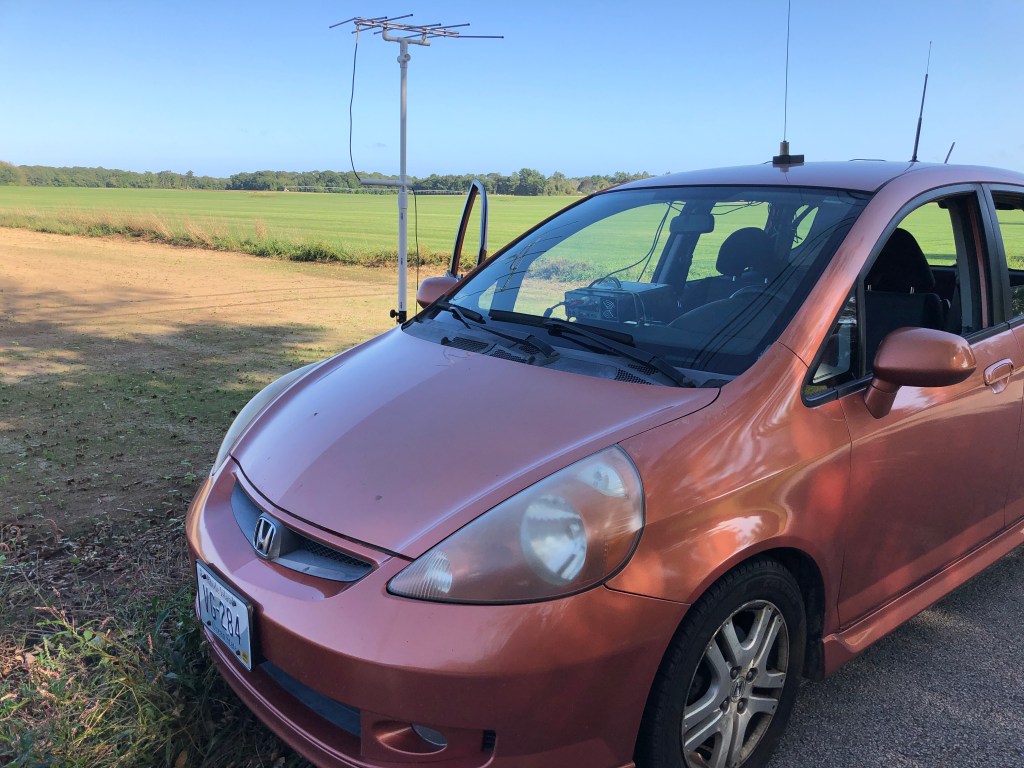
    I packed my 991A, my ELK LPDA, and a PVC mast on top of a PA speaker stand, and hit the road. I had a good time and actually racked up a respectable 2,325 points on SSB only, logging by hand, and only having a 5/8-wave 2m whip for 6m. This is how I learned to do it over 20 years ago, so why add more complexity for my first outing?

    2021 ARRL June VHF – Lessons Learned

    Three-Band Rover FN42 – June 2021

    Over the nine months since the September contest I have put together a better portable setup for both POTA-style HF ops as well as VHF hill-topping and contesting. I built a wire Moxon for 6m and tried it out in the January VHF contest (a wind-driven washout), and liked it so much I purchased a PAR SM-50 Stressed Moxon and have been running it for a few months. I also upgraded my homebrew “tesla cell” LiFePO4 battery to a Bioenno 20A unit. As for my antenna rigging, some time in a hardware store with calipers netted me a 12-foot painter’s pole that is a slip fit to the ID of my speaker stand tubing. It also has an aluminum hex shaft which is perfect for the SM-50 mounting clamp.

    I am still running RG-8X feedlines, and am not running any preamps, or power amps. This means I am making 50W max on 6m and 25W max on 144/432 with the 991A. It really is enough for the kind of operating I am doing. There is a huge spectrum between “stay home” and mega-rover. Even if the scoring system has no way to identify the details, I know my score came from single-handed barefoot operation with simple and affordable antennas.

    I also made the switch to computer logging. While it *almost* violated my “no new gear on contest day” mantra, I picked up N3FJP’s VHF Contest logger and had enough time for a brief dry run before contest weekend. I knew I would have to work out the fine points under contest conditions, but I also brought a pad and pen JIC. I also ran WSJT-X to get me on FT8. I wish I had success with employing the multicast protocol because I missed having GridTracker, but maybe next time. TIP: Let N3FJP handle rig control. I lost mode tracking when I let WSJT-X control the rig.

    VHF Digital Lessons/Issues:

    I have been lucky enough to operate FT8 during some good 6M Es openings during May and June 2021. My experiences on HF FT8 translated very well. I was able to use the same techniques of moving my transmit frequency, strategic CQ calls, and so on. I expected things to work just as smoothly during the contest. Yes, there is one born every minute.

    I had never operated WSJT-X in contest mode before and hadn’t really thought that through prior to the start of the contest. As I set up and started making a few pre-contest trial contacts it hit me that something was different. For one, the QSY on left pane double-click acts differently. As well I was having bad luck when replying to CQs while transmitting in a “clear spot”. I often had to reply on the calling station’s TX frequency. So while the potential for digging out more QSOs by working weaker stations was there, the reality was not so simple. I could have worked SSB stations much quicker, and “run the bands” much easier… if so many stations weren’t ditching SSB for FT8!

    N1QDQ/R in FN32

    I put in a fair amount of time, at least 25%, working non-digital modes. There were times when I was making good contacts, and others where the CW/SSB was dead and FT8 was the only thing where a contact was possible. I was able to work W1AW and W1AN on 6M CW from Mowhawk Mtn. That was pretty cool. As much as I enjoy digital modes I do think the CW/SSB action is more enjoyable.

    Route Decisions:

    I decided to activate FN41,42,31,32 this year. The 1800Z start time for Saturday of the contest is a real style-cramper. I get it, but really? For a rover it leaves about seven total hours of daylight on Day 1. With many parks closing at sunset the decision to move locations cuts into a lot of operating time. My memories of driving through the night and only making a few new contacts, while hearing the same big-gun stations made the decision simple: Start on time, wrap it up at dark, get home, get some sleep, and put in a good shift in FN41 on Sunday.

    Now that I live in coastal Rhode Island it makes the route-logistics a little more complicated. I started the contest in FN42 at a hilltop in Charlton, MA. That spot is great but they are all only as good as conditions (foreshadowing) allow. If I had just stayed there until dark I would have had a better overall contact/points total, but I was up for a drive and wanted to try a new spot for FN32.

    After many different ops operating from hilltops in the NW Connecticut and Western MA area (FN31,32) it is hard to break that habit. They are good locations, but not perfect. That spot was the parking lot at Haystack Mountain in Norfolk, CT. It’s got a lot of trees blocking the RF/View, and the entire northern half of the azimuth is blocked by a mountain, but it isn’t terrible. Not great either. You get about 100 degrees of actual azimuth to play with from maybe 120-240 degrees.. Next was Mowhawk Mountain in Cornwall, CT. Mowhawk is a great location, but there is a lot of RF equipment up there and noise/intermod levels can by nasty. Bring your bandpass filters! Neither location “popped” but I did activate the grids and get a few new worked grids in the log. All in all not worth the drive (points-wise), but on this beautiful June day the drive was spectacular.

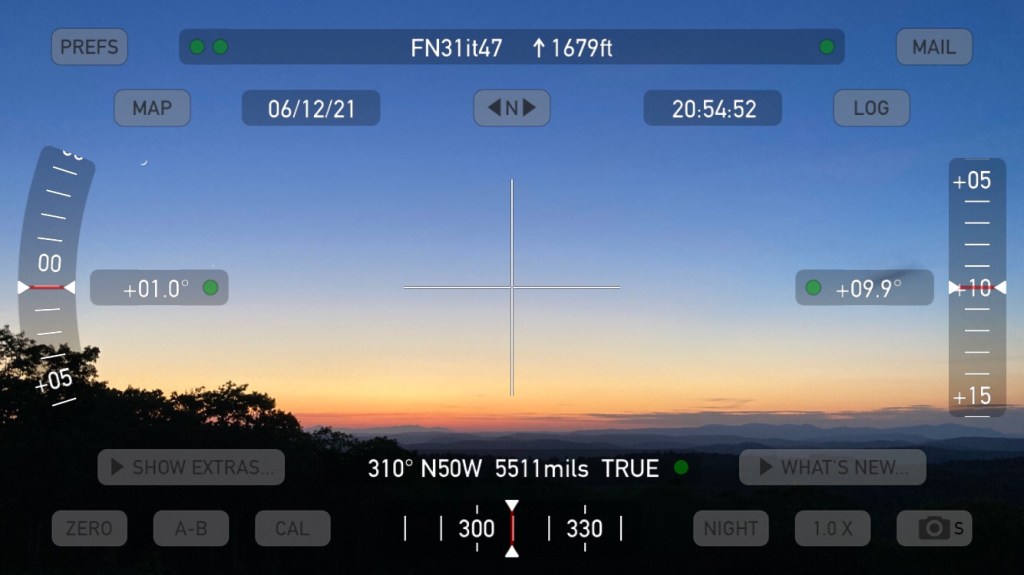
    Sunset at Mohawk Mtn, FN31

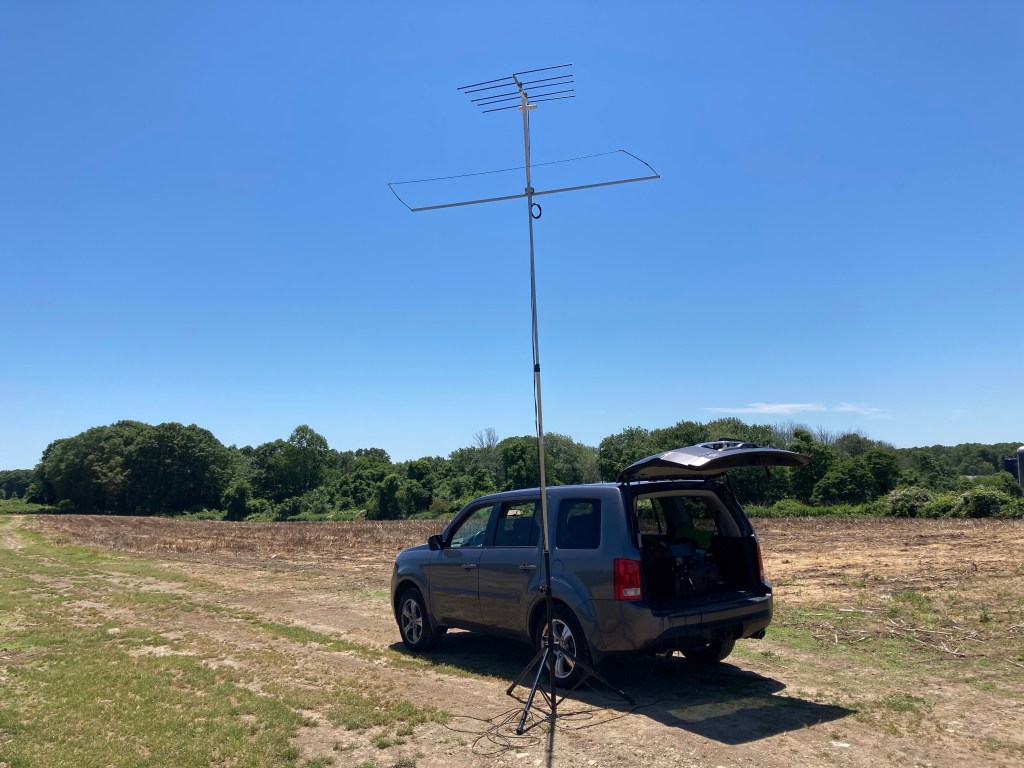
    I had a nice time operating on Sunday from FN41. A local high-ish spot at a local farm field gave me plenty of elbow room and a safe off the road location to operate from. The RF conditions were not super. Normally I’d be ok with hearing some distant grids but not being able to work them. I wasn’t even hearing that! It was a grind. I did manage to get some good runs on 6m and 2m, add a few worked-grids, and even snag some DX with a VP8 and an EA7. What we had here in the northeastern US was a nice opening to Europe! Even then I wasn’t hearing too many Europeans. It was just a soft day on the bands. After about 5 hours I worked a nice run of locals on 2M FT8 and called it a day.

    N1QDQ/R in FN41

    QRT:

    It wasn’t a terrible contest. For the type of operation I describe here it was a success. It looks like I tallied just north of 3,500pts, activated four grids, and put on about 300mi. Those are Southern New England Miles. It’s like dog years compared to other parts of the US. I think it’s fair to say conditions for this contest didn’t favor my low power setup. I was counting on a strong opening to the mid-west or southeast and it never materialized. Fun was had. I’m looking forward to the next one.

    Takeaways:

    1. Rovering is a great way to wring out your mobile/portable setups. I feel like my POTA setup got better, and I have a few ideas for improvements.
    2. Something was very odd with beam headings. I felt like I was way off heading on a few contacts where I set the beam heading by ear.
    3. Also, setting the beam heading on FT8 while armstrong-ing the mast with one hand and reading the screen and running a mouse is not easy. Ideally I would watch the waterfall and try to peak a station visually. Easier said than done.
    4. I ran my 20A LiFePO4 DEEP into the cycle and it held up beautifully. I have a Bioenno 1503CAR for charging on the go. It helps to recover charge but won’t fully recover the charge on a short drive. The way to go is probably switching between 2x20Ah, or just a 50Ah cell.
    5. It’s a fun way to get out and play on the high bands. Give it a shot even if all you have is a FM rig and a small beam. If nothing else use an all mode receiver (SDR is a great way to go) and monitor the high bands during a contest. It’s a good way to hear HF-band levels of activity on VHF+ and you might get motivated to join in.
  • Why So DGTL?

    Why So DGTL?

    The current explosion of HF weak signal mode users, coalescing primarily around FT8/FT4, has caused a bit of a rift in the ham community. I don’t think the rift is that big, but the rifters are pretty vocal in telling other hams how much they don’t belong on the air.

    I intended to formulate a Pro/Con list, but I don’t want this to be a contest (or con-test). I also don’t want to explore the negatives. Plenty of people are doing that 24/7 and somehow seem to enjoy (?) it. This is a list of things that make each type of communication interesting and unique (for me). I’d rather look at it that way because that is how I feel about it. I want to enjoy all that ham radio has to offer. That requires being open to what is positive about every opportunity.

    So here’s what I find attractive about FT8-style* operation:

    1. The Analog Internet Nexus. In conjunction with PSKReporter, RBN, and tools like GridTracker, it provides a near-real-time propagation indicator. I can set up for a few CQs, check PSKReporter, and see where I am being heard, with my relative S/N. Along with showing me where I might expect a reply, it gives me an idea of the difference between what I am hearing and who might be hearing me.
    2. Instant and visual split operation. WSJT-X makes setting split very easy, but only if you use the waterfall display. (I believe many users don’t, causing that crowding between 1300-1800hz). Shift-Click to position your transmit frequency in a different spot, and get out of the pileup of stations calling on the CQing station’s transmit frequency. Since WSJT-X decodes the entire bandpass, you can test this at will. 10 minutes with the WSJT-X manual will improve the experience 100x.
    3. Constant Global Activity. It’s pretty shocking, actually. Day after day if I just looked at the CW or Phone sections of the HF bands they may look dead, or occupied mostly by big signals. Often there is a big hump on say 20m at 14.074MHz. In my experience it is unprecedented to have this type of activity acting as a global beacon. These digital segments are in use at all hours of the day and when the band opens those ops will be there.
    4. Built for Low Power Ops. Being able to work down to -24dB is a great equalizer for lower power stations on less-than-spectacular antennas. I see all kinds of amazed reactions from mostly newer hams on QRP-focused boards like the Icom IC705 FB group, and I can only imagine how amazed they will be when actual good band conditions start arriving. I’ve worked 10,000km on 10W into a basic vertical antenna on FT8, during conditions like SF=75, SSN=15! No solar tailwind there. For reasons I will get into somewhere else, a non-directional antenna is really only sending a tiny slice of its output toward the other station. Being able to work deep into the noise floor makes the most of that tiny slice.
    5. Perfect for casual operating. Letting WSJT-X decode while I am making dinner, or doing other chores, lets me come back and see what stations are in play at my station, on my gear, at what strength. I can take 15 minutes, scan the waterfall, and either chase a few stations or find a spot to call CQ. Obviously I can also do this for hours, but if I only have small gaps to focus on the radio I can still make contacts this way.
    6. Good operating practices are rewarded. Far from being a “robot mode” FT8 gives the operator a lot of information if they are willing to look for it. It allows you to scan for momentary openings, dig out weaker signals, find opportunities to use split, and otherwise be creative with the information presented by the waterfall and the decode window. I recently made a few contacts to JA from Rhode Island with stations that showed up for less than 5 minutes, and then faded out. Tools like GridTracker and JTAlert let you watch for those stations in real time. I’ve come close to working deep into northern Canada (VE8) in this same manner. I’ve also seen the big Saudi or Kenyan stations about 20 times and never made the contact. Surfing the waves of fading/swelling conditions is a technique I learned on CW over 25 years ago.

    *FT8-style means computer-assisted digital modes, like RTTY, even. 2FSK is still FSK, folks. Get over yourselves.

    OK, that was a rollercoaster of unbridled optimism. I’ll now make similar points for analog modes:

    1. The experience of listening to radio is one of life’s great joys. The key word is listening. I like quality in a QSO. Rarity and quantity have never been my game. I enjoy finding and working DX, but have never applied for or sought any awards. Listening to a quiet band for a weak but copyable signal (usually CW) just above the noise, replying to a CQ, and having a QSO (no matter how short or perfunctory) is a real pleasure. I’m not too hung up on where that other station is.
    2. The Social Component. I have worked plenty of stations, mostly SSB, where the QSO is call, report, name, QTH, and 73. Nothing wrong with that. It’s not much more of a proof of concept than a FT8 contact, but you are making verbal/code contact. Neat. Occasionally though I end up in a real rag chew, with a personable operator, and it is a great experience. I have to make sure I am in no hurry, because I have had a few that ran for a long time. That is ham radio delivering on what I would call the classic roots: Two or more operators having a chat. Lovely.
    3. A true leisure activity. My process of slowly scanning a section of a band, giving even the weakest signal a chance, tweaking my rig’s controls in an attempt to pull that signal out of the noise… it takes time. I might make one contact in an hour. I might make none. I have done some salmon fishing, and it is similar. My salmon fishing mantra is “it’s fishing, not shopping”. If you don’t enjoy the process of fishing you will be having a lot of bad days. If you have a catch, that’s great, but you are still fishing.
    4. Skill Development. The skills necessary to operate successfully on the ham bands are still best, IMO, cultivated with analog operation. Just the habits of ensuring your frequency is clear, or listening to and identifying neighboring stations, or learning the band plan and using it… they pay off whether you are talking to someone on 2M simplex 500 yards away, or making an APRS contact through the ISS, or bouncing a signal off the moon. It might be analogous to driving stick shift. I think you get a better learning experience when you engage the fundamentals as completely as possible.

    So that’s a quick, stream of thought run through of how I see the allure of both “new school” and “old school” ham radio. It’s all out there to be done, and it’s all good. I hope to see or hear you on the bands. Pete N1QDQ

  • Lightweight Antenna Roundup – Episode 1 -The PAR TF 402010

    Lightweight Antenna Roundup – Episode 1 -The PAR TF 402010

    My first HF transceiver was a Ten Tec Triton IV with analog dial, followed by a TT Argo, A Yaesu FT101, and then one of the original, “shack in a box” radios, the ICOM IC706 (and later a MKIIG). For reasons mentioned in the previous post on this blog I moved on to running a Yaesu FT-857D, a FT-817ND, and an original FT-817. That gear, along with an assortment of V/U/SHF equipment for VHF contesting, and various FM HTs, was the basis of my experience with transceivers. I got to know what I liked and what I didn’t. The Triton IV was the most fun CW rig I have ever used. The receiver was easy on the ears, the QSK was fantastic (like listening to yourself on receive), and it was fairly portable. The IC706 rigs were more versatile, covered more bands, had more power, and included at 20/70cm all mode. And it wasn’t a bad all-mode. After seeing my gear pile dwindle to almost nothing I started putting together a new station. I was looking for something fun and portable and found myself looking at the uBitx. I worked up one kit but just felt like it was not going to handle what I wanted to do. Then Xiegu released their G90 and that radio got me back on the air for over a year. It’s a great rig, but it came with the question of what antenna to pair it with?

    Having used wire dipoles and a few commercial multiband verticals for fixed operation, and hamsticks, base loaded whips and other compact designs for mobile use, I had something to refer back to. My experiences with those mobile antennas was not great. Yes they work. But no, they are no comparison to a full size antenna. I used those in both fixed and mobile setups and I was happy for any contact I could make. To be honest hey were not good performers on either transmit or receive. Once band conditions improve you will be able to regularly work some sweet DX at 20W into a 20M hamstick on a mag mount. Now is not that time. If you can’t put up a perfect antenna, at least try for the least-bad antenna you can manage.

    It turns out that while I was off not paying attention to ham radio equipment there has been an explosion in “compromise” designs like end fed wire antennas and they can be built/purchased to suit anything from an altoids-tin rig to a legal limit linear. The development of these antennas revolves around two fundamental designs: A half-wave radiator with a 49:1 un-un at the feedpoint; or a 9:1 balun feeding a non-resonant wire. In practice the use of a counterpoise is either unnecessary or misunderstood. From an optimal antenna standpoint these designs leave much to be desired. The matching unit is being asked to make a large impedance transformation into a rather blunt radiator, without the typical array of ground radials or even a counterpoise of any kind. However, from a real-world standpoint these designs are proving to be both effective and easily erected while also being cheap to build. That is rare.

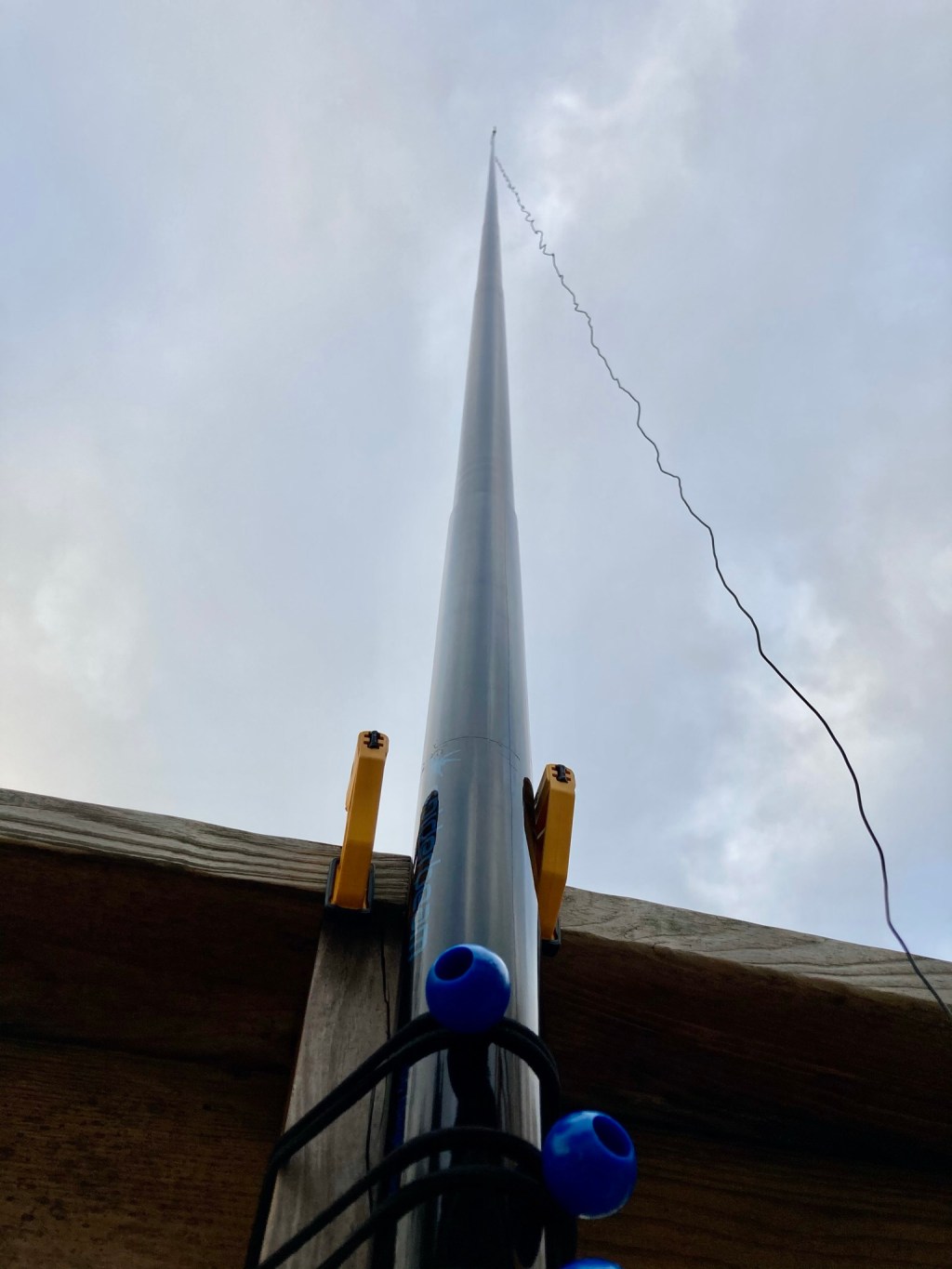
    After perusing many different designs I purchased the PAR 402010 Trail Friendly. It is advertised as covering three popular bands with no ATU, and it is light enough to be supported by just about any support. This is a design antenna with a history of being made by several builders and Vibroplex now markets them with the PAR branding. It features a 41′ lightweight insulated/stranded wire radiator with a 40M trap to make it resonate on both 40m and 20m, and it will also load on parts of the 10m band. The lightweight build still feels sturdy, and has proven durable over a year of regular use. The tip of the radiator can get mashed up a bit, especially if you have a mast collapse. Note my use of a heavy wrap of electrical tape at the tip of the mast. It helps with setup and fits in the collapsed tube.

    About that mast… (12M Spiderpole Mini-Review Alert) At the same time I was searching for antennas I found another member of the Vibroplex line, Spiderbeam, and their 12-Meter Spiderpole. Often nicknamed “the beast” It’s built like a tank and can hold up much more than this little low-power wire vertical. Interestingly they do fit like they were made for each other. “The Beast” isn’t a backpacker pole unless you are a glutton for punishment or take your Cross-Fit habits onto the trails. It isn’t terribly compact, and it isn’t light. What it is is a borderline overbuilt 41 foot weatherproof antenna support.

    The Spiderpole is overkill, a luxury, though a versatile luxury at that. It is a big, heavy telescoping mast and needs to be well secured at the base. It has more wind load than I guessed and exerts a lot of leverage on that base section, so you want it to be well secured while avoiding hard points where the fiberglass tube wall could fail under a sudden or heavy wind load. The upside is you get a 41′ vertical skyhook. Nice. It also shrinks the footprint compared to what you need for a sloper or inverted vee and allows you to work where there is no overhead support. I am surrounded by beaches, so something like this lets me operate from more locations and not be limited by the presence/absence of a large tree(s) and I create less of an attractive hazard for lookie-loos. It appears to be a law of physics that as soon as you put up an antenna some random mammal will walk directly into it within 5 minutes. All you can do is pad the odds in your favor.

    Very Vertical

    I was curious how this antenna would perform, especially compared to a 9:1 unit I had built and used on this same Spiderpole support. Mine is the basic trifilar design over a T200 core. The 9:1 works, but I always feel like I am working “up-hill” with it. That perception is based on ability to work stations I hear, and the signal reports I receive. There are worse options than a 9:1 into a chunk of wire sized to a convenient non-resonant length, but it feels very lossy in operation. When I first rigged the PAR I had my doubts. Rated at 25W SSB it isn’t much to look at. The matching unit is smaller than a fun-sized candy bar, the wire looks like overbuilt dental floss. Once I attached it to the Spiderpole and got it fully extended the ultralight wire It seemed out of balance being supported by “the beast”. Happily I was more than surprised at how well it performed. I observed much more parity with the stations I was hearing and working and logged several nice stretches of contacts on both FT8 and SSB. I was using it with both a Xiegu G90 and a Yaesu FT-991A, and aside from needing to watch the power output it did what it says on the tin. Three bands, no waiting. I don’t hesitate to set this up for a quick evening of casual operation since setup and take down require about 10 minutes each.

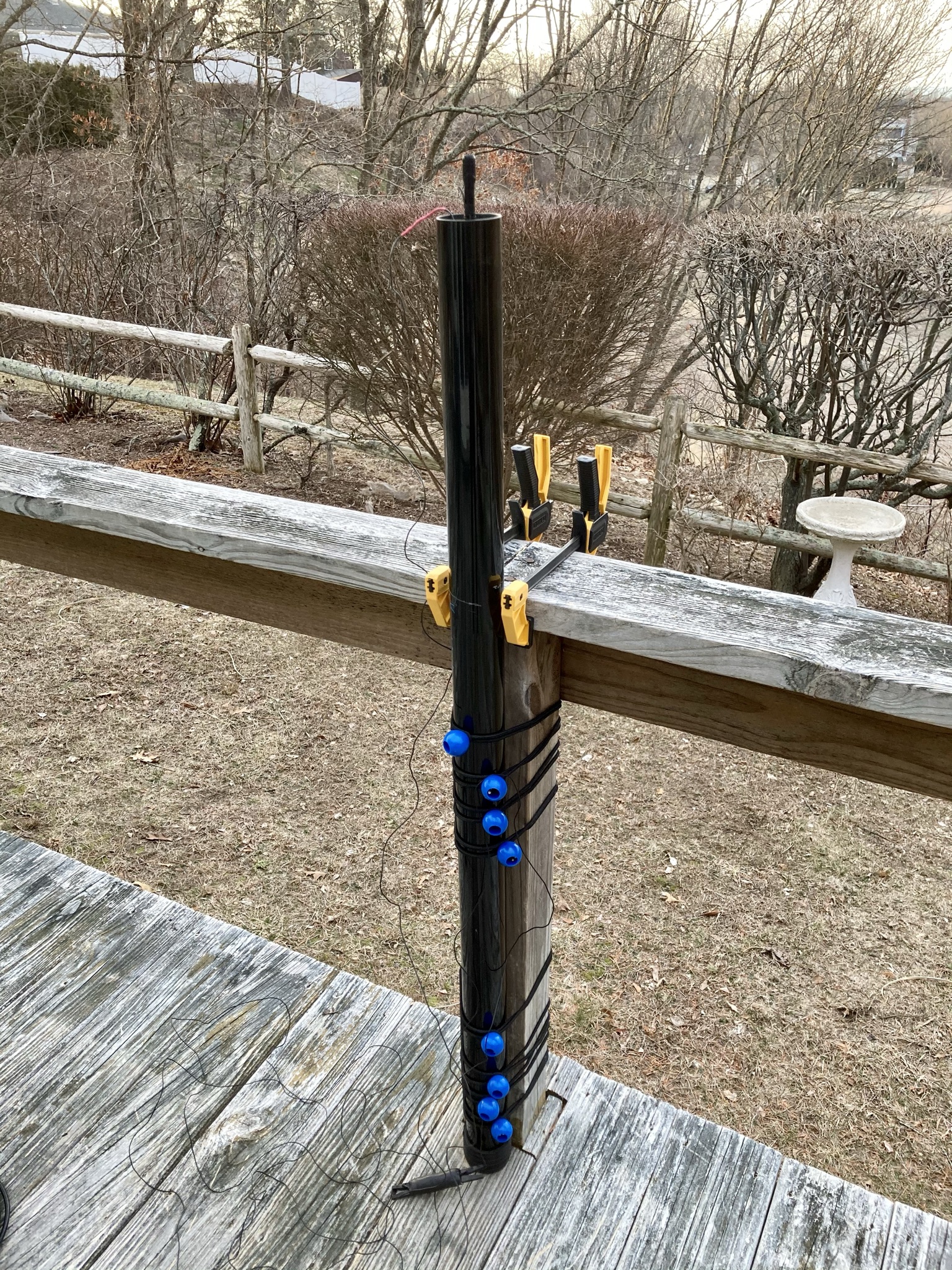
    Here it is lashed to a deck railing in my back yard (or “garden”. You know who you are). If I was expecting gusty conditions I would have a 4-way support at the top rail and the base. In calm conditions the bongo ties hold up just fine. Just use as many as you dare. This thing puts a lot of stress on the support system.

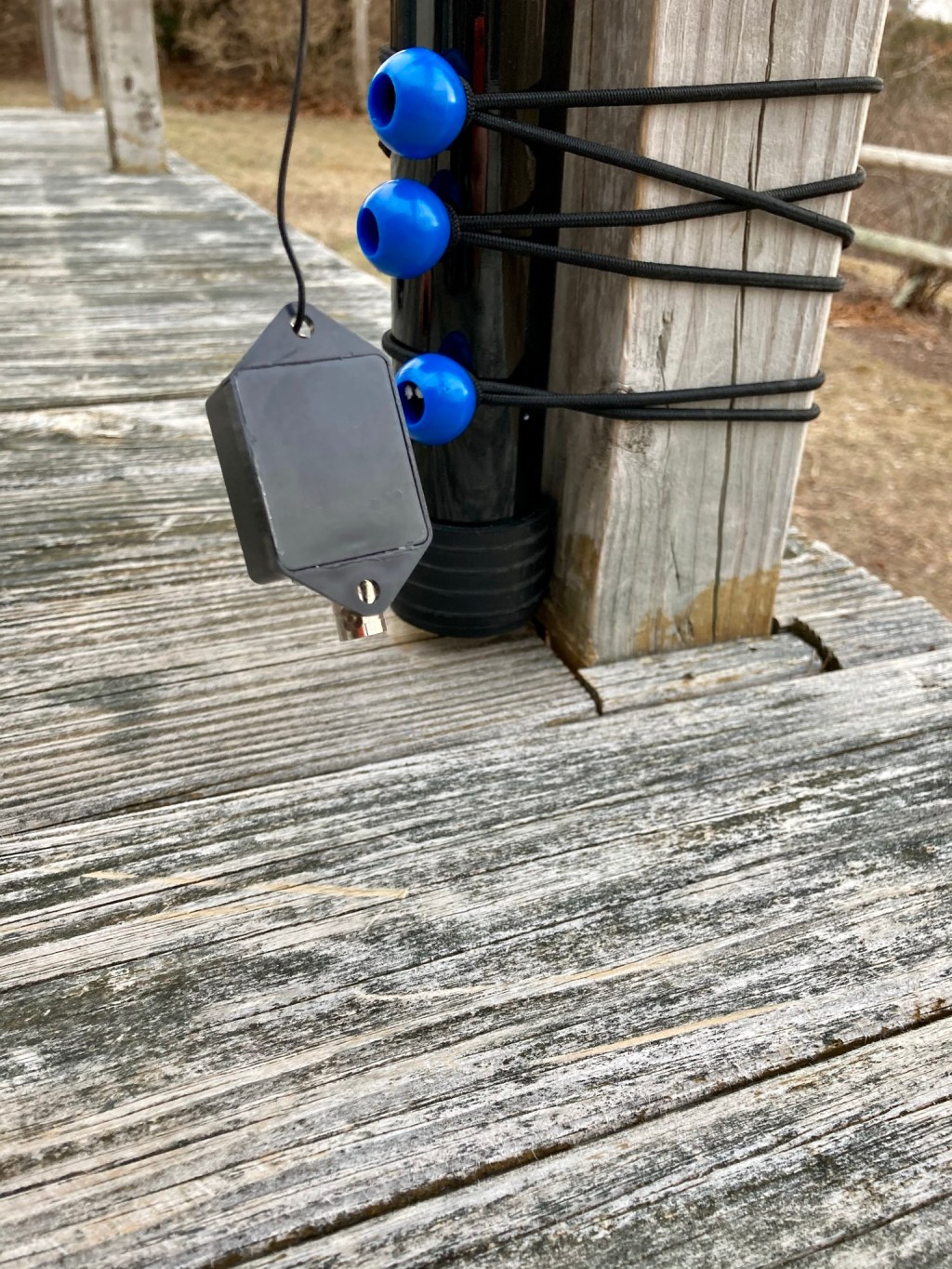
    When erected the matching unit sits about 3″ off the deck.

    Technical Aside: These end-fed matching devices are indeed lossy. You don’t need to break out a calculator to know this. All you have to do is look at the designs for different power ratings. The size and number of the ferrite toroids (typically 43-Mix) need to be increased to withstand the increased field density of each higher power rating, and the heat that comes with it. A good portion, perhaps as much as 30%, of the power making it to the matching device gets siphoned off as resistive/heat losses. [tl/dr YOU ARE MAKING HEAT NOT ERP] But hey, you know the setup is a compromise going in. That compromise is lower overall efficiency in exchange for ease of setup and portability. I found that going from 5W to 10W output caused a sizeable step change in the contacts I was able to make, but that is to be expected, since my ERP was probably going from 3W to 7W. Certainly you can make a lot of contacts with this antenna, but you will probably be be several dB down from where you *might* be on a more efficient antenna system. The upside is that you can get on the air quickly with not much fuss, which translates to more time operating and less time reading long winded blog posts. But I digress.

    A Phalanx of Bongo Ties and Clamps

    One big question with “the beast” is how to support it, and one of those lightweight drive-on flagpole mounts is not likely to get it done. I currently use a phalanx of bongo ties, woodworker clamps, ratchet straps, and U-Bolts. None of them are perfect but I can lash it to a variety of improvised bases. I’m thinking a 36″ tubular support welded to a 2″ trailer hitch is about what it would take to have real peace of mind with this thing while operating car-portable.

    Wrap Up: My feeling about this antenna has done nothing but improved each time I deploy it. I feel like this particular design gets overlooked. That’s a shame because it is a solid performer. It hears very well, is easy to tune, and I am always surprised at how well it works. We can hope all we want to have a low loss resonant radiator over a dense field of copper radials, or a big dipole/doublet/windom/curtain a half wave up on solid supports, but it seems that what many/most hams typically need is a way to get on the air under sub-optimal conditions. We also want to be able to actually operate once we get set up. What I would love to see is a 200W CW Rated version with the same 41′ design. Right now I guess I have to build one. Vibroplex has a potential two-fer on their hands if they can match a 41′ triband wire vertical to their affordable heavy-duty 12m Spiderpole. That opens it up to running CW or digital/RTTY at a full 100W and having a solid safety margin at the feedpoint.

    I hope this was informative, or at least I hope you had a good nap. 73, N1QDQ

  • A quick note about my shack, and why..

    A quick note about my shack, and why..

    I’ve been licensed since about 1992 and never had a “real” ham shack. My home shack was usually an extension of my desk area, and never a classic, photogenic, radio room with awards on the walls. As well, I have never owned a tower and have used either wire antennas or trap verticals. I had a good sized lot but I was losing trees to various blights and my spouse is…. antenna adverse? She has not problem with radio activity, but having a nest of wires on display is not her idea of a good time. We lived in a valley surrounded on three sides by basalt bedrock and till. If you want a RF absorbent QTH, move to the bottom of a valley surrounded by iron ore. Good times. That lays the basis for my choices, and as a result I did a lot of mobile and portable operating.

    As I am closing in on 30 years as a ham I have had burst of activity and have been active sporadically for the past 15 years. I was living between two QTHs for the past 10 years and didn’t have a good spot for a permanent antenna at either. Plus, I was planning on selling a house and didn’t want to put something up and then have to break it all down again in short order. That property had too many scars from previous antennas already!

    Even though I didn’t always find time to operate I always had at least one transceiver and an assortment of shortwave receivers. At the new QTH on the Rhode Island coast I have a smaller lot, and am planning some landscaping and construction. That is a bad time to start putting up permanent antennas. Thanks to a host of portable antenna options that didn’t stop me from finding a way to get on the air. Previously I had been operating on an Alpha-Delta DX-EE multiband dipole mounted in an attic space. Aside from being a bear to tune to resonance, It came with a host of RFI issues, and attic spaces make for poor antenna locations. I ran a Bencher Low Pass Filter which knocked down the worst of the RFI I was generating. It worked, and I made some good contacts on it, but overall I consider it a last-option solution. Again, an antenna surrounded by a RF absorber.

    As I rebooted my shack setup and started researching gear I saw that a forest of QRP/Portable/Packable antennas and antenna supports had sprung up over the past decade. That piqued my interest in a major way. The idea that I could operate portable and not have to make huge compromises in antenna performance, or be limited by the ability to string dipoles in a forest canopy, was and is very attractive. I jumped in and built or purchased several pieces that allowed me to get on the air with a better signal, even if I was still operating out of Pelican cases at home. My plan is to cover a few of these choices with an eye on how I planned to deploy them, What I learned from deploying them, and my impressions of their performance. To say I am not being paid is an understatement. If I was ever to be endorsed or get a product to review it would be in boldface at the top of the post/video.

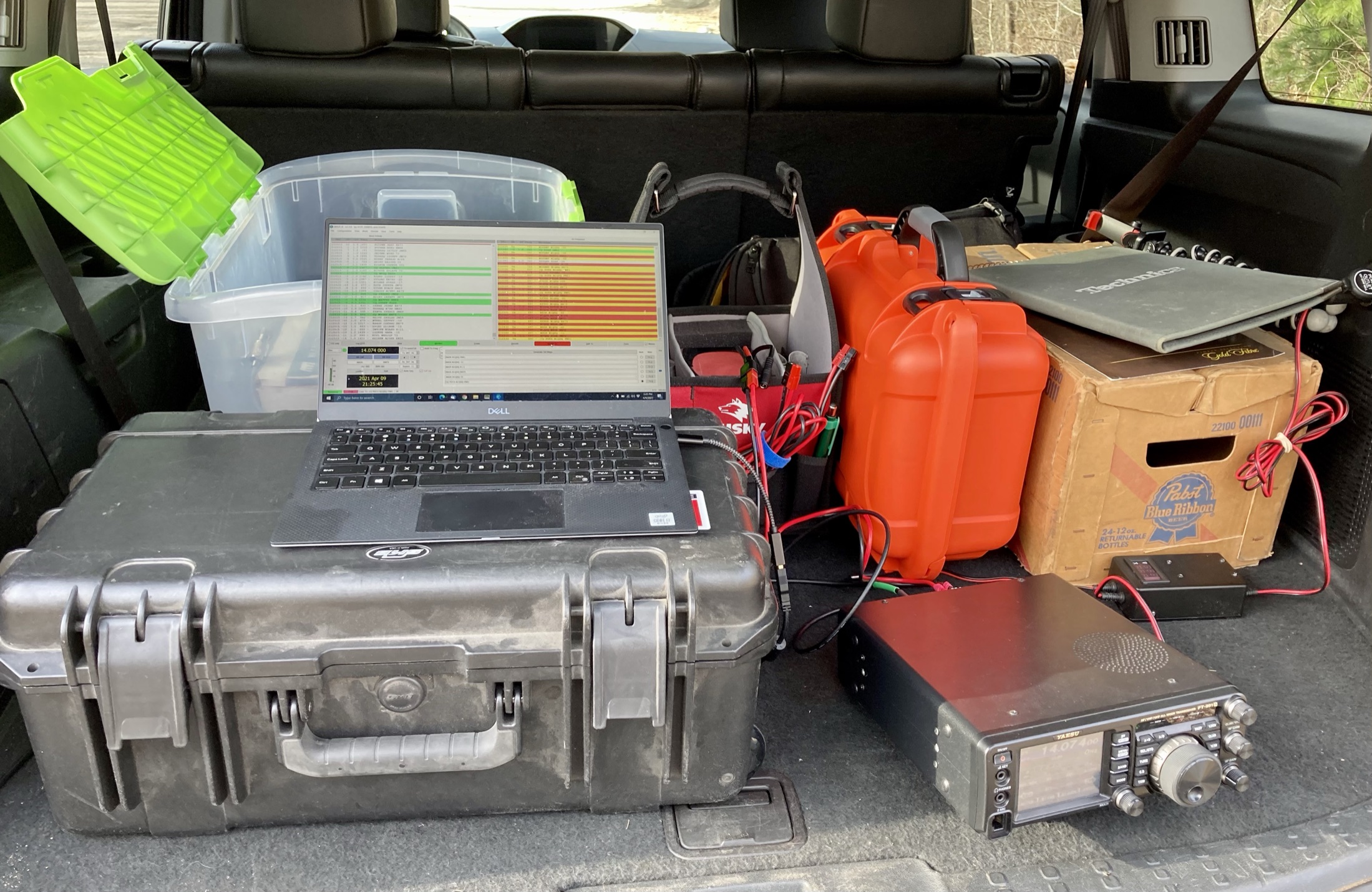
    A Car-Portable POTA Activation Setup – FT-991A and no weight restrictions

    Here’s a partial list of the gear I am hoping to cover, in no particular order, except that I am reviewing the PAR 402010 TF first…

    PAR Trail Friendly 402010 (Vibroplex)

    PackTenna Mini EFHW

    Homebrew 9:1 End Fed Wire System

    Homebrew 49:1-ish EFHW System

    Spiderbeams 12M Spiderpole HD

    DX Commander Expedition

    Wolf River TIA Max

    Chameleon MPAS Lite

    Thanks for looking, and I hope I’m able to add something useful to the conversation around these popular antenna systems. My goal is to try and knock one out each week, and we will see how that goes.

    Best 73, Pete Brunelli N1QDQ

  • Who’s afraid of FT8?

    Preface: I am planning on creating some posts addressing this in a more technical fashion. This is not a comprehensive tech essay full of footnotes. You either know what this is about or you don’t. For now I am sharing this brain dump addressed to all amateur radio operators. We find ourselves in a unique circumstance where great changes have occurred over a long period of low solar activity, and we are now emerging with some very real social turbulence in the ham radio ranks. I think it is useful to take a broad view of this pursuit, this service, and reflect on how we have moved forward, and how we can continue to move forward. 73, Pete N1QDQ

    Let’s travel back to the heady days of 2010, when a new ham radio sensation called PSK31 was “taking over the ham bands”. It allowed users with less than massive transmitters and antennas to make reliable keyboard to keyboard contacts on HF. It wasn’t perfect. Many ops ran too much power, or had overdriven signals, or both, and the small stations had a bit of work to do to get through a QSO. The spectrum slices being used were narrow/cramped, and it didn’t take much to interfere with another op. You pretty much had to be on the same frequency/offset as the other station (not reliable in split mode) or it didn’t work, and a big wooly signal would wipe out a quarter of the subband. The advantage was that it took up about a tenth of the spectrum of a RTTY signal, and was more power-efficient. It also allowed many more operators to share the same slice of spectrum. As is the case today it was also a reason for the “big gun” stations to sneer down their noses and tell “lesser’ operators how they were killing ham radio.

    FFW to today, and we are in much of the same predicament with a newer mode called FT8. It is even more flexible than PSK31, works at even lower signal to noise ratios, and is implemented primarily through one application called WSJT-X. It does not support anything much beyond the bare bones exchange of callsign, location and signal report. That makes sense since the suite of modes associated with Joe Taylor K1JT, Steve Franke, K9AN, and a cadre of experimenters was developed for very weak signal operations like Earth-Moon-Earth (EME) and Meteor Scatter. It turns out some of these modes, specifically FT8 and FT4, are very robust over traditional HF frequencies and propagation modes. And yet, despite allowing a large number of contacts over a small slice of spectrum, with lower power, and lower s/n ratios, FT8 users are again subject to ridicule by keepers of the mid-20th century technology flame. This extends to purposeful QRM, sneering memes about how FT8 ops are not real hams, how their QSOs don’t count, how it is “cheating”, and so on. Even as predictable as it is, it puts the ugly side of the “friendliest hobby” at the forefront of the much needed conversations around how our spectrum allocations are utilized, and how they will be used going forward.

    Which is a shame, because these computer-controlled weak signal modes on the HF bands are nothing if not entirely consistent with the traditions of ham radio, and the central thesis of evolving to incorporate new technology as it emerges. The integration of existing and new technologies into radio communication is the hallmark of ham radio. What began as the transmission of Morse Code (tech adapted from the wired telegraph industry) using a spark gap transmitter, quickly evolved to a continuous-wave (CW) transmission based on the implementation of the vacuum triode as a tunable oscillator and amplifier. The spark-gap blasted RF across a big slice of RF spectrum. CW turned that on its head and allowed for more efficient narrow-band communications. Suddenly there was more room for more operators to communicate with less power over longer distances.

    When modulated carrier audio came into being, it was double-sideband full carrier amplitude modulation, or AM. This is what we hear when we listen to the AM broadcast band. It takes a lot of power to generate that signal, and it also takes up a lot of spectrum. As the need arose for more efficient communications modes (portable equipment, lower power requirements, covering greater distances) it was found you could do away with the carrier (which was the reference frequency for the audio sidebands) and then one of the two sidebands. Thus Single Side-Band (SSB) was created. By giving the receiver the necessary oscillators to rebuild the audio information, the transmission could be made using much less power. This mode relied on the many improvements to vacuum tube technology, including miniaturization, lower power circuitry, and the use of multiple oscillators in new configurations. These fundamental modes of radio communication, data and audio, integrated new technology as it appeared, and hams were pivotal in their widespread adoption. As well, hams were pivotal in the development of new modes of radio communication based on these principles. They were, as now, radio experimenters. They were doing for free what governments were doing under much less liberated circumstances.

    Radio technology eagerly adopted every advance in electronics tech, from vacuum tube minaturization, to the semiconductor, the integrated circuit, the standardization of component packaging, and then the microprocessor. Microprocessors were a natural fit for radio communications because they can manipulate control voltages and logic states at a blinding pace. The earliest and slowest microprocessors were adding communications capabilities beyond the analog realm. It also turned out you could emulate an oscillator with a microprocessor. Even at audio frequencies this was a giant leap for oscillator miniaturization and stability. Once these microprocessors were integrated into computing platforms, handling user input, program code execution, data storage, and data output, the modern era of computer/radio hybridization was in play.

    It is simple enough to state that a radio station operating without some form of semiconductor and microprocessor technology is indeed a rarity. I know of no hams who are aching to go back to drifty oscillators and inefficient transmitters. Yes, that gear is still in use by a few stations, but I’ll bet each one has a modern rig right next to it. While modern technology has come to dominate the scene, all of the historical phases of electronics technology still have a place in the pursuit of radio communications (ok, maybe not spark gap). The fundamentals of radio still apply regardless of the technology.

    So I ask, earnestly: How did this illustrious, enjoyable, and diverse pursuit of technology applied to radio communication become beholden to gatekeepers who selectively decide which modern technology is appropriate, and which they believe makes one a “fake ham”? It is almost universally the cry of hams who are “fortunate” enough to have a tower(s) supporting a big directional antenna(s) fed by a kilowatt(s) of RF, using modes established in the WWII era, who demand that they be crowned the gatekeepers of What Is Correct.

    The facts are decidedly at odds with their position. If they were in any way in the majority it would be reflected in radio equipment sales and development. I believe the “average” ham has a somewhat modern 100W transceiver with a simple antenna, and a few helpful accessories. Additionally, they own a computer, which has become not only extremely cheap, but extremely effective. Somehow, in the middle of a deep and prolonged solar minimum, the airwaves are increasingly being used by many low power stations using compromised antennas, often with portability in mind. One reason this has been possible has been the development of modes like FT8. When you can run a 1-30W transceiver into a $20 homebrew end-fed wire, controlled by a $50 Raspberry Pi “toy” computer, and make a contact 10,000 miles away, it opens up the accessibility of radio communication in a myriad of ways. I made my first JA contact from my new QTH using 35W into a wire vertical, and FT8. It’s just as valid as any other contact.

    I agree that the FT8 QSO is not very satisfying from a “chat about the weather and your radio” perspective. But let’s be honest, a typical CW conversation is name, location, rig, antenna, and brief weather observation. It’s fun. I love it. But it isn’t exactly deep bonding going on there. FT8 is giving the user more of a “contest mode” QSO. Being that it is good enough for the biggest stations in the world, as long as an actual contest is afoot (every weekend, #jussayin), why is it less appropriate in weak signal work? Maybe it’s has to do with the fear of losing status? Maybe it’s the need to ensure that kilowatt stations using 80 year old tech continue to dominate the way hams use their HF spectrum allocations in the 21st century? I can understand it, objectively, though I have not been able to assemble that kind of station. I also understand bullies. All too well. Ham radio needs to face up to the fact that it has a bully problem.

    Unless you have been under a rock you know that every slice of the radio frequency spectrum is being eyed by some monied interest somewhere across the globe. Each time you see a nation kick their amateurs off an allocation it should raise an alarm. One would think the response of established spectrum users would be to promote increased usage and improved spectrum efficiency. It is counterintuitive to act as if relying more heavily on old tech is some kind of hedge against spectrum loss. I also fear that hams hold themselves to a standard that is not recognized outside of ham culture. An objective survey of the HF allocations would hear a small segment of intense activity in the bottom 100KHz, and then a lot of SSB voice spread out across the rest of the allocation.

    My purpose here is to begin a conversation not end one. This is the scenery as I see it, from my perspective as a ham who has held an Extra Class license for almost all of my 27+ years of ham-life. I am often operating portable equipment, often at QRP or slightly higher power levels. I try to enjoy all that ham radio has to offer. I like HF QRP CW, as well as digital modes, as well as VHF/UHF contesting, as well as SSB, and SWL, and applied electronics concepts, and so on. I feel that there is a disturbing social pushback on the current practices and adaptations many hams have made in the era of condo rules, suburban/urban constraints, restricted public space access, and accommodating family and work life, by a small population of operators who don’t share those constraints. All of the tools available to hams have a place. And it is a great credit to hams everywhere that there is a general respect for gentleman’s agreements and international spectrum guidance. What I hope we see as this next solar cycle heats up is not just continued cooperation, but greatly enhanced cooperation. There is room for everyone, and every facet of the hobby. There has to be. The alternative is unimaginable, avoidable, loss.

    Endnote: One piece of Amateur Radio News that spurred me to write this piece is this: FT8 Ruling The Airwaves from DXWorld.net. I believe it shows how a more efficient mode of communication increases the effectiveness of the power output on hand, and how attractive that is to many hams. I don’t think it is more complicated than that.