It’s been minute since my last poet but here I am with a little update on my amateur radio satellite station. I had a bit of a break from the sats this spring as I was planning travel, then traveling, then recovering from travel, then had a back problem, then recovered from that, and now I am back operating sats again. Whew!
I still use my original two-radio setup consisting of a Yaesu 817ND uplink radio and am iCOM IC-705 as a downlink radio, with no automation. I still love using it and can’t say enough about how much the 705 and it’s pandapter display improves the experience of working full duplex. Being able to see your signal on the downlink and then tune to it makes getting on frequency a breeze. That’s less QRM caused, and more time making contacts.
I thought about this the other day: If I was using two 817/818’s I would make a habit of using my phone to snap images of both displays during the pass. That would let me build a better cheat sheet and save a lot of time. Let me know if you do this, or if you use another method.
The other development is my use of the CSN SAT controller with my IC-9700 in a sling-style camera bag, into the ARROW II antenna. I stopped procrastinating and finally did the easy work of connecting a battery bank to the SAT, and connecting it to the CI-V port on the 9700. I’m using a HEIL headset and I run in VOX mode. I still have a few wrinkles to work out. The connections for the CI-V and the Key, and probably the HEIL headset cables and adapter, may be picking up some RF and I get a popping/click in the RX when transmitting on 2M (RS-44, for example). I will be making sure I have the wiring as neat as possible and throwing a choke or two into the mix in attempt to quiet that down.
Not only am I enjoying the life of automated Doppler compensation, which is a great way to operate, but I get to see how manual tuning stations sound to the automated stations. On several occasions I had been told I was “drifting” and it made the contact difficult. It’s all relative I guess.
In manual tuning I set the lower of the two bands (2m uplink on RS-44) and track the Doppler with the higher of the two bands (70cm RS-44 downlink). An automated station adjust both uplink and downlink to maintain the same frequency at the input of the transponder. Last night I heard a station on RS-44 that was super loud but couldn’t find themselves. It sounded like a lot of power and seemed to be pumping the RS-44 AGC, but who knows. I eventually worked them and had two observations. The apparent drift I was observing was due to differing tuning methods. Also the other station was super loud but often couldn’t hear themselves or the other station. I’m going to make a guess: Manual tuning, no frequency display on the downlink, likely too much power, and probably a mounted linear-polarized antenna and not able to twist it to match the sat’s polarization.
Having a man-portable/wearable, computer controlled IC-9700 opens up a lot of possibilities that would be difficult to wrangle with a manual tuning station. One is quick QSY between satellites since you can use the SAT control app to just pick another sat as it comes into view. Another is eliminating the need to switch antenna connections when switching modes as I need to do on my two-radio setup. Lastly I have started to use CW on RS-44 which is “interesting. I have to secure the paddles well enough to send accurately, and in a position where I can manipulate them in something like a normal hand position. It’s all a compromise. Then there is the challenge of manual tuning while sending with my right hand while pointing and twisting the Arrow with the other is quite a juggling act. With the two-radio setup I have to tune ahead, my signal or the other station drifts past, and then I retune again. The 9700/SAT will allow me to just send and manage the antenna.
The last difference is weight. The 9700 weighs a lot, and using a sling bag does not help as the weight really digs in to one side of my neck. I’m looking for a backpack that I can wear in reverse in order to distribute the load better. Until then I can manage that setup in return for the ease of use.
All of these things are pointing to another round of finding a suitable pack, them modifying it to solve these problems, and trying to keep the weight as low as possible.
That’s all I have for now. Have fun on the air, and Stay tuned.
[This post was drafted in early 2024. As of December 2025 I have cleaned it up and added a bit of new information with the intention of writing a Part II with comparison images]
Three things that defined my childhood were Music, Radio, and Photography. This was almost completely due to the influence of my father and my grandfather. My grandfather had started in photography in the 1920’s, developing his own roll film and making prints in a home darkroom. He started by installing electrical extensions in homes where the only electrical was one plug in the parlor. Later he worked as a projectionist, and then he started a “mom and pop” Radio, TV and Appliance store. It was literally mom and pop as he ran it with my grandmother. As a result our home was littered with radios and electronics. I started with a little transistor AM radio and unwittingly got into AM DX as I followed Boston Red Sox games while they were on the road.
Another thing my grandfather had was a darkroom. He picked up photography as a young man and that carried on to my father and then to me. I learned how to develop black and white film, and got to spend time in the darkroom learning to make basic prints. My grandfather started out on something like a Kodak Brownie but quickly switched to 35mm roll film cameras like the affordable Argus C-line. Both my grandfather and my father were low-tech photographers. An internal light meter was a luxury! As such, I was given a Yashica Lynx rangefinder with a dodgy shutter and broken meter as my first real camera. Little did I know I was learning Shutter Priority mode as only the 1/30, 60, and 125 shutter settings seemed to work. Later on I scraped together the cash for an Olympus OM-G and had a SLR with a working shutter and light meter! What joy.
I’ll be the first to admit that I had no style as a photographer. It took me a long time to get beyond snapshots. It wasn’t until I started using a digital camera that I had the kind of immediate feedback I needed. That’s not much as admissions go but I learned a lot about what kinds of processes I feel engaged with. In music I prefer live performance where the feedback is immediate, and similarly with amateur radio. But it was digital photography where I could have the immediate feedback while using a camera. I think my first digital camera was a Nikon point and shoot. It was poor on specs but a fun camera anyhow. I went through various compact (cheap) digital cameras and then I got a used Nikon APS-C DX format DSLR camera (D50, D200, D300). Those were very good cameras and relatively affordable. I shot with those cameras for years. They were bulky and heavy, but very reliable. Looking for something lighter led me to the Olympus Micro Four Thirds system. These cameras had a good sensor with a 50% crop factor (20mm lens is equivalent to 40mm on a 35mm full-frame sensor. The compact size and relative affordability was reminiscent of why I was drawn to the Olympus 35mm film cameras 30 years earlier. They were small, light, capable, and had excellent lenses.
I’d say the lens selection for m4/3 is as good any any camera system in production, with the exception of the Nikon F-Mount system. Even the plastic-ish kit lenses are sharp and bright, if not especially fast. The sensors are not great at high ISO, but the in-body image stabilization (IBIS) is among the best available. I shoot almost entirely handheld so this is a huge benefit. I can run longer shutter speeds and keep the ISO lower. After a trying a few other lenses my main setup has been a Olympus EM-1 MK-II with the 14-40mm and 40-150mm PRO zoom lenses. They fit perfectly in a Think Tank sling bag and cover everything I need in focal length with a constant f/2.8 aperture. Compared to my Nikon gear the Oly setup was lighter, more versatile, shot better video, and the lenses were as good an anything I used from Nikon. That bag has traveled the world with me and I took a lot of good photos with it.
And then a funny thing happened… I shot some film with my trusty Olympus 35SP rangefinder. I was back to a fixed lens camera with a 42mm f/1.7 lens, almost exactly the focal length I used in my old Yashica. Sure, film is getting nothing but more expensive and processing is eye-watering costly, but the feel of a simple camera with a “normal lens” was immensely satisfying.
I picked up a used Panasonic 20mm f/1.7 “pancake lens” to use on my Olympus, and while I loved the images I could never be friends with the slow autofocus in low light. It isn’t a great performer on Panasonic/Lumix cameras, but it gets even worse when that lens is mounted on a non-Panasonic camera. But the idea was set.
Meanwhile I was also reviewing thousands of images in my Adobe Lightroom library and doing a lot of culling. Digital has the advantage of letting me make a lot of exposures without fearing the time and cost of processing, but that also means I have a trove of bad images in there. As soon as I started that project I was confronted with the reality that I wasn’t happy with a lot of my images, even the technically solid ones. doing a review of 20 years worth of digital images is a great way to take a step back and think about what you really want out of photography. Sure, there are the travel photos, the special moments with loved ones, the special places and faces. Of course that is essential and something I would not change. But there are also many times when I was using those nice zoom lenses and the results were not great.
So I did two things: I put that 20mm Panny onto my EM-1 and started shooting with it again; and I started looking at fixed lens compacts. The Panny is as I remember it. It makes beautiful images, but as soon as the light dims the autofocus heads for the exits. I loved the compact feel of ditching the big zoom for a pancake lens, and I loved the way it brought my focus back to the composition instead of “zoom to compose”.
On the search for a compact camera there were a few options that rose to the surface immediately: Fujifilm rangefinder style compacts with the X100v sitting at the top of the heap; The Sony RX-100 VII with insane autofocus and exposure capability and a superzoom lens; Canon G series camera of which I have owned a few and like them; and this oddball camera from Ricoh called the GR III. I had seen the GR before, and I knew Ricoh because my dad had a Ricoh 35mm SLR that used Pentax K-mount lenses. The Ricoh full manual SLR was about the least expensive point of entry into 35mm SLR in the 70’s and into the 80’s. It was even cheaper than the Pentax K-1000, the cockroach of the camera world (durability and ubiquity, not revulsion).
Any research into the Ricoh GR III immediately brings you into the world of street photography because it combines a 24mp full frame sensor and excellent image quality with a pocket sized basic-black point and shoot that looks like a toy. On the street this is akin to a secret weapon where you look like a clueless tourist but you are getting the good stuff. Subjects who might recoil at the sight of a “real” camera just go about their business when you point this little chunk of camera at them. It is also seen as a good alternative to the “unobtanium” status of the Fuji X100-V, a camera in low supply commanding twice it’s sticker price. The Fuji is a great tool, though it isn’t actually compact like “in your pocket” compact. Styling-wise it is a dead-ringer for the rangefinder classics of the 50’s through the 70’s, which I love. Sadly it also has a certain hipster cachet that has helped pump up the street price. The list price is about $1300 USD but finding one for under $2000 is rare. Also, at that $2k+ point many photographers start looking at Leica as an option, as opposed to looking for cheaper alternatives.
At the end my decision came down to the Sony RX100 vs the Ricoh GR. Simply, the Fuji wasn’t small enough and the Canon wasn’t going to give me the image quality I wanted. The Sony is an excellent camera and I have pixel-peeped some raw files and I think it is the best 1″ sensor camera out there, but one of my goals was to make a step up from the IQ of the 20mp Micro 4/3 sensor in the Olympus. It’s not that the Oly is bad, it is actually a great sensor and Olympus packages it with great technology and lens selection. The problem I have is the resolution/look for the actual digital negatives. I shoot in RAW+JPG and edit my RAW files in Adobe Lightroom (actually now Luminar Neo). The Olympus RAWs are just what you would want. They can take a lot of manipulation and hold up great to any kind of preset edits. It turns out that I’m not a true “pixel peeper” but I found some of the Oly images wanting.
So that leaves the Ricoh, and I decided that the GR IIIx was the way to go. I like shooting wide, and I can see where a pure street photographer could make use of the extra width of the 28mm GR III even just for some wiggle room on framing/cropping when shooting from the hip. But I wanted to go back to the boring days of a fixed normal lens and the IIIx is the best option for me.
About two months later I was in a local (since closed) camera shop, yes a real camera shop, and they had a Sony RX-100VA for a very good price. After not much thought I purchased the Sony and now have a little competition going on.
In the next post I’ll put together a mini review and my first impressions. Thanks for reading. P
Just a quick update on my language learning adventure before I move into some new topics. I am still very comfortable with my decision to stop using Duolingo. I’m trying to be fair in saying that it has a place in the language learning landscape. If I was stuck with limited financial resources and needed to get the basics of a language, plus build a daily study habit, then certainly Duo fits the bill. The user data I have seen shows that it is massively successful in teaching English to people who will see a massive economic benefit of being able to find work in English-speaking communities, or in their own communities. While traveling I have stuck to a rule that if you needed to find an English speaker, walk into a hotel lobby. In many countries the people there got the job precisely because they speak English. In Mexico, Central America, and South America, learning English makes a lot of sense as a career builder. In the USA the same can be said of learning Spanish which is very much the second language in most of the country. It also might be useful to be learning Japanese or Cantonese/Mandarin if you are looking to work in those countries or with companies from those countries.
I’m a guy with an Italian ancestral background who decided to make sure I could manage the basics in the Italian language. I’m also old and currently retired. My tolerance for nagging from a cartoon bird is minimal. I also found Duo to be a poor fit with my approach to learning a language, and with the other tools I am using.
The good news is I gave Busuu a try, and it is a much better fit. It keeps some of the features of Duo like streaks and daily goals, but it does away with almost all of the game elements. Another improvement is the voices used in the spoken examples. Where Duo can sound very artificial and cartoonish, Busuu uses actual people speaking naturally. My comprehension has improved greatly thanks to that feature. It also has a very robust social element where you can correct other student’s work, and have yours corrected. Having a native Italian speaker correct my work is fantastic. I try to return the favor as often as possible. If I see someone learning English and their written/spoken example needs a tweak, I can give them feedback.
Another area where Busuu clobbers Duo is in practice mode. You can pick Vocabulary or Grammar, and work on only words you have had trouble with, for example, or only a specific grammar topic. In some cases you can engage with either voice or writing. It’s a great way to review and isn’t any more complicated than Duo’s, but it is much more effective.
I’ll leave that right there. Check out Busuu if you are in the market for a daily language app.
Here are links to a few more resources I have found useful/essential:
itakli spoken language platform. The UBER of language learning (minus the strong smell of Axe Body Spray)
Deep-L AI-assisted language translator app. Better natural-language translations.
WordReference Dictionary/Thesaurus/Conjugator. The interface is terrible but the value is immense.
Collins Dictionary is a WordReference alternative. Better in some ways, worse in others. Some day one of these will get a modern makeover. Until then have both ready to use.
Memrise enhanced flashcard platform. Some features of an app, in flashcard form. Great for quick-hit learning.
Language Reactor translator plugin for Chrome. A learning platform based on translating foreign language closed captions. Amazing.
I’m new to Satellite operations having started just over five months ago, but I’m not new to portable operations. I don’t build fancy rover rigs. I just secure my gear, use a good portable antenna support, and keep things “fast and light”. That means I don’t have much for rainproofing and am turning antennas by hand, but I like the flexibility.
Here’s a short video I took at a portable IO-117/Greencube activation here in southern Rhode Island. The location is Ninigret Park, a former military air base and bombing target (!!!!). This video is from one of the large parking lots with decent horizon views. I am able to work passes down to about 5-degrees.
A few additional items to fill in the gaps:
I think the WIMO X-Quad is a good antenna. In use I have not found a way to get fade-free performance on Greencube. The RHCP harness works, but isn’t consistent. I have also run it by only feeding the Horizontal or Vertical inputs. Even though WIMO says it can’t be used like this, it can. I find it covers better with less fading, but when it goes bad it is just as bad as the RHCP setup.
DC power is a 20Ah Bioenno LiFePO4. It will run this station at 25W for multiple passes. Probably 6 or more. I don’t transmit too much so it is mainly the 1-Amp idle current of the 991A that eats up capacity.
I buy Times Microwave LMR240-UF (Ultraflex) in bulk and build cables as needed. I like the DX-Engineering crimp/solder PL-259s for 8X/240, and they sell good BNCs at a variety of price points. I wish the flex was a little more “ultra” but the performance at UHF is worth some stiff handling.
I’ll be sure to make another video when I have a windproof mic and I’ll go into more detail.
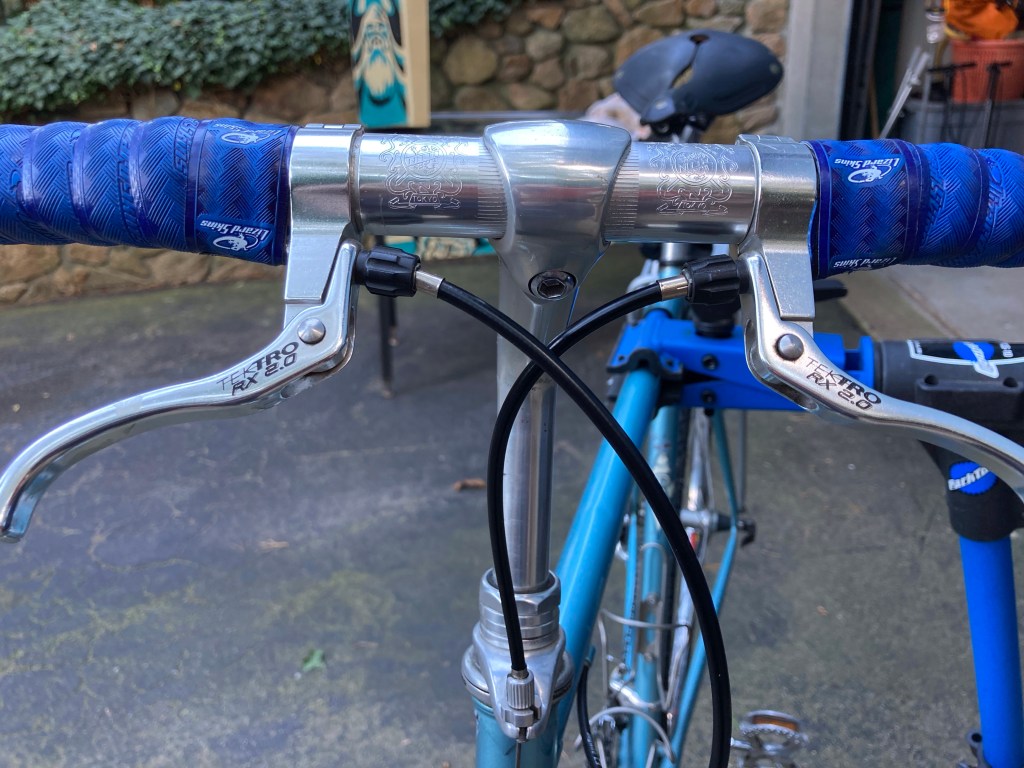
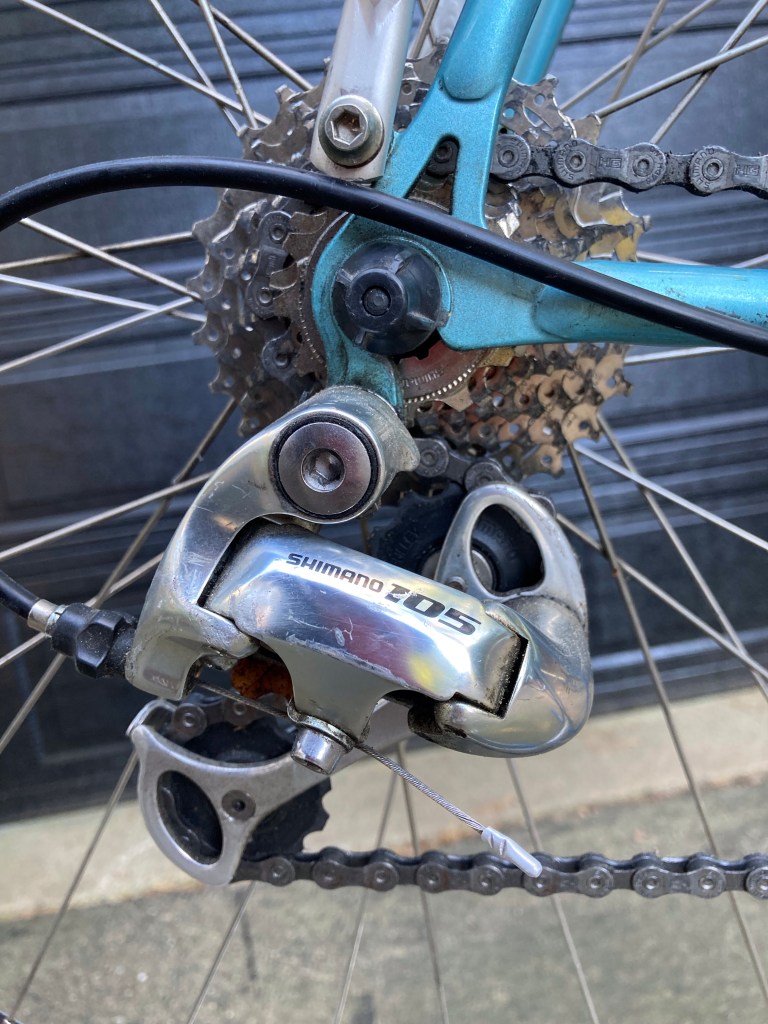
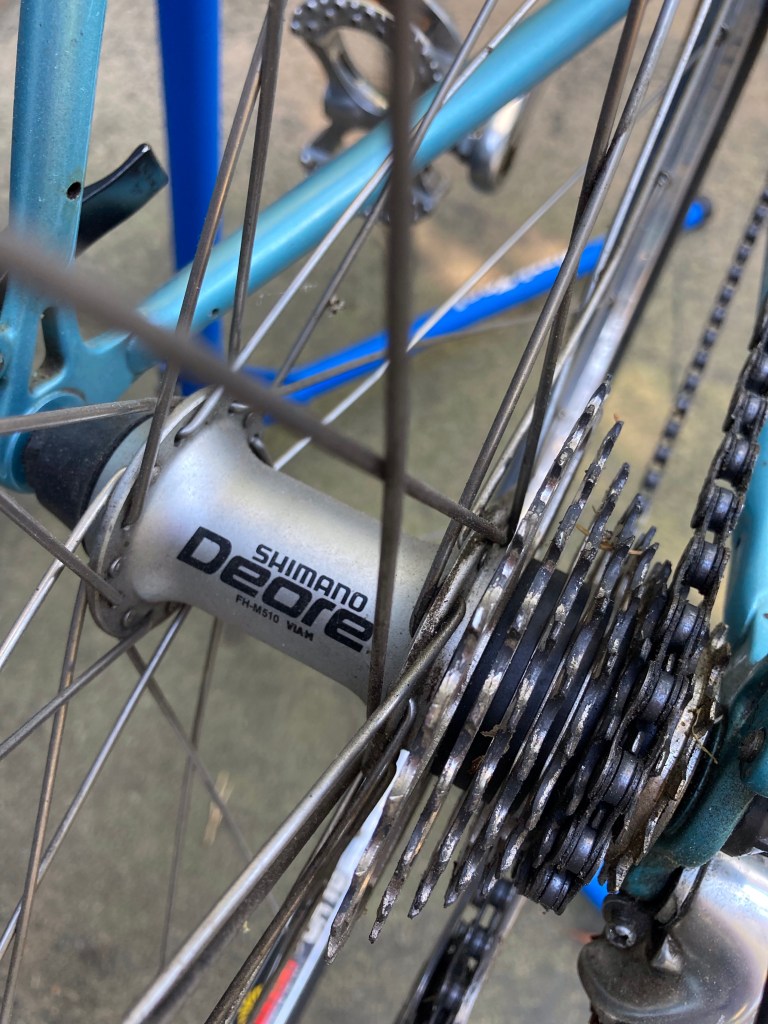
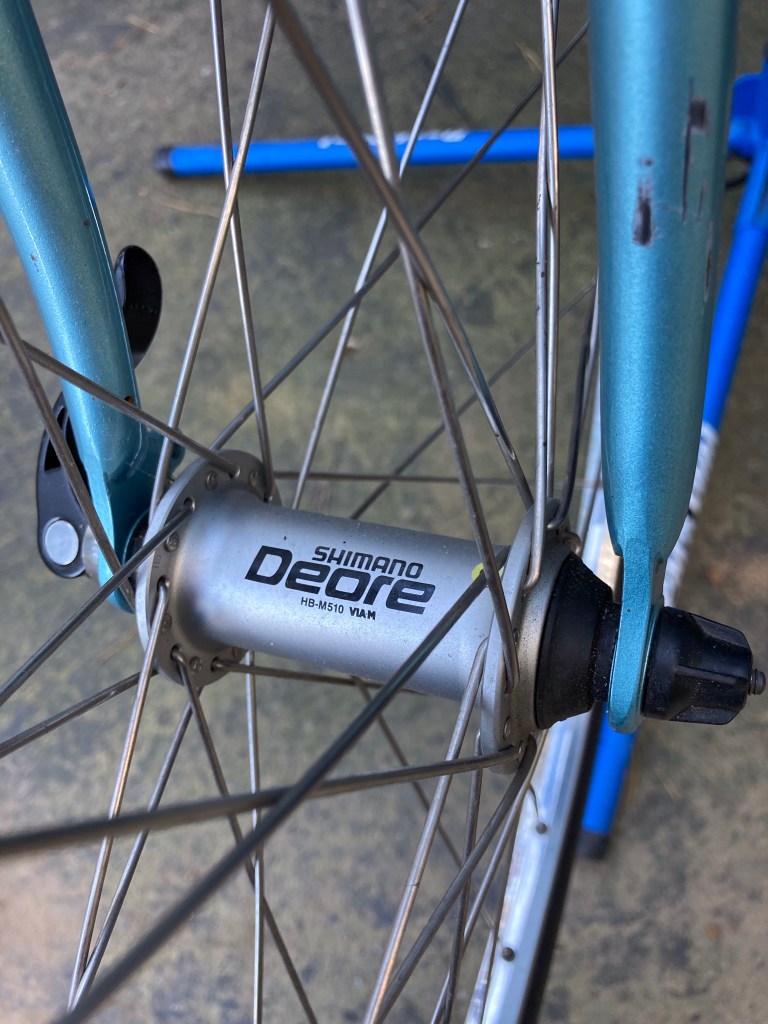
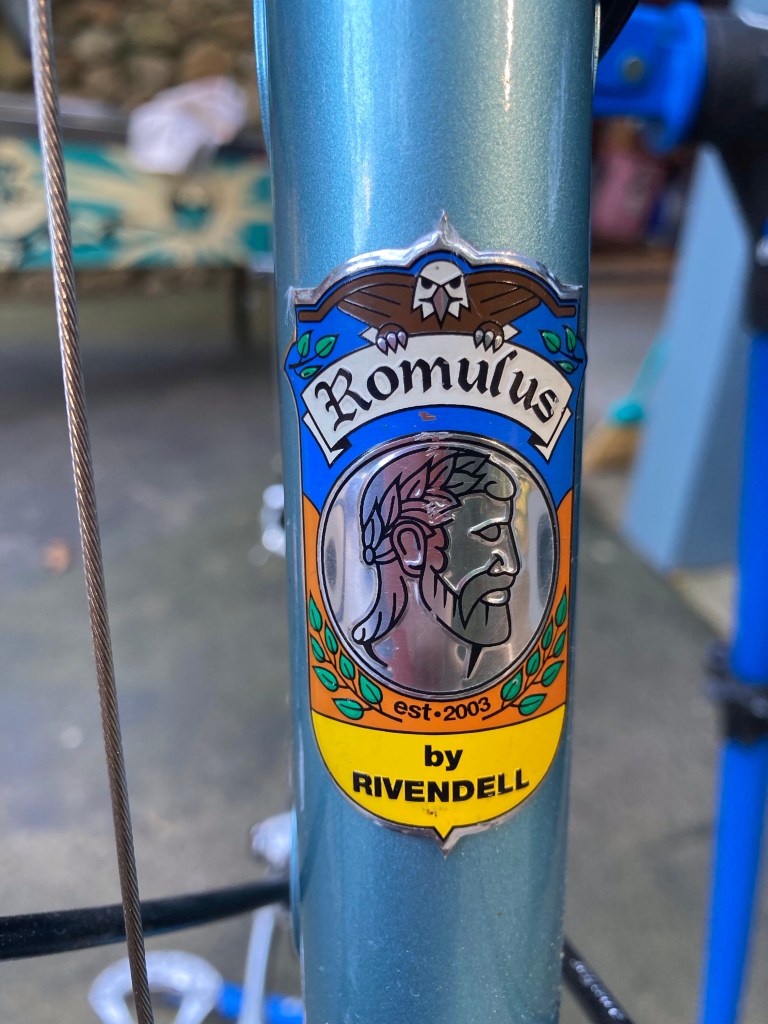
After long consideration my progressive sciatica and various SI/IT/disc issues have made the decision to sell my Rivendell Romulus a fait accompli. I needed an easy way to share photos so why not blog them! It is a 59cm Romulus (circa 2003/4) with cantilever brakes, no modifications, in great condition. Shimano 105 group set, Shimano hubs and brakes, Tektro interceptor brake levers, Sugino triple crankset, new Shimano cassette, and currently has a nice brushed Planet Bike rack installed.
I am a huge fan of Grant Petersen and his Rivendell Bike company. His design ethic and approach to cycling have kept me on a bike for many years when I had about given up. The common bike-shop bikes were making me miserable, and American spandex mafia bike couture is…. Gross. After finding his writing, looking at his bikes, and deciding I might find a used model to better fit my budget, I found this Romulus on eBay from the original owner in upstate New York. Two-wheeled bliss is to have a fast, comfortable, capable bike that can handle dirt trails as well as blacktop touring. This, is that.
There is a bit of a story behind the canti-rom, and this is how I understand it. Rivendell Bikes is all about steel framed bicycles with a focus on usability for the daily rider, commuter, and tourer. Many of the bikes are hand built, lugged steel construction, and kitted out with premium components. They are not, as you might expect, cheap. They are not nosebleed expensive, but if you are comparing them to mass produced bikes at the local shop you might feel they are out of reach. In the early 2000’s Rivendell wanted to sell a more affordable version of their custom Rambouilette sport-tourer. The Romulus was spec’d with the same frame materials and geometry, but with a plain paint job and it was assembled in Japan as a complete bike with a solid component selection. The original was designed with center pull Shimano brakes, but there were discussions between Grant Petersen and the factory about a cantilever brake version. There was a miscipommunication of sorts, and before he knew it Grant was taking delivery of a batch of complete cantilever equipped Roms. This is one of those bikes.
As you can see from the long Nitto stem and the seat position I have it set up for my 6 foot frame in a very upright position. That’s first a testament, if extreme, of Grant’s approach to rider comfort, and how I was able to parlay that into a back-friendly riding position. As of 2021 I simply can’t take the beating from high pressure tires. I am now cruising around on my 1987-ish Peugeot Orient Express, kitted out Riv-style with 26×2 Schwalbe Fat Frank tires, Riv sweep bars, and a good saddle. It’s super cushy and it’s all I can ride now. sniff.
So here are the pics. More on bikes and why I love bikes in a later post:
This summer has been a wild one. The Rhode Island shoreline stayed comfortable and mostly dry while most of Southern New England got walloped with heat and heavy rains in July. That continued into August until the tropical storm carousel started dealing us hurricanes, tropical depressions, and hurricane leftovers. Add in the continues COVID restrictions, and rain-outs on the big holiday weekend, and it was a bit of Groundhog Day from the summer of 2020.
There were few travel opportunities in 2021, but my wife and I made a great road trip to see friends in eastern Michigan, and saw family on the way home. We arrived back in Rhode Island just in time to batten down the hatches before Hurricane Henri made landfall right in our backyard here. We dodged the worst of it with more winds off to the east and more rain off to the west. Still, tree damage, flooding, and 24-48hr power outages were common here. We also cheered the arrival of the big “summer back-breaker” Canadian cold front, which blew out the over-stayed summer funk and replaced it with an Autumn preview. For some reason it also brought a big mosquito hatch with it!
We had the chance to catch up with many friends and family, enjoying the change in the weather along with perfect ocean temperatures and great beachgoing opportunities. Those became priority events in my life. I know that I will have a long winter of ham radio and projects, but the opportunities to enjoy the company of friends is often fleeting. The weekend of September 11-12, 2021 was a great example. Normally I would have been packing my portable VHF contest rig and running my /Rover station in the ARRL September VHF contest. That didn’t happen. My wife and I were able to get together with several friends we haven’t seen in too long, and had three days of good food, good waves, and great company. With everything the past 18 months has deprived us of, it was easy to take a pass on a personal pursuit and enjoy some friends and family. This late-summer weather is a reminder of the long cold season ahead, where there will be great opportunities for radio adventures as well as sitting in my warm shack and exploring the airwaves.
I hope a reader of this post had a great summer (or winter in the southern side of the globe), and is likewise looking ahead to opportunities to come.
When I was a kid my grandfather gave me a Hallicrafters S38-C, starting me down the road to radio madness. I had already been listening to AM Broadcast DX, though all I knew was I could hear the Red Sox games from other cities, like Chicago and Kansas City, late at night with my AM transistor radio under my pillow. Shortwave just blew my mind. I started to learn the bands, and some of the fixtures on those bands.
Shortwave in 2021 isn’t what it used to be. Most people comment on the decline in stations on the bands. That’s true, but I believe what they really mean is “big English-language international broadcasters” are fewer and weaker. Stations like BBC and Deutsche Welle no longer aim powerful signals to North America. We now hear a greater proportion of religious broadcasters, Latin American and Asian broadcasters, if we bother to listen at all.
Over the past year I found out about a program called Shortwave Radiogram. They broadcast a 30-minute MFSK program of text and images every week. Their programming runs on WRMI Radio Miami International and WINB in Pennsylvania. Check out their website for times and frequencies. It’s definitely worth your time.
The hardware required to participate is extremely simple. You can, and I have, decoded it via the microphone on the computer. No wiring or fancy interfaces needed. You can also just run a 3.5mm stereo patch from your radio to the computer soundcard. You aren’t transmitting so isolation shouldn’t be necessary. I use the same laptop rig I use for all my digital ham radio work because I usually have it set up and ready to go. I set FLDigi to RXID and it will switch modes based on the RXID header sent before each text block or image. The copy today was flawless. My rig was a Yaesu FT-991A with a DX Commander Expedition Vertical. I have done this with a Sony IC-7600G and the built in whip. You don’t need a monster SWL setup, just a receiver and a computer.
First, they play a spectrogram header which I never get around to screengrabbing. Then they have a few text articles of interest. Today I copied (most of) the broadcast. I made a mistake on my soundcard setting so I missed the beginning but captured this:
“…32 m (105ft) long, featuring the company’s own proprietary “Inductrack” mag-lev technology and sensor-embedded “Vibranium” carbon fiber skin.
It’s laid out some 320-odd m (1,050 ft) of fully functional test track in France, vacuumed down to hundred-pascal pressure levels lower than what you’d get at altitudes over 38,000 m (125,000 ft). It’s long enough to do some initial tests, but obviously not to approach the 1,220+ km/h (760 mph) top speed the passenger system is projected to hit when it’s got some room. The company has signed some exciting-looking deals in India, China, the USA and the United Arab Emirates over the last six or so years, but no full-scale implementation seems to be under construction yet.
Fair enough; the World Bank estimated in 2014 that even a regular high-speed train track costs somewhere between US$17 million (in China) and $56 million (in California) per kilometer of track. And that’s without putting the whole thing in a huge, airtight tube with vacuum pumps and some of the largest, strongest mechanical pressure valves ever built dotted along its length. The up-front capital cost of a cross-continental supersonic hyperloop system would be epic – but once up and running, HyperloopTT says it could deliver “airplane speeds at freight costs.”
The HyperPort development proposes to plug container shipping logistics into the mix, with freight capsules designed to open at the top and accept either two standard 6-meter (20-ft) shipping containers or one double-length 12 to 13.7-m (40 to 45-ft) unit, dropped in and picked up by the same sorts of gantry cranes that already load and unload container ships. Freight speeds would be limited to around 965 km/h (600 mph), so either the passenger pods would have to slow down to this speed as well, or separate tracks would be needed.
It’s all very pretty and futuristic-looking, and HyperloopTT says it’s designed everything to meet current industry standards. The HyperPort is now being submitted for certification design review, and the company says the next step will be a VR demonstration, to be presented at the ITS World Congress in Hamburg this October.
It’s a long and winding road from concept to reality, obviously. And while a solution like this would indeed be much faster and greener than the battalions of trucks that get the job done today, battery and fuel cell trucks are on the way, ready to haul containers to anywhere roads can take them, with zero local emissions.
The crazy speeds promised by the HyperPort will come at a hefty cost, but they could cut down a lot of road miles and get things moving even faster in a world whose patience grows ever shorter. I wonder if we’ll see this kind of thing get done – vacuum tube transport seemed just years away back in the 1800s too. Between Virgin Hyperloop, HyperloopTT, TransPod and other companies, it seems investors feel this kind of thing is ready for prime time.”
Hyperloop image accompanying above text, broadcast in MFSK 64
After this they broadcast a selection of images. Here are the images of the day, with the captions broadcast with them:
Deer on a shore of Loch Hourn, Scotland.Sunset at Blackness, ScotlandMiddletown, Maryland, facing west towards South Mountain, July 12 [2021]A monarch butterfly flexes its wings in Marple Township, PennsylvaniaThe pier at Fontainebleau State Park, on the north shore of Lake Pontchartrain, LouisianaBetony, Betonica officinalis, at Jubilee County Park, LondonHybrid pimpinellifolia shrub rose (Rosa ‘Golden Wings’) at the Arboretum at Penn StateOur painting of the week is “Usonian View” by Michelle Lewis
Check out the SWRadiogram website and give it a try. The ability to set this up for unattended decoding/recording makes it very convenient. Can you think of any other services (ARRL Maybe?) that could benefit, or act to the benefit of listeners with digital capabilities in this way?
When I was running mobile HF in the 1990’s and early 2000’s I accumulated a bunch of 3/8-24 mount antennas. There were hamsticks, Hustler coil-loaded whips, an Outbacker Perth, plain whips… Outbacker sold a metal tripod that was marketed as a ground plane and antenna mount in one. I didn’t spring for that. I just bolted a 3/8″ coupler to a cut-down surveyor’s tripod, made a quick and dirty radial plate, and gave it a go. It worked. It wasn’t great but it gave me a different way to deploy those mobile-mount setups. At that time these “stationary mobile” solutions were a novelty setup among the hams and publications I interacted with. A simple dipole was always going to crush that mobile antenna, and did.
FFW to the vaguely 2020-ish period and somehow ultra-portable field antennas, mainly for QRP use, are flying off the shelves. In the depths of a solar minimum, no less. The effectiveness of these systems is a tribute to the radio arts in general. Getting a signal onto the air is still job #1. The vagaries of propagation and the system on the other end of the QSO take care of the rest.
Three of the most popular categories today are end-fed wires, linked dipole/monopole, and coil-loaded verticals. Some designs hybridize these approaches. I’m leaving the brilliant DX Commander line out of this because I think they are portable with an * in that it isn’t a trivial thing to set up. I own one and will be giving it the treatment it deserves soon.
I currently maintain a small armada of portable antennas and they all have their strengths and weaknesses. Today I’m going to examine two designs that have some similarities, some differences, and I feel they fill a similar niche:
Chameleon MPAS Lite
The Chameleon MPAS Lite is an end-fed design based on a CHA Hybrid-Micro (roughly 5:1 un-un), a very nice 17′ stainless steel telescoping whip, and a burly stainless steel ground spike to mount them on. It also comes with 50′ of medium duty feedline RG-58-looking coax with a ferrite-bead common mode choke installed, and 60′ of tacti-cool PTFE insulated he-man wire on a heavy duty winder. A supplied stainless steel D-ring on a 3/8 stud allows the CHA Micro to feed a wire (The supplied wire or your own) for NVIS and other “mo’ radiator mo’ betta” setups. Not coincidentally it has the look and feel of the Jeep of portable antennas. I would not want to be on the receiving end of that ground spike wielded in anger.
WRC SB1000 TIA
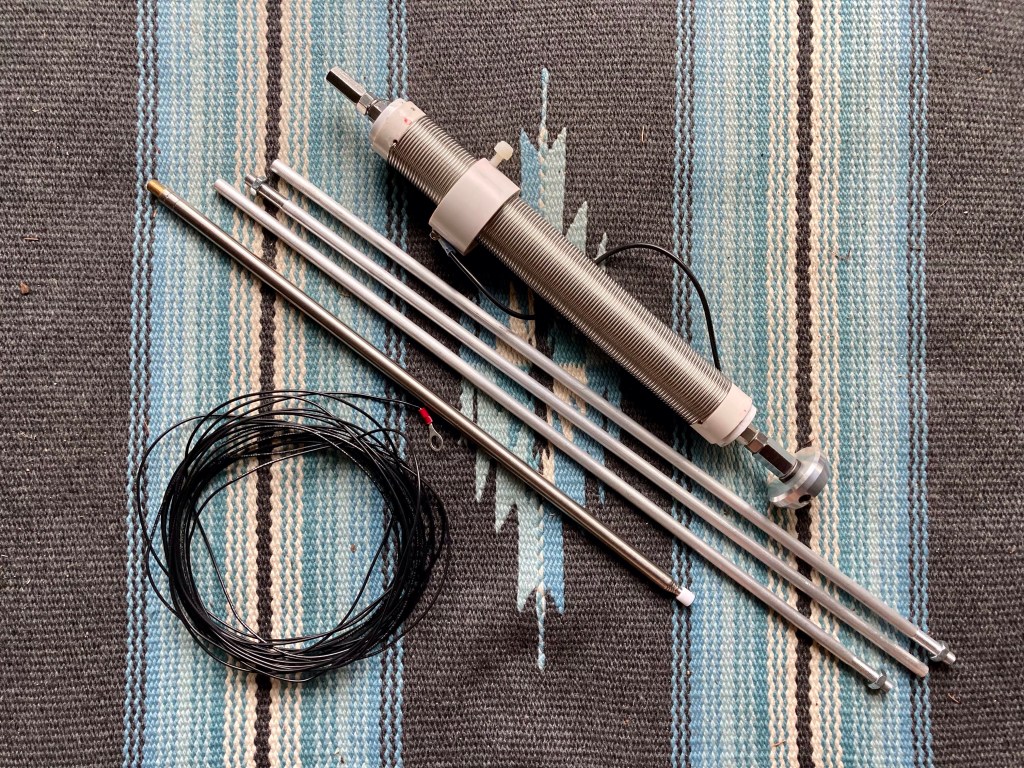
The Wolf River Coils SB1000 TIA, Mega Pod is a self-supporting HF vertical antenna system. The SB1000 is a sliding-contact adjustable coil. This design is immediately familiar to any mobile HF op. In fact many users deploy the Silver Bullet series coils in HF mobile setups and their reviews indicate satisfied customers. Think of a screwdriver coil without the screwdriver. It feeds a stainless 102″ (8.5 foot) whip, and the coil is designed to load that whip from 80-12m. The kit comes with three 35′ wire radials, and the Mega-Pod. The pod is a machined aluminum hub with three 3/8″ tapped holes at 120 degree intervals, and a standard SO-239 to 3/8″ stud mount adapter mounted through the center. Three aluminum rods with threaded ends form the legs, which also act as radial attachment points thanks to the provided lock nuts. It’s a good, reliable design and the use of aluminum in the Mega-Pod helps keep the overall weight down.
Portability and Ease of Operation
Both antenna systems are light, portable, set up and break down easily. The Chameleon has a smaller footprint due to only using one (or zero) radials. The WRC needs a larger area to spread out the radials, which are key to both tuning and performance. The CHA Spike is quicker to set up and less fiddly than the Mega-Pod. The Mega-Pod can be a little springy and while not unstable is not rock solid stable. I don’t think it needs to be overbuilt. The threaded rods and lock nuts let you set the nut at a point before the rod bottoms out, and then tighten the rod against the radial lug. Don’t hesitate to put all three radials on one leg. It will work the same and it’s easier to set up that way. If you really needed it to be easier you could make lugs with extensions terminated in your choice of quick connector and then terminate your radials to match. I think that is overkill. The spirit of the WRC TIA is to have a working setup without a lot of fuss. The TIA Mega-Pod is more of a casual, less “tacti-cool” piece of gear, but it still effective.
With either setup you can be on the air in about 5-10 minutes. The CHA will set up faster, but neither is a chore. It hasn’t escaped my imagination that the CHA Spike is a really nice way to mount the WRC. In fact you could also imagine running the 17′ CHA Whip on the SB1000 and having a 80/40 setup with a better radiator.
Tuning/Matching
The user can get the WRC tuning very close by listening for peak noise on the band of interest. Once the user gets close it can be a bit of a chess match to get it zeroed in. The TIA is easiest to tune if you have an antenna analyzer or other SWR sweep device. I first used this antenna with a Xiegu G90 and the internal SWR sweep/analyzer was a big help. My old MFJ-259 makes it easier still. The key is being able to sweep around the band to determine if your current tuning is low or high. Once you are close it only takes small tweaks to move the resonant point. Without much fuss I was able to tune it on 80m through 12m. You can get it on 10m by shortening the whip, or just using the whip alone.
The tuning reference points in the WRC instructions will get you in the ballpark, but all kinds of external factors can change the amount of loading you will need. Tuning the stock setup with the three radials over average ground is what the instructions are based on. YMMV. As discussed in a previous blog post I consider a base-loaded whip to be in the “tuned circuit” family. The whip isn’t resonant, but the coil is making a resonant circuit for the frequency of interest. The apparent Q of the design is “moderate”. Not razor sharp, not super broad, but it can be touchy once you get the coil contact close to your tuning point. You probably won’t need a common-mode choke, but I always bring one because… RFI Happens.
The MPAS Lite is a whole different concept. It is not designed to show a low SWR on any band. The design assumes you have a matching device between your rig and the Hybrid-Micro. You might get lucky and see a sub-2:1 one one band and it might be fine. I typically see SWR values between 1.5:1 and 5:1 without a tuner. My 991A has a built in tuner and matches it with no complaints. I use a LDG Z817 with my IC705 and that matches it easily as well. With a manual tuner you are back to peaking band noise then fine tuning. My MFJ 901 will tune a watermelon, so it’s no news that it was great with the MPAS.
Radial/Counterpoise
The three 35′ radials supplied with the TIA are both the bare minimum, and also seem to be enough. I tried adding three bundles of three 20′ radials in addition to the supplied ones and it didn’t seem to help much. If I was trying to improve on the system I would try three 20m radials marked off at the 1/4 wave points for each band of interest. Just unroll the radials to the band marker. Of course this means you need over 60′ in each direction on 80m. Tuned radials have the potential to improve the performance of this system. It could be an interesting project. It also might not matter too much.
As for using a counterpoise or radials on the MPAS… one, zero, five, nine? In my experience the performance of these systems is unpredictable in the literal sense. If it gets you on the air it is working as advertised. Counterpoises in an untuned system are a funny business. When the radiator is not a resonant length I think you can do more harm than good trying to run tuned radials. I typically attach the CHA Radial and lay out about 25-35 feet of it in a convenient direction. If you are having tuning issues just change the counterpoise length/config or remove it entirely. Like a 9:1 end-fed the function of the counterpoise is debatable. It also might not have the same function in every deployment.
In a related topic, the MPAS isn’t limited to using the 17′ whip. You can attach whatever radiator you want and it will probably work. I believe the best to approach to sizing a wire radiator is to keep the suggested lengths for 9:1 un-un operation in mind. The transformer ratio might be different, but you still don’t want resonant lengths if band flexibility is on the menu.
Power Handling
Both matching units have loss issues that result in heat buildup. The WRC SB1000 is rated at 100W SSB, 50W CW, and 20W Digital. Similarly the CHA Hybrid-Micro is rated at 100W SSB and 50W continuous. I think a conservative approach to power output is wise here. You can smoke either device if you get too aggressive with the power. On the TIA the coil is trying to load a 102″ CB whip on 80m or 40m. This is a lot to ask and there are plenty of examples available on forums like eHam attesting to either deformation of the coil former, or outright failure when pushing the power ratings. On the Hybrid-Micro I would just assume the match at the feedpoint is bad, and that will make a lossy system worse, and that makes more heat. Heat Bad. I won’t run more than 35w in digital mode on either, and no more than 50w in SSB/CW.
Performance
I will be running a side-by-side test of the two systems soon. For now I will just give my impressions of them based on using them in the field using the same radios under similar conditions. I’ll get the bad news out of the way first: Neither is a fantastic antenna system when compared to almost anything else. Short radiators and lossy base loading are not a recipe for great antenna performance. However these antennas are not marketed as high-performance DX machines. Their calling card is portability and ease of deployment. In that respect they are both very good systems. Perceptions of on-the-air performance will have a lot to do with expectations, operating style, location, and whether making a specific contact at a specific time is essential. I have used both on POTA and POTA-style outings and they both hear much better than they get out. That’s normal. I felt like I was taking advantage of my “always loud somewhere” approach on every contact. I would be unable to work a solid 4-lander from RI (normally a given) but I might be getting 59+ reports from Kansas or Idaho. You will make contacts on either. You will make a mix of stateside and DX contacts. And no, these are not just pricey dummy loads.
The TIA got my initial performance nod based on my preference for tuned circuits over broadband transformers. But the TIA uses a whip that is half the length of the MPAS, giving up some if not all of that advantage. Also, if you run those TIA radials out to full length (recommended) you will need something like a 60-square-foot area to lay it all out in. The design is a little quirky and the user needs to be more involved with those quirks. It’s built out of hardware store parts and stainless wire. That isn’t a knock. Any ham will look at it and know that WRC puts a lot of care into their product and they are getting good value.
If you are intending to do a lot of band-hopping you will be much happier with the MPAS. Hitting “TUNE” and being ready on a new band is certainly seductive. It comes at the cost of additional system losses, but if you are making the contacts you want to make it doesn’t matter too much.
Straight Talk!
Aside from being a snap to set up in the field these antennas are providing regular HF capability to hams who may have given up on running a “real” HF antenna on their property. That’s great and the easy setup, small footprint, and low visibility are big selling factors. A concern I have expressed here and in other places is that there seems to be some confirmation bias among hams who haven’t worked with better antennas. I’ve seen excited reports of working monster Slovenian contest stations with one of these antennas and 10W, and I hate to tell you that is not a measure of *your* antenna’s performance. I’d also point out the fine work of Thomas Witherspoon, K4SWL, on his YouTube channel. He has many great real-time videos of an array of QRP rigs with different portable antenna solutions including the MPAS line. Note that he is almost exclusively calling CQ, hence pre-selecting stations that can hear him. If he was chasing stations with the MPAS he would need to take a very different approach. I don’t mention this as a negative on these antennas or the users. I mention it as a point that might be of help interpreting on-line reviews including this one.
Bugs and Observations
None of these issues are “deal-breaker” serious, but each antenna has some quirks and design issues:
I found that I needed to keep wrenches in my kit for the WRC because the 3/8″ hardware gets stuck together. It was a little annoying and I think a couple of inexpensive adjustable wrenches are a good accessory to keep with the WRC kit. Disassembly might also result in the SO-239 to 3/8 adapter coming loose on the Mega-Pod hub. I have a spare Hustler quick release that I am thinking of using to knock these issues down.
As I mentioned, the WRC Mega-Pod can be a little springy. Some care is required when deploying it, especially making sure you have slack in case of a trip or snag. The WRC whip isn’t going to take too many flops before it needs serious attention.
The MPAS Lite has fewer parts and doesn’t have much to go wrong. Still, I feel like the knob used to secure the counterpoise feels tacked on. It’s has red plastic knob and a small threaded rod which will only grab the eyelet on the CHA Radial by a corner. It doesn’t seem like it will make solid, reliable, electrical contact. It stands out mostly because everything else is so burly. Note: Unlike the SB1000 coil, the CHA Hybrid-Micro is not rated for mobile use.
WRAP
As you can tell I want to review these systems for what they are. They both work as designed to allow quick setup in tight spaces and allow operation across the HF bands. They both use standard 3/8-24 hardware allowing the user to mix, match, modify, and experiment with the provided building blocks. I haven’t touched on cost but the MPAS costs more than twice the tag on the WRC. Value is so subjective that I will just say that both feel like they are priced right. Also, I don’t feel like one is a big performance winner over the other.
If I was looking for an affordable portable setup to use around the campsite, for instance, The WRC TIA is a great option. I’ve covered the setup and tuning procedures. The result is being able to work on many HF bands with no additional tuner needed.
If I had to deploy something as fast as possible, with the least hassle, the winner is the MPAS by a large margin. You will draw very little attention, take up very little space, and get on the air. Even though a transmatch is required it doesn’t seem to be much of a hurdle. I used several matching units, including the MFJ-901, and they all worked just fine. You can also load a long wire, end-fed inverted vee, vertical wire… so the system is more flexible than the WRC.
I hope this post has been helpful. I have enjoyed using these systems, and can see why they maintain their popularity. As long as your expectations aren’t for some miracle system that gets big antenna performance in a small package then you can expect to get a lot of enjoyment out of either.
When I was first licensed in the early 1990’s I traveled a fairly standard ham radio pathway. I bought a Kenwood TH-78a (There were no ‘Fengs) and I already owned a few decent SWL rigs. I had access to all the test equipment I grew up with, and had my dad as a tutor on some electronics concepts. I needed that because I went from Tech to Extra in about 8 months. That also involved learning code. I passed the then-maximum 13wpm, but was able to pass a 20wpm for fun a few months later. The basics of VHF repeater operation and HF SSB/CW are still a large part of my ham radio experience. I also had interests like hiking, camping, road trips, and I liked to build antennas. It wasn’t long before I found out about VHF contesting, and the Rover classification. I worked with another ham, N1QVE, to assemble a rolling station and we did some good work in VHF contests in the 90’s.
I have been in and out of active ham radio operating for about a decade. It wasn’t until 2019 that I started thinking about improving my equipment and getting something better than my attic dipole for HF. I also had one eye on VHF all mode operation. I owned a Ten Tec Scout for HF mobile, and few of the Icom single-band VHF rigs like the IC-202/402/502 for VHF SSB/CW. Then I splurged and bought a “shack-in-a-box” Icom IC706, soon upgraded to the IC706-mkII, and that was my main radio for a few years. I’ve since owned a few of the Yaesu FT-857/817 family, and found them to be great radios. Looking around the catalogs in 2019 there were not many V/U All Mode options. I was running a Xiegu G90 (great rig) but it had no VHF+ capability. I decided on a Yaesu FT-919A and have been very happy with that radio.
2020 ARRL September VHF – Initial Low Drag Rover Concept:
Roadside Stop FN41 – Sept 2020
In the summer of 2020, COVID-fever was at a max and any reason to get outside was a good reason. I used my free time to scout a few hilltop locations and figured I would give the ARRL September VHF Contest a go. The design restrictions were pretty simple:
Single Op setup, so everything had to be riggable by me, alone, quickly, in whatever conditions I dared operate in.
I ruled out operating on the road. I would only operate fixed. My days of running a recorder in the car and reviewing audio logs were well behind me.
No major gear purchases. I only do it for fun, so why shell out for an extra few DB here or there
Keep the rove manageable and fun. No slogging through vast stretches of highway in the dark of night for a possible grid activation.
Have Fun.
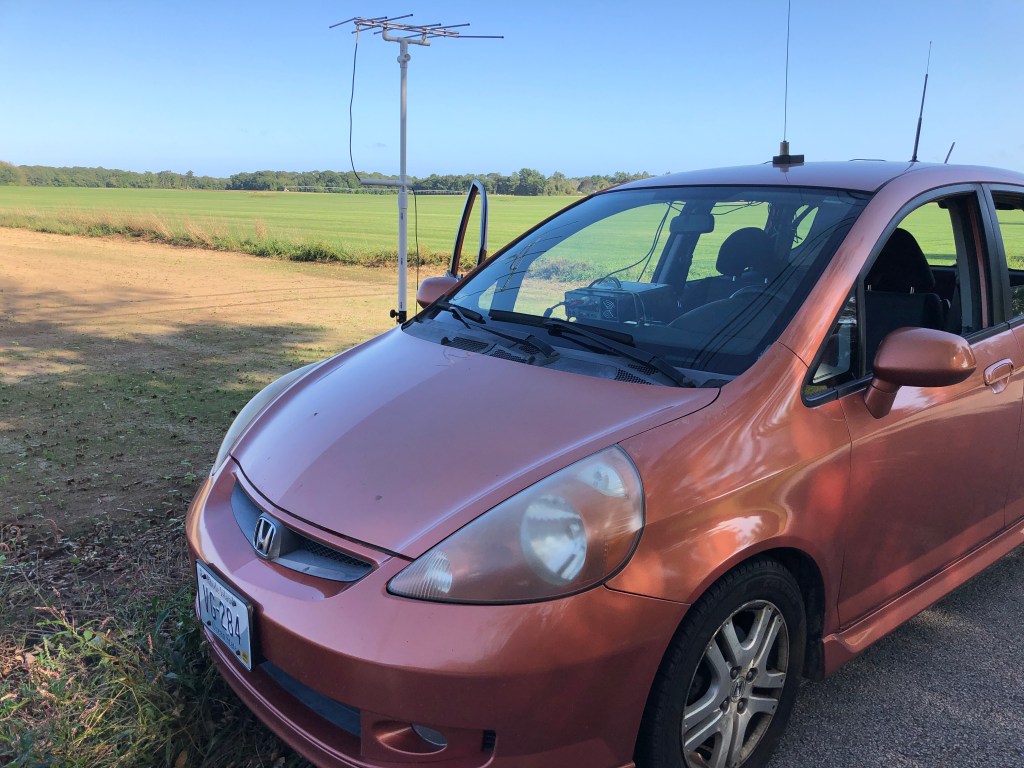
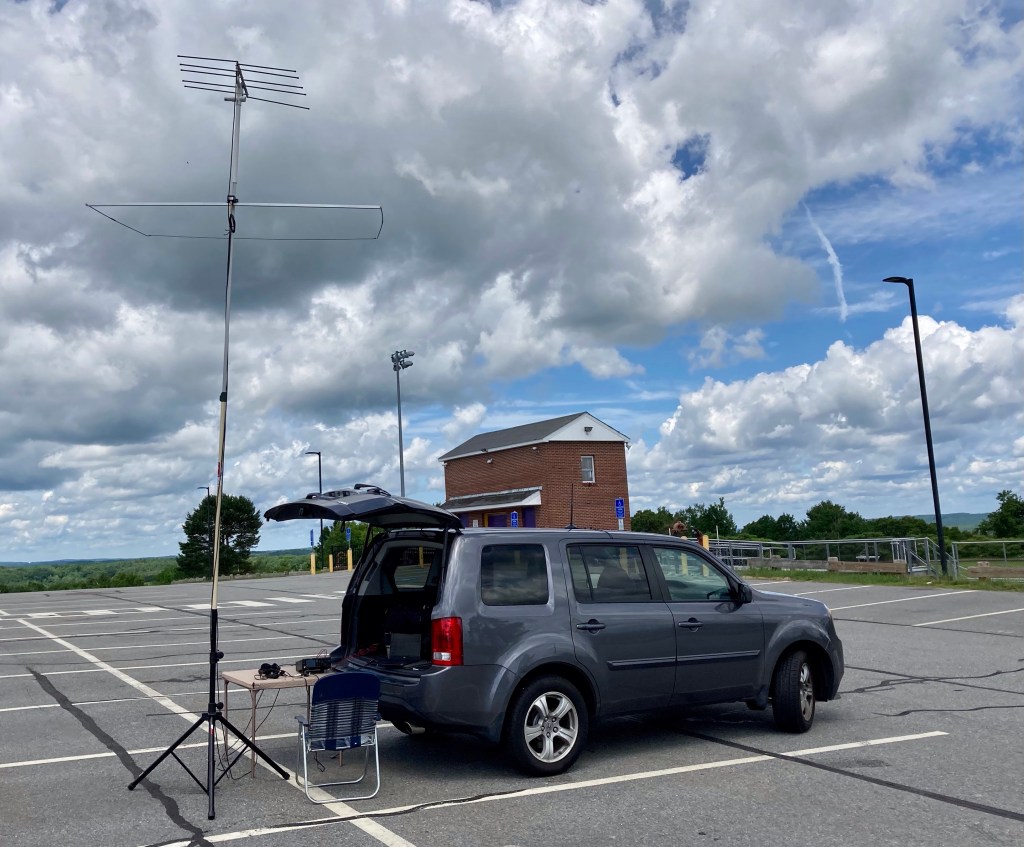
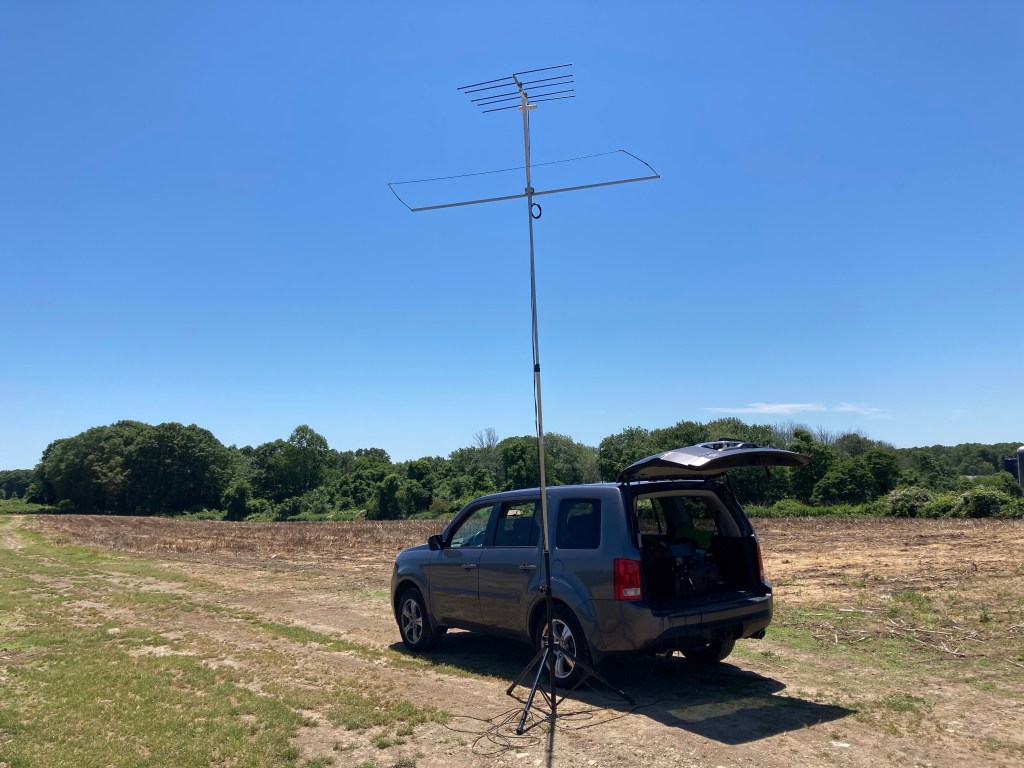
I packed my 991A, my ELK LPDA, and a PVC mast on top of a PA speaker stand, and hit the road. I had a good time and actually racked up a respectable 2,325 points on SSB only, logging by hand, and only having a 5/8-wave 2m whip for 6m. This is how I learned to do it over 20 years ago, so why add more complexity for my first outing?
2021 ARRL June VHF – Lessons Learned
Three-Band Rover FN42 – June 2021
Over the nine months since the September contest I have put together a better portable setup for both POTA-style HF ops as well as VHF hill-topping and contesting. I built a wire Moxon for 6m and tried it out in the January VHF contest (a wind-driven washout), and liked it so much I purchased a PAR SM-50 Stressed Moxon and have been running it for a few months. I also upgraded my homebrew “tesla cell” LiFePO4 battery to a Bioenno 20A unit. As for my antenna rigging, some time in a hardware store with calipers netted me a 12-foot painter’s pole that is a slip fit to the ID of my speaker stand tubing. It also has an aluminum hex shaft which is perfect for the SM-50 mounting clamp.
I am still running RG-8X feedlines, and am not running any preamps, or power amps. This means I am making 50W max on 6m and 25W max on 144/432 with the 991A. It really is enough for the kind of operating I am doing. There is a huge spectrum between “stay home” and mega-rover. Even if the scoring system has no way to identify the details, I know my score came from single-handed barefoot operation with simple and affordable antennas.
I also made the switch to computer logging. While it *almost* violated my “no new gear on contest day” mantra, I picked up N3FJP’s VHF Contest logger and had enough time for a brief dry run before contest weekend. I knew I would have to work out the fine points under contest conditions, but I also brought a pad and pen JIC. I also ran WSJT-X to get me on FT8. I wish I had success with employing the multicast protocol because I missed having GridTracker, but maybe next time. TIP: Let N3FJP handle rig control. I lost mode tracking when I let WSJT-X control the rig.
VHF Digital Lessons/Issues:
I have been lucky enough to operate FT8 during some good 6M Es openings during May and June 2021. My experiences on HF FT8 translated very well. I was able to use the same techniques of moving my transmit frequency, strategic CQ calls, and so on. I expected things to work just as smoothly during the contest. Yes, there is one born every minute.
I had never operated WSJT-X in contest mode before and hadn’t really thought that through prior to the start of the contest. As I set up and started making a few pre-contest trial contacts it hit me that something was different. For one, the QSY on left pane double-click acts differently. As well I was having bad luck when replying to CQs while transmitting in a “clear spot”. I often had to reply on the calling station’s TX frequency. So while the potential for digging out more QSOs by working weaker stations was there, the reality was not so simple. I could have worked SSB stations much quicker, and “run the bands” much easier… if so many stations weren’t ditching SSB for FT8!
N1QDQ/R in FN32
I put in a fair amount of time, at least 25%, working non-digital modes. There were times when I was making good contacts, and others where the CW/SSB was dead and FT8 was the only thing where a contact was possible. I was able to work W1AW and W1AN on 6M CW from Mowhawk Mtn. That was pretty cool. As much as I enjoy digital modes I do think the CW/SSB action is more enjoyable.
Route Decisions:
I decided to activate FN41,42,31,32 this year. The 1800Z start time for Saturday of the contest is a real style-cramper. I get it, but really? For a rover it leaves about seven total hours of daylight on Day 1. With many parks closing at sunset the decision to move locations cuts into a lot of operating time. My memories of driving through the night and only making a few new contacts, while hearing the same big-gun stations made the decision simple: Start on time, wrap it up at dark, get home, get some sleep, and put in a good shift in FN41 on Sunday.
Now that I live in coastal Rhode Island it makes the route-logistics a little more complicated. I started the contest in FN42 at a hilltop in Charlton, MA. That spot is great but they are all only as good as conditions (foreshadowing) allow. If I had just stayed there until dark I would have had a better overall contact/points total, but I was up for a drive and wanted to try a new spot for FN32.
After many different ops operating from hilltops in the NW Connecticut and Western MA area (FN31,32) it is hard to break that habit. They are good locations, but not perfect. That spot was the parking lot at Haystack Mountain in Norfolk, CT. It’s got a lot of trees blocking the RF/View, and the entire northern half of the azimuth is blocked by a mountain, but it isn’t terrible. Not great either. You get about 100 degrees of actual azimuth to play with from maybe 120-240 degrees.. Next was Mowhawk Mountain in Cornwall, CT. Mowhawk is a great location, but there is a lot of RF equipment up there and noise/intermod levels can by nasty. Bring your bandpass filters! Neither location “popped” but I did activate the grids and get a few new worked grids in the log. All in all not worth the drive (points-wise), but on this beautiful June day the drive was spectacular.
Sunset at Mohawk Mtn, FN31
I had a nice time operating on Sunday from FN41. A local high-ish spot at a local farm field gave me plenty of elbow room and a safe off the road location to operate from. The RF conditions were not super. Normally I’d be ok with hearing some distant grids but not being able to work them. I wasn’t even hearing that! It was a grind. I did manage to get some good runs on 6m and 2m, add a few worked-grids, and even snag some DX with a VP8 and an EA7. What we had here in the northeastern US was a nice opening to Europe! Even then I wasn’t hearing too many Europeans. It was just a soft day on the bands. After about 5 hours I worked a nice run of locals on 2M FT8 and called it a day.
N1QDQ/R in FN41
QRT:
It wasn’t a terrible contest. For the type of operation I describe here it was a success. It looks like I tallied just north of 3,500pts, activated four grids, and put on about 300mi. Those are Southern New England Miles. It’s like dog years compared to other parts of the US. I think it’s fair to say conditions for this contest didn’t favor my low power setup. I was counting on a strong opening to the mid-west or southeast and it never materialized. Fun was had. I’m looking forward to the next one.
Takeaways:
Rovering is a great way to wring out your mobile/portable setups. I feel like my POTA setup got better, and I have a few ideas for improvements.
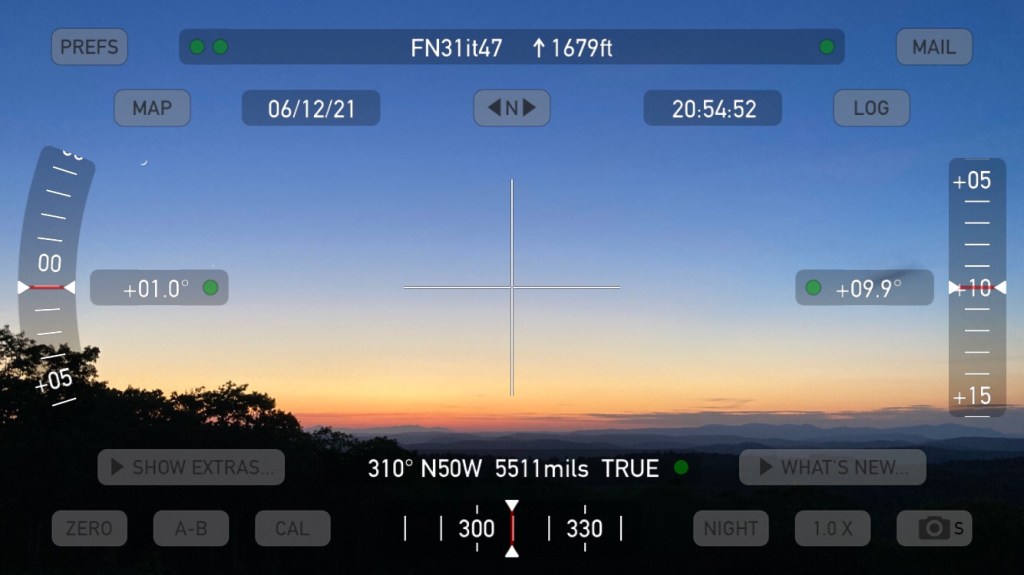
Something was very odd with beam headings. I felt like I was way off heading on a few contacts where I set the beam heading by ear.
Also, setting the beam heading on FT8 while armstrong-ing the mast with one hand and reading the screen and running a mouse is not easy. Ideally I would watch the waterfall and try to peak a station visually. Easier said than done.
I ran my 20A LiFePO4 DEEP into the cycle and it held up beautifully. I have a Bioenno 1503CAR for charging on the go. It helps to recover charge but won’t fully recover the charge on a short drive. The way to go is probably switching between 2x20Ah, or just a 50Ah cell.
It’s a fun way to get out and play on the high bands. Give it a shot even if all you have is a FM rig and a small beam. If nothing else use an all mode receiver (SDR is a great way to go) and monitor the high bands during a contest. It’s a good way to hear HF-band levels of activity on VHF+ and you might get motivated to join in.
The current explosion of HF weak signal mode users, coalescing primarily around FT8/FT4, has caused a bit of a rift in the ham community. I don’t think the rift is that big, but the rifters are pretty vocal in telling other hams how much they don’t belong on the air.
I intended to formulate a Pro/Con list, but I don’t want this to be a contest (or con-test). I also don’t want to explore the negatives. Plenty of people are doing that 24/7 and somehow seem to enjoy (?) it. This is a list of things that make each type of communication interesting and unique (for me). I’d rather look at it that way because that is how I feel about it. I want to enjoy all that ham radio has to offer. That requires being open to what is positive about every opportunity.
So here’s what I find attractive about FT8-style* operation:
The Analog Internet Nexus. In conjunction with PSKReporter, RBN, and tools like GridTracker, it provides a near-real-time propagation indicator. I can set up for a few CQs, check PSKReporter, and see where I am being heard, with my relative S/N. Along with showing me where I might expect a reply, it gives me an idea of the difference between what I am hearing and who might be hearing me.
Instant and visual split operation.WSJT-X makes setting split very easy, but only if you use the waterfall display. (I believe many users don’t, causing that crowding between 1300-1800hz). Shift-Click to position your transmit frequency in a different spot, and get out of the pileup of stations calling on the CQing station’s transmit frequency. Since WSJT-X decodes the entire bandpass, you can test this at will. 10 minutes with the WSJT-X manual will improve the experience 100x.
Constant Global Activity. It’s pretty shocking, actually. Day after day if I just looked at the CW or Phone sections of the HF bands they may look dead, or occupied mostly by big signals. Often there is a big hump on say 20m at 14.074MHz. In my experience it is unprecedented to have this type of activity acting as a global beacon. These digital segments are in use at all hours of the day and when the band opens those ops will be there.
Built for Low Power Ops. Being able to work down to -24dB is a great equalizer for lower power stations on less-than-spectacular antennas. I see all kinds of amazed reactions from mostly newer hams on QRP-focused boards like the Icom IC705 FB group, and I can only imagine how amazed they will be when actual good band conditions start arriving. I’ve worked 10,000km on 10W into a basic vertical antenna on FT8, during conditions like SF=75, SSN=15! No solar tailwind there. For reasons I will get into somewhere else, a non-directional antenna is really only sending a tiny slice of its output toward the other station. Being able to work deep into the noise floor makes the most of that tiny slice.
Perfect for casual operating. Letting WSJT-X decode while I am making dinner, or doing other chores, lets me come back and see what stations are in play at my station, on my gear, at what strength. I can take 15 minutes, scan the waterfall, and either chase a few stations or find a spot to call CQ. Obviously I can also do this for hours, but if I only have small gaps to focus on the radio I can still make contacts this way.
Good operating practices are rewarded. Far from being a “robot mode” FT8 gives the operator a lot of information if they are willing to look for it. It allows you to scan for momentary openings, dig out weaker signals, find opportunities to use split, and otherwise be creative with the information presented by the waterfall and the decode window. I recently made a few contacts to JA from Rhode Island with stations that showed up for less than 5 minutes, and then faded out. Tools like GridTracker and JTAlert let you watch for those stations in real time. I’ve come close to working deep into northern Canada (VE8) in this same manner. I’ve also seen the big Saudi or Kenyan stations about 20 times and never made the contact. Surfing the waves of fading/swelling conditions is a technique I learned on CW over 25 years ago.
*FT8-style means computer-assisted digital modes, like RTTY, even. 2FSK is still FSK, folks. Get over yourselves.
OK, that was a rollercoaster of unbridled optimism. I’ll now make similar points for analog modes:
The experience of listening to radio is one of life’s great joys. The key word is listening. I like quality in a QSO. Rarity and quantity have never been my game. I enjoy finding and working DX, but have never applied for or sought any awards. Listening to a quiet band for a weak but copyable signal (usually CW) just above the noise, replying to a CQ, and having a QSO (no matter how short or perfunctory) is a real pleasure. I’m not too hung up on where that other station is.
The Social Component. I have worked plenty of stations, mostly SSB, where the QSO is call, report, name, QTH, and 73. Nothing wrong with that. It’s not much more of a proof of concept than a FT8 contact, but you are making verbal/code contact. Neat. Occasionally though I end up in a real rag chew, with a personable operator, and it is a great experience. I have to make sure I am in no hurry, because I have had a few that ran for a long time. That is ham radio delivering on what I would call the classic roots: Two or more operators having a chat. Lovely.
A true leisure activity. My process of slowly scanning a section of a band, giving even the weakest signal a chance, tweaking my rig’s controls in an attempt to pull that signal out of the noise… it takes time. I might make one contact in an hour. I might make none. I have done some salmon fishing, and it is similar. My salmon fishing mantra is “it’s fishing, not shopping”. If you don’t enjoy the process of fishing you will be having a lot of bad days. If you have a catch, that’s great, but you are still fishing.
Skill Development. The skills necessary to operate successfully on the ham bands are still best, IMO, cultivated with analog operation. Just the habits of ensuring your frequency is clear, or listening to and identifying neighboring stations, or learning the band plan and using it… they pay off whether you are talking to someone on 2M simplex 500 yards away, or making an APRS contact through the ISS, or bouncing a signal off the moon. It might be analogous to driving stick shift. I think you get a better learning experience when you engage the fundamentals as completely as possible.
So that’s a quick, stream of thought run through of how I see the allure of both “new school” and “old school” ham radio. It’s all out there to be done, and it’s all good. I hope to see or hear you on the bands. Pete N1QDQ

















 petebrunelli