Category: yaesu

  • How I learned to stop worrying and love the ICOM IC-9700 – Part 2

    How I learned to stop worrying and love the ICOM IC-9700 – Part 2

    Much like my interest in radio I’ve been playing musical instruments almost my entire life. We just used to be somewhat obsessed over the guitars, keyboards, amplifiers and eventually software that we saw on stage (on air) and in magazines. Eventually that got its own acronym G.A.S. for Gear Acquisition Syndrome. What I learned from years of horse-trading equipment via selling, buying, swapping, upgrading, downgrading… is that at some point I was very happy with my equipment and changing it around was a distraction. I play electric bass and usually am playing one of the four basses I own to the exclusion of the others. It might be a holdover from the many years when I had one bass, one amp, and not much else. Honestly I am a relentless pragmatist and mostly look for a piece of gear with certain capabilities. There have been… exceptions. Nuff Said.

    It has become the same thing with ham radio equipment. I moved around between many different radios and antennas in my first 10 years of ham radio operating. Mostly it was a need for a specific capability, like UHF all mode, or QRP HF with great CW chops. It was messy, and most of that gear is gone, but I learned a lot about what I do and do not like. I do still buy and sell things, but in the main I use the same gear for a long time. Time in the hobby helps you think “into the future” a bit and you can identify gear that will be junk soon, is junk now, is highly functional junk (heck yeah), or is the real deal. Spending time at hamfests is like a crash course. When I was an organizer for a small hamfest in Connecticut I was perusing somegrar at a table and one of the club “Elmers” buttonholed me and said “That rig was junk when it was new, and it hasn’t gotten any better. Talk to me later, but don’t buy it!” And we lear to sepeate the good from the bad (for our particular needs). There are radios that have very long useful lifespans (The FT-817/818, for example. The cockroach of the ham radio world.) and others that either have not or probably won’t.

    Warning: The G.A.S. Monster is devious and does not sleep! Even as I started devoting more and more time to satellite operation I had resisted selling my FT-991A. It is a great radio. The ICOM IC-9700 is the only in-production V/U all mode with full duplex capability. That’s rare. There is usually competition in any given product segment. QRP radios, HTs, 100W entry level, Contest-focused rigs, HF linear amplifiers… There are choices. Not so in satellite ground station equipment. As I said in the last post, “One rig. That’s the list”. Meanwhile I am using my FT-817/IC-705 portable rig with a handheld antenna for all my sat work except for simplex digipeaters like Greencube/IO-117. I don’t know if I will ever put up a computer controlled alt-az antenna mount, preamps, etc… but I am interested in the capability. It was only a matter of time until I would decide to cut bait and obtain an IC-9700. May 2023 was that time.

    After a short flurry of sales activity on QRZ.com I had moved my Yaesu FT-991A and backup FT-817ND on to new loving homes, and had squirreled enough cash to blunt the not insignificant cash crater the purchase of a new IC-9700 would create. It’s the only game in town. There are no sales, incentives, or promotions worth mentioning. You want it, they have it, and if you don’t buy it someone else will. That, friends, is Scarcity Economics in action. So on to my preferred enablers at DX Engineering I went and plunked down the plastic for a IC-9700, a headset adapter, and the Icom/Electret variant of the dynamic-mic Heil Sound Proset 6 that I use on my portable rig (FT-817 is my uplink rig). The Pro-7 would give me better isolation, but I will take a lighter headset with some bleed when operating out in public. I can hear someone walking by or asking a question. That’s not a bad thing.

    It arrived quickly since DX Engineering is the king of getting the gear to your doorstep, pronto. First reaction: It’s a beautiful radio! I already had most of the power cabling I needed, along with N-Connector adapters, and it didn’t take me long to connect it to a dummy load and run through some menus. As I expected I felt right at home in the menu system. It is very similar to the IC-705. I also quickly noticed that the front panel is a bit cramped. Most modern radios have the same issue but I was thinking about using this radio outdoors, portable, and hitting the wrong control is something that just happens (foreshadowing).

    Some of the questions I had about operating this radio would only be answered through use. I have picked the brains of some very helpful satellite operators, and scoured the web for videos, but nothing gave me a clear idea of how this thing worked in comparison to my FT-817/IC-705 satellite rig. I am fully manual with that setup, tuning the uplink rig (817) and the downlink rig (705) separately. The waterfall display on the 705 makes finding myself on the downlink easy with little need for a cheat sheet. I know the transponder ranges and centers, and get within a few KHz right away. QSY is as easy as tuning the RX, having an idea of how far away I moved, then adjusting the TX the same amount (in reverse on a sat like RS-44. RX up 3, TX down 3…).

    The IC-9700 is different. It has a dual-VFO split mode and you can A/B between the two VFOs with dedicated touch screen buttons, using the main tuning knob to adjust each VFO one at a time. There is no sub-VFO control. There is RIT, but I am still not a fan of RIT for satellite work. My OCD tells me to just tune it correctly. I also won’t forget my RIT setting is on and waste time trying to figure out why I am out of band! That is similar to running two radios, but you only have one VFO knob.

    Then there is SAT mode. I figured this would be the “killer app” for tracking frequency on sats. You can activate either VFO, and there is a NOR (normal)/REV (reverse) button between the VFO buttons on the touch display. Sweet! (Reverse is where the input of the transponder and the output are reversed. The bottom of the uplink puts you on the top of the downlink, and as you tune the uplink higher your signal on the downlink tracks lower, and v-v)
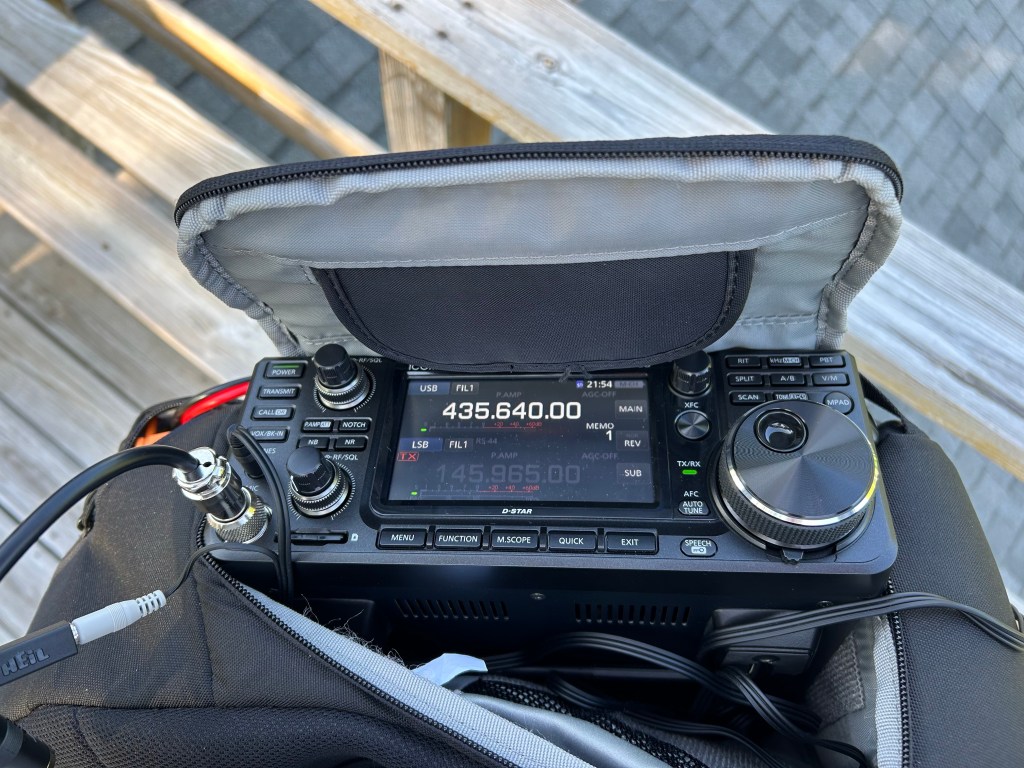
    IC-9700 in a modified LowePro sling bag
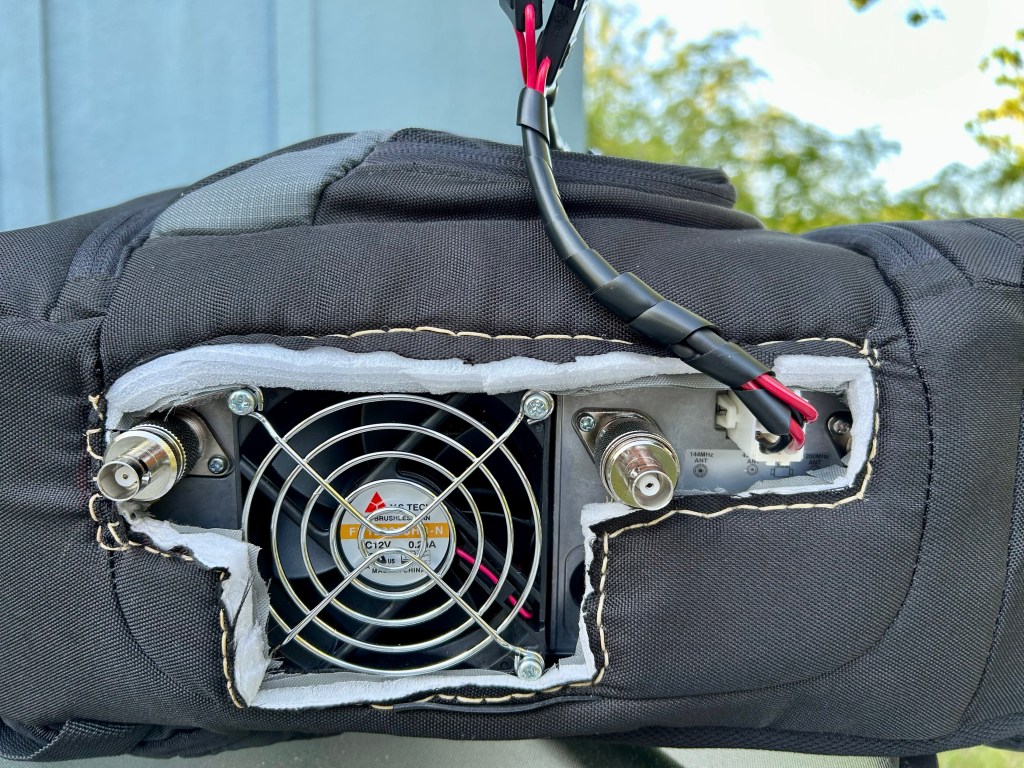
    Rear Panel Access

    I still use a handheld Arrow II antenna so operating sitting down is not a great option. Much like I did with my camera bag holster for the 817/705 rig I turned a LowePro sling bag that I had bought for a full-sized DSLR kit (and the bag was not great for that) and carved it up to allow me to wear the IC-9700. A Speedy-Stitcher made it easy to neaten up the cutouts I made for the rear connector access. I had to punch a hole through the side of the top compartment to snake the power lead out to the radio. Done. It worked and the rig only feels heavy, not unbearable. I hooked it up and went out to try a RS-44 pass. That’s a bird I am very comfortable on.

    I put the radio into SAT mode, set the VFOs, and off I went.
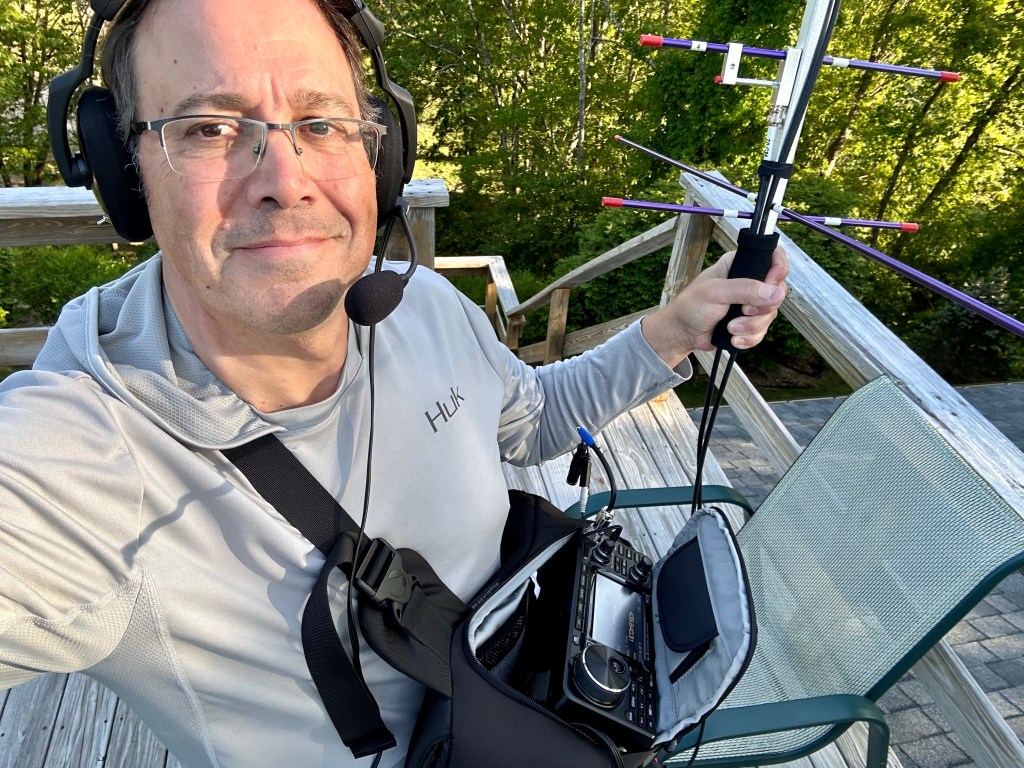
    Me and my Arrow

    Let’s just say it did not go well. I’m going to bullet list the things I tripped over because I think it will make it easier to convey:

    • Seeing the display in sunlight is very difficult. I will need t make a shade to use this reliably in this configuration.
    • Changing between VFOs is not as intuitive as I expected, and not hitting the NOR/REV pad by mistake is even harder.
    • If you press on one of the frequency displays the frequency is highlighted making it easier to see, but that does not select the VFO for tuning.
    • If you use the VFO Select pads you can select the correct VFO, but it doesn’t highlight the associated VFO display. There is also that NOR/REV button waiting for you to step on it like Sideshow Bob on a rake. So switching VFOs and being able to see the display in daylight is a two-press and check the status of the NOR/REV before proceeding. Every time.
    • Then there is VFO synchronization where neither VFO is selected and NOR/REV tells the rig how to sync the VFOs. Yes, it works. But as you QSY the tracking isn’t great and once you have the RX on frequency you now have to retune the TX VFO (or v-v) to get yourself back on frequency. So it works, but not well enough to just retune and hit the PTT.

    Admittedly I made it hard on myself by not doing more than a quick dry run before trying to make contacts with this radio. But I hope I am making the point that while the radio is a fantastic performer it seems more at home in a shack than hung around my neck. At the very least it will take practice to get to the point where manual operation is as intuitive as a dual-rig setup.

    My next mission was to get active on Greencube/IO-117. This turned out to be much more straightforward. Because the IC-9700 presents two virtual COM ports over USB I was able to run CI-V control on one and trigger PTT with the other. I use SATPC32ISS for the CI-V (CAT) control, and UZ7HO Soundmodem controls the PTT by directly addressing the higher-numbered of the two ports. I was able to get rid of the VSPE Virtual Port Splitter app I was using, and SATPC32ISS instead of HRD/HRD Satellite. That’s three open apps as compared to five which is a better place to be in the field when things inevitably go wrong.

    Greencube Portable Setup

    It was as easy as the previous attempt was difficult. Using the same 70cm WIMO X-Quad I used with the 991A I was hitting IO-117 easily at 25w and made a few contacts immediately. Then “Greencube Hell” broke out and I wasn’t able to break in over the big signals is Europe and Russia. But it wasn’t due to a problem on my end. SUCCESS!

    After a few tries I was able to make SSB and FM LEO contacts with the IC-9700 in my portable setup. I was still getting tripped up a bit, but having the sats in memory banks and being able to switch between them that easily is very cool. I am still occasionally hitting NOR/REV by mistake and my next step is to just run it in dual-VFO Split Mode and see if that is easier. I think it will be.

    The performance of this radio is superb. Compared to the Yaesu FT-991A the receive sounds more sensitive and cleaner on weak signals. The 991A has a very good receiver, but there is something more “contrasty” about the RX on the 9700. The TX audio is levels above the TX audio on my FT-817ND. It is much punchier and clearer. You can pretty much tell a 9700 on the birds once you have used one. That is not a small detail when trying to make difficult contacts. Neither is the ability to dial up a few more watts when needed.

    One last thing before I close this and start thinking about Part 3:

    Even though the IC-9700 looks very much like the IC-7300 and IC-705 it is an older design and does not have features like Bluetooth Audio that I use all the time on the IC-705. Even if it was available I wouldn’t be surprised if it was left out to have one less RF source causing problems inside the IC-9700 chassis. It doesn’t feel as “fresh” as the IC-705 but maybe that is because I have a few years of 705 operation to rely on.

    Nobody has ever said the IC-9700 is a “field radio”. It is meant for the shack and if you take it into the wild there will be compromises. Little buttons, crowded display, not designed for cold fingers or no-look operation… But once it hooks up on a satellite it doesn’t matter. If we have only one choice in this category I am glad it is the IC-9700.

    Here’s the deal on not having the Yaesu FT-991A in my shack. I could easily see myself owning one again. It is a lot of radio for the dollar, epecially at the prices on the used market. As I have said on this blog, many people complain about the menus but how much time do you spend in the menus? The quick access menu takes care of day to day adjustments. I only had to go into the full menu to make major changes for data modes or filter ranges. The actual radio (not the feature set, the radio) is brilliant. It is a standout 100W HF rig with a great receiver, great on 6M, and the V/U performance is very usable. It isn’t a V/U thoroughbred like the 9700, but for most weak signal operation it is very good. I don’t work a lot of QRO HF, especially since getting set up for satellites, but I will miss a 100W HF rig at some point. The bigger miss is 6M. I like working 6M and this is a bad time of year to be without a 6M radio. My plan is to pick up a Yaesu FT-891 eventually and fill that void and have a portable QRO HF option.. Until then 10W on the IC-705 has been a good HF setup for me since I bought it, and it is still a great choice.

    More soon. Lots to learn about the 9700.
  • How I learned to stop worrying and love the ICOM IC-9700 – Part 1

    How I learned to stop worrying and love the ICOM IC-9700 – Part 1

    The Inevitable Happened…

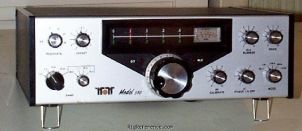
    2023 marks 30 years of being a licensed ham and over that time I have owned a range of brands and types of radios, built QRP kits, built antennas… the usual stuff. I started out with a Ten Tec Triton IV, dial cord tuning, and that was a great rig. Excellent receiver, excellent QSK, great company. I ran a TT Scout for mobile HF and that was a fun radio. I liked the simplicity and the analog performance of those radios and can say I started off in ham radio as a “Ten Tec Guy”.

    Ten Tec 540 Triton IV w/ Analog Tuning

    But… I also have a “early adopter” streak, so I also bought an original Icom IC-706, then traded up to a MKII G when it came out. It was like buying a rig from the future! It may have been because the MKIIG is still a very good radio over 25 years later! Icom was ahead of the pack with the size and the feature set. The bleeding edge can be a good corner to hang out on.

    Later on my VHF Rover activities gave me a chance to use various Kenwood, Icom and Yaesu radios. They all had pros and cons. They all made plenty of contacts. Over the years I have owned a few of each, but on balance you could call me a “Yaesu Guy”. Yaesu vs Icom reminds me of Nikon vs Canon cameras. Yaesu is more like a Nikon, making great performing gear but holding on to a set of features and specs well past their due date. Icom is to me an equivalent to Canon. Canon always felt a little more flashy, more modern and easier to use, and Nikon was more old-school tried and true. Maybe Ten Tec was my Olympus, because I was a Olympus guy, who eventually became a Nikon guy, who became an Olympus guy again. It’s complicated! Like this analogy.

    A few years ago, after a bit of a layoff from ham radio, I had almost no gear left, and some accessories and a few HTs were all I had in my “shack”. I bought a Xiegu G-90 which is a very good radio, and a lot of fun, and it got me back on the air and active again. I also purchased a Yaesu FT-817ND because I have owned several before and I feel kinda “naked” without one. When I decided to get a 100W HF rig a few years back I realized that I needed VHF/UHF as well and the Yaesu FT-991A was the obvious choice. It covered VHF and UHF with some power, has a great receiver, and it has built in audio and and CAT over USB. After buying it I felt like I might have underestimated it. It is a better rig than I expected it to be. I have made loads of contacts with it. It is a 3-band VHF Rover rig, out of the box. I worked SSB, CW, RTTY, FT8, and other digimodes with ease. It’s also an excellent general coverage receiver and I did a lot of SWL with it.

    But a funny thing happened when Icom came out with the IC-705. The early adopter in me was back in charge. I bought one soon after it was released and I have been blown away by that radio. It has done everything the 991A has done, and more, with the trade off of less power against less weight. I used it for POTA, travel operation, mobile use, and then as half of my portable LEO satellite station. The 705 has been my downlink rig since I started satellite operation, and it is a joy to operate in that role.

    Icom IC-705

    You can see where this is going. Right now Yaesu is making a great line of HF radios, with several new models over the past five years, but the 991A is their only V/U All Mode, and there are no indications of anything new coming any time soon. The 991A is similar to the FT-817/818 in that it is an older design and the clock is ticking. Just this year Yaesu killed off the 817/817 line and Yaesu has not indicated that it will replace that radio. Meanwhile, the IC-705 showed me a better interface, better menus, and in many ways better performance in a very compact package. Certainly it is more convenient than the 991A and a technological leap beyond the Yaesu FT-817/818.

    In fact, I like the 705 so much that the 991A started to look like it might need a new owner. Between satellite operation and QRP the 991A wasn’t getting as much use. I never worried about the performance. It performs very well. Even the menu system isn’t that bad. It just isn’t great. And while it is a very good option for satellites like Greencube/IO-117 it isn’t full duplex and there is only one full duplex VHF/UHF All Mode currently in production, and it’s the Yaesu IC-9700. It might seem cliché for a sat op to run one but if you want the best satellite rig you can buy new the list is one rig long.

    So it happened… I sold both a backup Yaesu FT-817ND and the FT-991A and am now yet another sat op with a IC-9700! I have some immediate reactions from the first few days of ownership and I will cover them in the next post. Spoiler: Both the 991A and the 9700 are very good radios. They are also very different radios. And that’s a good thing.

  • Greencube and You (meaning me)

    Greencube and You (meaning me)

    One thing that long-time satellite ops will tell you is they worked birds that are long out of service, and they had some amazing capabilities. While we can’t bring them back we can try to take full advantage of the sats we have while we have them. Here in the northeastern USA we don’t have many nearby DXCCs. FO-29 and RS-44 are reliable LEOs that put some of Europe in a common footprint with my station, but the limitations are clear. I just don’t have access to many DXCCs from FN41. When I started my path toward working satellites in early 2022 I realized we didn’t have a Mid-Earth Orbit (MEO) or Geostationary (GEO) like QO-100 accessible to North America. So in early 2023, when I heard we might have a MEO bird available to hams, I was very interested.

    The newest and highly popular kid on the block is Greencube, aka IO-117, a Mid-Earth Orbit (MEO) satellite with a 435MHz digipeater on board. This is good news because the footprint is huge, allowing access to grids you won’t get on RS-44 or FO-29, as well as Zones and DXCC Entities you won’t get any other way. I am still not in a great spot for those European DXCCs, but I have worked plenty of them now, along with stations in Africa, Japan and China, so it’s working well enough.

    One good thing about IO-117 is you do not need a full-duplex radio to communicate with it. It’s a simplex digipeater much like the ARISS FM APRS digipeater. You do need some way to track uplink and downlink doppler independently and this is typically done in split mode. My Yaesu FT-991A is a very good choice for this application. It can put out 50W max on 435Mhz and split mode is no problem as it is a dual-VFO radio.

    THE BIG DISCLAIMER: None of the other tutorial pages for this kind of thing worked for me as written. Mine will probably not work for you as written. You will need to know how to configure audio and CAT devices. Your base frequency for doppler correction might be different. Your CAT software might handle doppler correction differently… You should be familiar with the software packages you are using. Be ready to crack a manual. That sort of thing.

    Here’s a blow by blow of how I got my Yaesu FT-991A to play nice with the software needed to access IO-117.

    The Elements of my IO-117 Station:

    • Yaesu FT-991A
    • Windows Laptop
    • USB Cable w Ferrite Chokes
    • Ham Radio Deluxe software
    • UZ7HO Software Modem for Greencube
    • UZ7HO CAT.dll file in directory with Soundmodem
    • OZ9AAR Greencube Termimal
    • Eterlogic Virtual Serial Ports Emulator

    The challenge for me is to get my computer to track the uplink and downlink doppler corrections over CAT, while also allowing UZ7HO Soundmodem to access the PTT over that same same CAT port. The VSPE software takes care of that.

    What you will definitely need is a good IO-117 entry for your Doppler.sqf file, or a good base frequency for doppler correction. That will tell the software what kind of correction to make and what the rig is expecting. Check HF5L’s FT991 tutorial for more info, but this entry is a good starting point:

    IO-117,435308.7,435308.7,DATA-USB,DATA-USB,NOR,0,0

    My base frequency is around 435.308.7Mhz. You want to adjust this base frequency until the IO-117 downlink signal is centered at 1500Hz in the Soundmodem waterfall. It doesn’t have to be exact, but it has to be close.

    In order, my startup routine is:

    • 991A connected and Ports noted in Device Manager
    • 991A in Split Mode
    • Set up VSPE as Splitter
      • Yaesu Standard COM Port to an Unused Virtual COM Port Number
    • Open HRD
    • Connect to Virtual Port
    • Open HRD Satellite Module
    • Select IO-117 pass in HRD Satellite
    • Open Radio Control, Check Both RX and TX
    • Open Soundmodem
    • Open GC Terminal
    • Open GC Telemetry (be sure to check TCP Client box)

    Here’s the VSPE setup. The VSPE Device you want is a Splitter:

    My Yaesu Standard COM Port is COM6, and I am choosing COM20 as the Virtual Port. All your apps will now address COM20 with no sharing issues. TIP: Once your configuration works use the SAVE function and put the config file in with your other Greencube stuff. When you start a session just OPEN the saved config file, and Bob, as they say, is your uncle.

    At this point the radio should be tracking Doppler shift in both VFOs. Remember that the RX Freq is Plus Doppler Correction and the TX is Freq Minus Doppler Correction. Once the satellite passes the point where the shift is Zero, the sign of the Doppler shift correction changes to negative so you will see RX decreasing and TX increasing. That’s normal.

    The Soundmodem and Terminal setup can be a challenge if you aren’t familiar with these packages. I’m not doing a UZ7HO guide, but the communications part goes something like this:

    • Open UZ7HO for Greencube
    • Make sure you have the Audio Ports set correctly
    • Set CAT to Virtual COM port, Select rig, baud, RTS/DTS…
    • Once you have audio and have confirmed PTT operation…
    • Open Greencube Terminal

    I don’t have a al-az rotator for my antenna so I manually point it at the sat. That’s not a big deal because you don’t have to be too fine, and the apparent motion of the satellite is not too fast. I make maybe seven or eight corrections over the course of 45-60 minutes. Yes, a typical pass lasts an hour or more. Welcome to MEO. It isn’t like frantically chasing CAS-10 across the sky!

    I’ll go into the antenna side in a bit, but if you are pointing anywhere near the bird you should hear packets and see something on the Soundmodem waterfall. You want to see the GC downlink signal centered arond 1500hz and the decode “bar” in the waterfall set the same way. You can change your reference frequency in HRD Satellite and see the change in real time. I wouldn’t lean too hard on moving the deode bar or picking a different center frequency. These settings might get you some downlink decodes, but it will mess up your uplink frequency.

    At this point you are ready make contacts. There is more on this below, but my advice is to be patient. There are many stations transmitting packets at the satellite. Just try to transmit between downlink transmissions and you will get digipeated eventually. There is a pattern and you will get the hang of it pretty quickly.

    Helpful Links:

    Greencube Observer – Put in your grid and see which stations are in your possible footprint

    FG8OJ Greencube Setup – A comprehensive page about IO-117 from Bert FG8OJ, one of the early GC ops

    UZ7HO Main Page – You will get a security warning, it’s not HTTPS, but you want greentnc.zip and ptt-dll.zip

    OZ9AAR Greencube Terminal – The Cadillac of GC Terminals. Use this one. You won’t be sorry.

    DK3WN Telemetry Software – A telemetry decoder application. Useful!

    Antenna Chat:

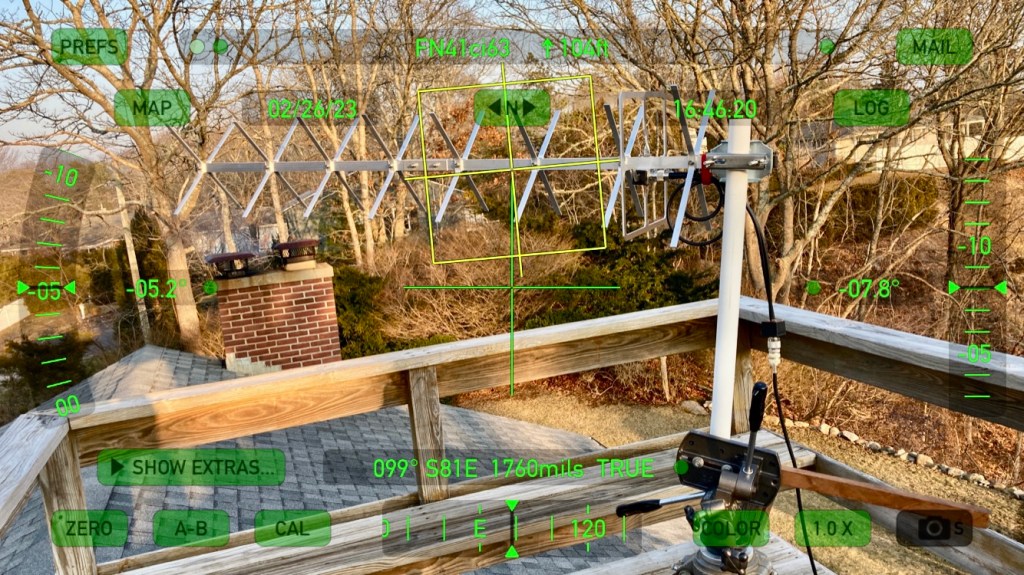
    I’m using a 70cm Wimo X-Quad on a heavy Gitzo photo tripod. It isn’t fancy, and it isn’t automated, but it works. I use the very fine iOS app THEODOLITE to set both azimuth and altitude. Until I have the mone-ays (sp. Monet) for an automated alt-az setup it is all armstrong rotation for me.

    During the pass I use GoSatWatch on iOS (Sky Mode) to know where the bird is, and Theodolite for iOS for setting the azimuth and altitude of the antenna.

    WIMO X-Quad

    The X-Quad has parallel horizontal and vertical inputs, and they make a phasing harness for circular polarization. In my naivete I thought RHCP was going to be a set-and-forget decision. That has not been the case. In fact, I am often connecting straight to the horizontal input and that seems to have less fading and better performance. That kinda means I could have bought a yagi with better performance, but the X-Quad is a steal at under $200 and it fits in the back seat of my car. So I’m happy with it and would buy it again.

    The X-Quad has a good published pattern but it isn’t so tight that I am chasing the sat around. I typically move the antenna aim-point in 10-degree increments, putting the antenna 5 degrees ahead of the bird, letting the sat cross the antenna’s capture area. In many cases you can widen that out to 15 or even 20 degrees with the antenna 10 degrees ahead.

    Predicting IO-117 Passes:

    Use your choice of satellite pass prediction application and get used to the times and types of passes you have at your location. For me it is the usual East, Overhead, and West passes, but the western passes appear to cross NW-NE, as opposed to a SW-NW pass like RS-44. This is a good thing as I can often work the last third of that pass down to about 10-degrees toward Europe and Asia. YMMV, but when you put in the time to examine pass orientation and satellite footprint you will make more and further contacts.

    SATPC32 is still one of the best apps for analyzing passes in non-real-time. You can plug in a time/date and an interval and see what the footprint will cover during a pass. On Greencube it can be a little disorienting because the footprint is so huge, but it can help plan your operations if you are interested in contacts at the fringes of the coverage. And, trust me, you are.

    Here’s a short discussion of IO-117 operating practices:

    If you have worked, or more likely attempted to work, the ARISS APRS digipeater then you have an idea of what IO-117 is doing. It is listening, decoding incoming packetized messages, and then retransmitting them, all on the same frequency. Much like FM sats you are essentially fighting capture effect. The strongest stations have the best chance of being digipeated when there are many stations transmitting. You can’t work around that. You will notice a pattern of digipeats, telemetry packets, and gaps where the digipeater is listening. Find your own approach to getting heard.

    A good example of where digipeater operating practices fail is when you show up as a new station, or another new station shows up, it becomes a frenzy of QSO requests. If you are the “DX” I suggest just relaxing and working one at a time. It will be difficult because stations will keep calling you even if you are in QSO. It will suck as you try to get digipeated while doing whatever else you need to do (like pointing an antenna or even tuning a VFO). It is frustrating and you probably work half the stations you could (that’s optimistic) because those same stations are clogging up the digipeater even though they have clearly been digipeated several times and everyone knows they are there. Take that knowledge with you when you see a new station. All those “me me me” calls are just making it harder for the DX to make the contacts they are hoping for.

    Therefore…

    Here’s a short rant regarding IO-117 operating practices:

    IO-117 is a flying digipeater, and as such it has very limited bandwidth when it comes to messaging. If you see 20 stations on a pass, most of them are trying to get digipeated. Only one or two will get digipeated on each transmission because Greencube is only digipeating the transmissions it can decode. As well, there is no time synchronization so it is receiving a morass of signals. My rule is to transmit as little as possible, and only CQ when absolutely necessary. This approach reduces the QRM the digipeater has to deal with.

    However… There are operators who will send a CQ message every 60 seconds, or even more often. This is simultaneously bizarre, counterproductive, and boorish. If you have worked a FM bird like the ARISS FM Voice Repeater you know this pattern. You hear two stations trying to complete a QSO and another op calls CQ. They can hear that station trying to get a grid confirmed (usually because someone doubled over that station), but they don’t care. A digipeater has the same limitations, and the same bad operating practices. Rise Above.

    I have worked a lot of VHF contests and thrown my call around in many DX pileups. As hectic as those situations can be, most stations will back off to let the DX complete a QSO. Not so on Greencube. Everyone just keep calling and calling, unwilling or unable to realize the reason the DX isn’t working ANYONE is they keep “winning” on the uplink, and the DX keeps losing.

    As for the ultra-frequent CQ calls it is obviously a way to avoid having to compete in a pileup if a new station appears. The hope is the new station will call the CQ they see before just calling a station they see in QSO. As above, they are taking up digipeater slots that the “DX” needs to get digipeated themselves. Four big-gun stations sending CQ every 60 seconds are monopolizing about a third of the available slots in any given minute. Probably more.

    Here’s an actual screengrab from a IO-117 pass. If a weaker station was trying to get digipeated they will have given up at some point.

    That’s an extreme example during a quiet pass over South America. But you will see this during crowded conditions.

    Rant Mode Off, but I hope it helps at least frame the issue of a limited resource and how easily it can be wasted by bad operating practices. Enjoy, and Best 73. N1QDQ

  • 2022 News Flash – Yaesu FT-818ND Discontinued

    2022 News Flash – Yaesu FT-818ND Discontinued

    The Golden Retriever of the Amateur Radio World

    As 2022 draws to a close the amateur radio community was in a bit of shock as Yaesu announced that production of the FT-818ND will cease as well as the FTM-400XDE.

    Greater minds than mine have paid homage to a classic:

    K4SWL at QRPer.com

    OH8STN recounts his feelings here

    A thread on the SOTA.uk board

    And EI7GL pays tribute

    On one hand it is sad because the FT-817/818ND has been and still is such a great radio for so many hams. I had owned three of them (maybe four) before buying a used 817ND in October as a portable LEO uplink radio. I now own a second one which I will not be parting with any time soon. I “speak Yaesu” having owned many Yaesu radios, and currently own two 817NDs, a FT-991A, a FTM-300D, and a FT3D. (I don’t have a problem, YOU have a problem!)

    The 817/818’s low price, wide RX and TX coverage, and small size have made it the right rig for many purposes. The paired 817/818 (1634/1636) approach put thousands and thousands of QSOs in the logs of satellite ops. It has also been a mainstay in backpack/SOTA/POTA operations. They are found as IF rigs in many microwave stations. Even with the original battery it is one heck of a self-contained QRP radio. With one of the modern high capacity replacements it is even better. It is a natural for manpack operation with that front-mounted antenna connector. The one I recently purchased was in use as a bedside radio checking 80M and 40M net activity for a long time ham! It’s the Zelig of Amateur Radio.

    They are known for durability, with some claiming they will be the cockroach of the used amateur transceiver market. They have an alloy chassis, metal covers, and a simple and not-fragile control/display cluster. The aftermarket has been very good to the 817/818, with all sorts of mounting, power, antenna, and user-comfort accessories available. A blind spot in the aftermarket is a reliable source of crystal filters. That would be a game changer. One of the rigs I owned about 15 years ago had both of them installed. Before the supply dried up. Kicking myself but that’s how it goes.

    On the other hand this was predictable. Was it a perfect radio? Not even close. At its time of release it was known that the internal battery was garbage, the idle current was high, the power connector was terrible, the receiver was average (though not fatiguing) and it kinda needed those expensive optional crystal filters to be really useful, especially on CW. Oh, and the original FT-817 had an appetite for final output transistors. Even though the design and construction are more expensive now than they were 20 years ago the price has remained very stable. That’s not sustainable. The boards are full of discrete components, not offloading a lot of features onto a big CPU like you see on the Icom IC-705. It is a throwback radio in a world of muscled-up iPhones with an antenna connector.

    I’ve written in this blog that I believe Yaesu is philosophically incapable of making a real competitor to the ICOM IC-705. They have doubled down so hard on HF+6 contest/DX radios and have gone so far away from the 817-type market that I don’t see them coming back. The 705 could be described as a 10W IC-7300 and a 10W ID-5100 shoehorned into a small box with a big display. It also uses a standard Icom battery. Brilliant. There really is no equivalent in Yaesu-world. Maybe a FTdx10 and FTM-300 mashup? Maybe I’ve just been juked too many times recently by Yaesu’s teasing of a groundbreaking new radio only for it to turn out to be the FTdx10, or the FT-710. The latter was especially tough because that was the rig I thought would be the IC-705 competitor and I could not have been more wrong.

    I feel lucky to say that I run a 817ND and a 705 side by side in my LEO-bag rig, and it is an amazing contrast. I’d take the 705 receiver and DSP all day long, same for the built in recorder and the ICOM twin filter, but the simplicity of the 817ND and the flexibility, especially the dual antenna connectors, is unmatched in a shack-in-the-box rig. Once the noise dies down and the price gougers get their fill we can expect a long post-production lifespan fot these radios. Not unlike the ICOM IC-706/MKII a rig this capable will always be attractive.

    Here’s to the little rig that could, and can, and will. Cheers.