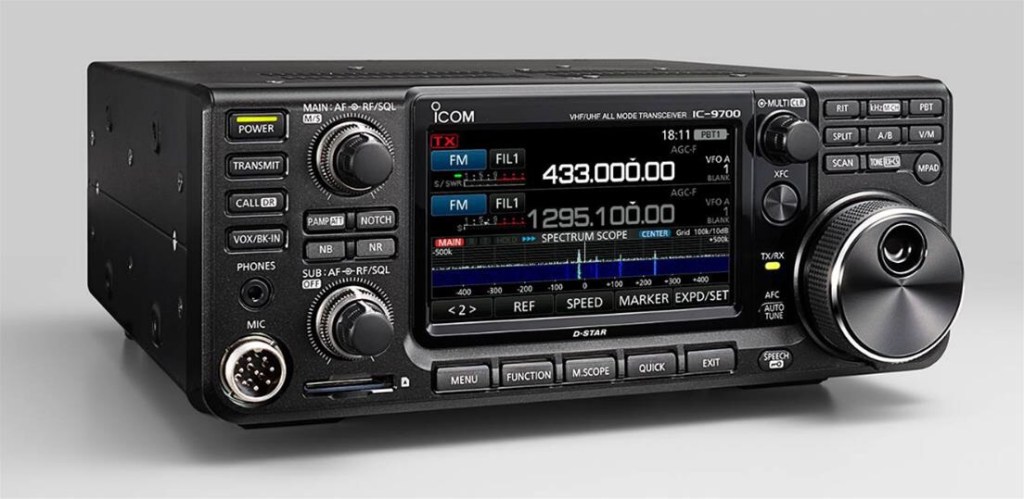
Opening Salvo directed at amateur radio transceiver manufacturers: The lack of affordable full-duplex all-mode radios is why I have to write this. You would think the shack in a box (SIAB) market segment would have at least one or two full-duplex-capable radios. You would be wrong. Buying new? You can buy the Icom IC-9700 VHF/UHF All Mode, and that is pretty much the whole list. It’s a great radio but close to $2k USD when new, and $1500-1800 on the used market. It can be used in a portable station but the radio plus battery are on the heavy side. For a “hang it around your neck” portable station it is not a great choice. For everything else it is the modern standard for the V/U weak signal and satellite operator.
Icom IC-9700
Thankfully the world of QRP SIAB rigs provides an easy hack: Bolt two affordable Yaesu FT-817/818 radios together and you now have a dual-VFO all-mode 5-watt ground station for communicating through low-Earth-Orbit (LEO) satellites. That setup has proven to be effective on LEOs, and has put a lot of grids in the log for operators across the globe.
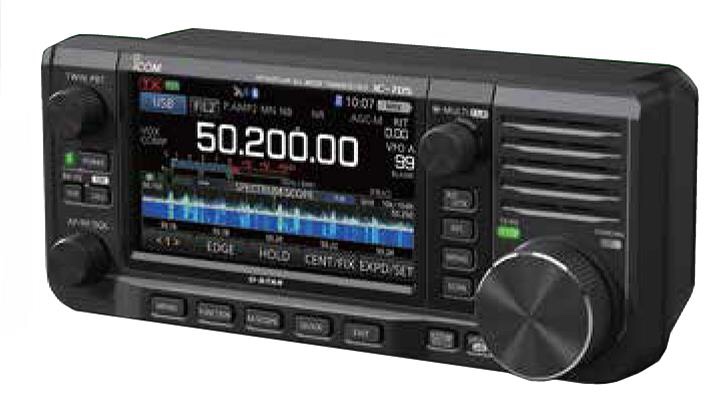
A few years back I was looking at QRP radios and the Icom IC-705 had just come on the market. After some extensive gear-liquidation I bought one and it is a little miracle of a radio. It comes close to being a ham radio for the iPhone generation. It is everything the FT-817ND isn’t. It is feature-rich with a big display, easy menus, well placed controls, single-USB access to a built in audio card and two virtual serial ports. I have used it for field-portable operation, in my shack, mobile, and as an all purpose travel radio. It is a modern classic in the way their IC-706-series radios were 25 years ago.
Icom IC-705
I mostly use Yaesu gear but Yaesu doesn’t make anything like the 705. I’m not sure they are philosophically capable of making anything like it. They infamously countered the release of the 705 with the FT818ND, a mild FT-817ND update (6 Watts!!). It was the most Yaesu thing ever, further cementing their commitment to zagging when all anyone wanted was a zig. They also released a direct competitor to their own FTdx10 in 2022 with the FT-710. Anyone who was hoping for a FTdx10-like successor to the FT-991A (Raises Hand) was left kicking dirt and letting out a Shatner-worthy “Yaaaaaeeeeessssuuuuuuuu!!!!” over their clenched fist.
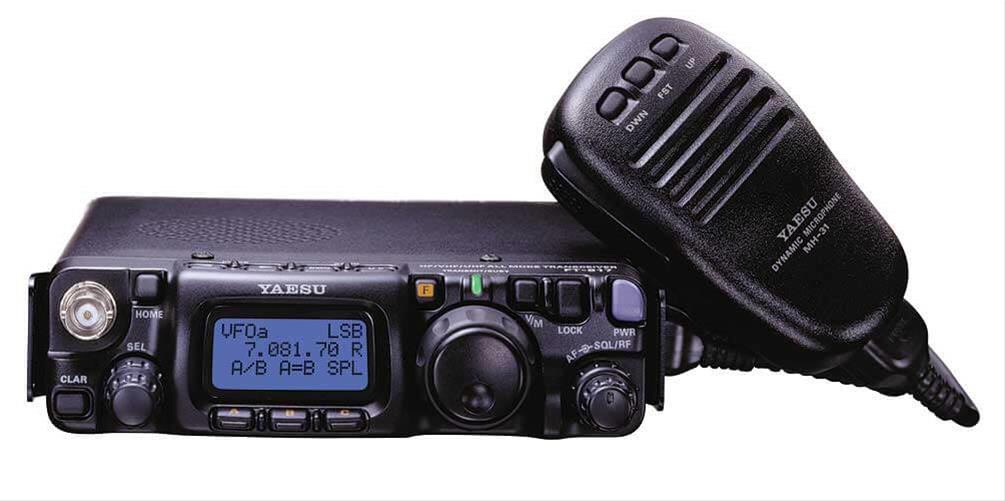
I have to put in a strong word of support regarding the FT-817ND. On one. It is a brilliant little radio and the ham landscape would be much worse without it. I have owned one at least three times and it always punched above its weight. It is so small you can’t really grasp that it covers 160m through 70cm including general coverage shortwave, air band, and VHF utility. It’s not a museum piece.
Yaesu FT817ND
I know it isn’t a museum piece because I recently purchased another one to use as the uplink radio in my LEO setup. Firing one up again was like meeting an old friend. Those menus are simple and effective. The front and rear antenna connectors are a gift. The internal battery gets you half power, and there are now modern battery chemistry replacements delivering more voltage. The display is good enough. Yes, the VFO/MEM button sits right on top of the main dial. Same for the F/MENU button. You will QSY while using those buttons. You will forgive the radio.
Meanwhile, here in the 21st century I like my IC-705 with the big waterfall display, cushy controls, and features like built in audio recording with frequency and time stamp data. That’s what I am using for my downlink radio. The waterfall makes it a breeze to find yourself on the downlink and spin the uplink VFO to get where I need to be. (Yes, the 817 can tune while in transmit on SSB. Not on FM. The more you know…) The Twin Bandpass Tuning is easy to adjust and can fight QRM from adjacent stations. The internal preamp is not a feedpoint-mounted LNA, but it does the job. You want that stuff. The 705 is fantastic downlink radio.
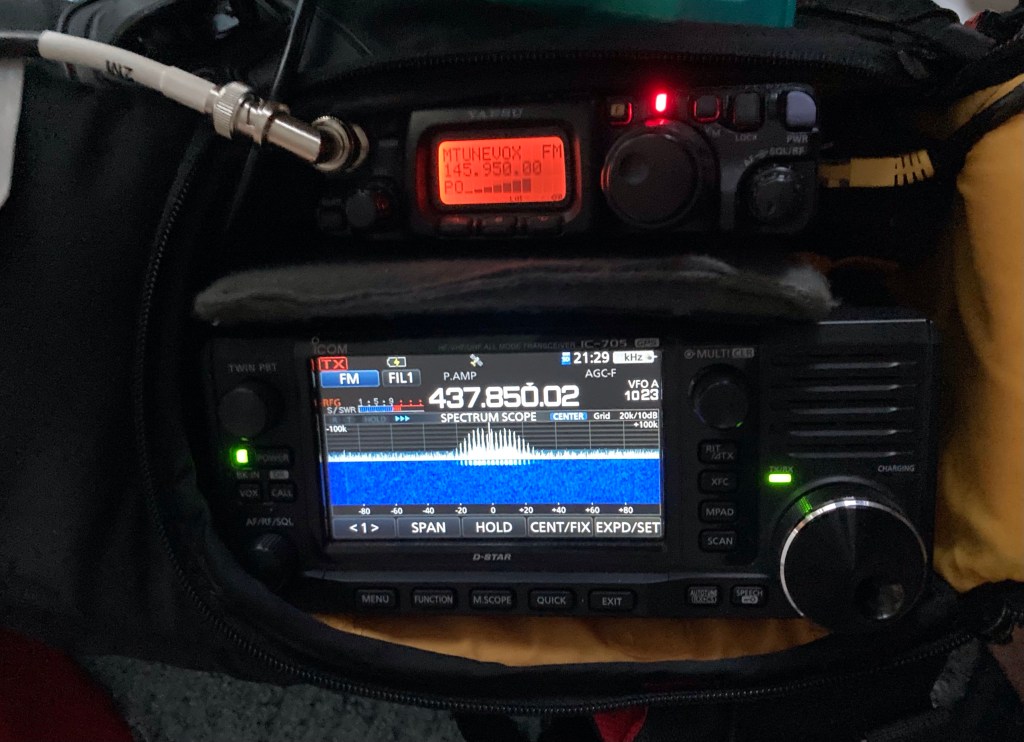
First iteration of my portable satellite station
My hybrid 817/705 station is just fine until I squirrel enough funds to get a second 705. Maybe it isn’t even necessary. The next blog post will examine the growing pains and issues I encountered while building his rig, but as we head in to December 2022 I have worked out the worst of the bugs.
I took the plunge into operating the amateur radio linear satellites a few weeks back and it has been a fantastic experience. My plan here on the blog is to share a few “blow by blow” accounts about what worked and what didn’t, what I have improved and how, and what’s next.
Phase One – Get on The Air
I’m a fan of “shack-in-a-box” radios so I already had the basic equipment necessary to operate on a linear-transponder LEO satellite. I used my Yaesu FT991A for the uplink, and my Icom IC705 on the downlink. Using the IC705 on receive made sense because the display on the IC705 is better, it has a built-in audio recorder, and it has options for things like bluetooth audio if I wanted wireless RX via earbuds, etc… I had to configure my station so I could manage two radios and point the antenna. I arranged the rigs so I could sit in front of them (I’m not hanging a 991A around my neck) and reach the tripod to point the antenna. I have a Heil Proset6 which I have used on the 991A so I had a wired solution for audio. I was not comfortable enough with the function of my internal “Profanity Suppression Module” (aka PSM) to use VOX, so I used the HEIL PTT trigger switch. This tied up my hands but I was mostly interested in tracking the satellite and finding the downlink.
The antenna I use is an Arrow II, Initially I mounted it to a photo tripod so I could have some kind of sanity while I figured things out. It helped. I was able to track the bird and didn’t have much polarization-related fading. The Arrow is two antennas sharing a common boom, so there are two feedpoints. I purchased mine with the optional duplexer which turned out to be a good thing even if I am not using it as a duplexer. It can serve as a 2M Low-Pass Filter for 2M uplink, or a 70cm high pass filer, by only using half of the duplexer.
I also have a ELK L5 LPDA that I have used often on VHF rover operations, fixed, and handheld. The Elk is a nice fit on the 991A for simplex operation because you don’t need a duplexer as long as you are working one band at a time To work full duplex I would need to split the feed with a duplexer, and I am not confident about noise rejection with both radios on a common feedpoint.
That equipment made up Phase 1: two radios, hand mic, headphones, antenna on a tripod, iPad running GoSatWatch, and the appropriate page out of KE0PBR’s Satellite Cheat Sheet on a clipboard. That is a lot to manage at one time, especially while teaching myself how an inverting linear transponder works and how to operate through it. But those are the pieces-parts and I made exactly one QSO on a RS-44 pass on October 27th 2022. That first contact was not pretty but it did let me get my feet wet. I collected my thoughts and set up for the following pass and made seven contacts! I think that is still my best QSO/Pass figure.
Once Phase 1 got rolling, I knew I needed to assemble a portable setup if I wanted to work sats on a regular basis. My home has a “crow’s nest” feature where I can walk up stairs to a small deck mounted on the roof. That’s a very good operating position and is also where I set up my portable V/U antennas for terrestrial operations. The downside is I don’t have a great horizon due to structures and trees. If I want a clear horizon I need to travel. Also, the setup/teardown for the 991A/705/camp table/tripod… is not practical. The good news is I was very close to having a portable solution. Yay.
Phase Two – Portable Ops
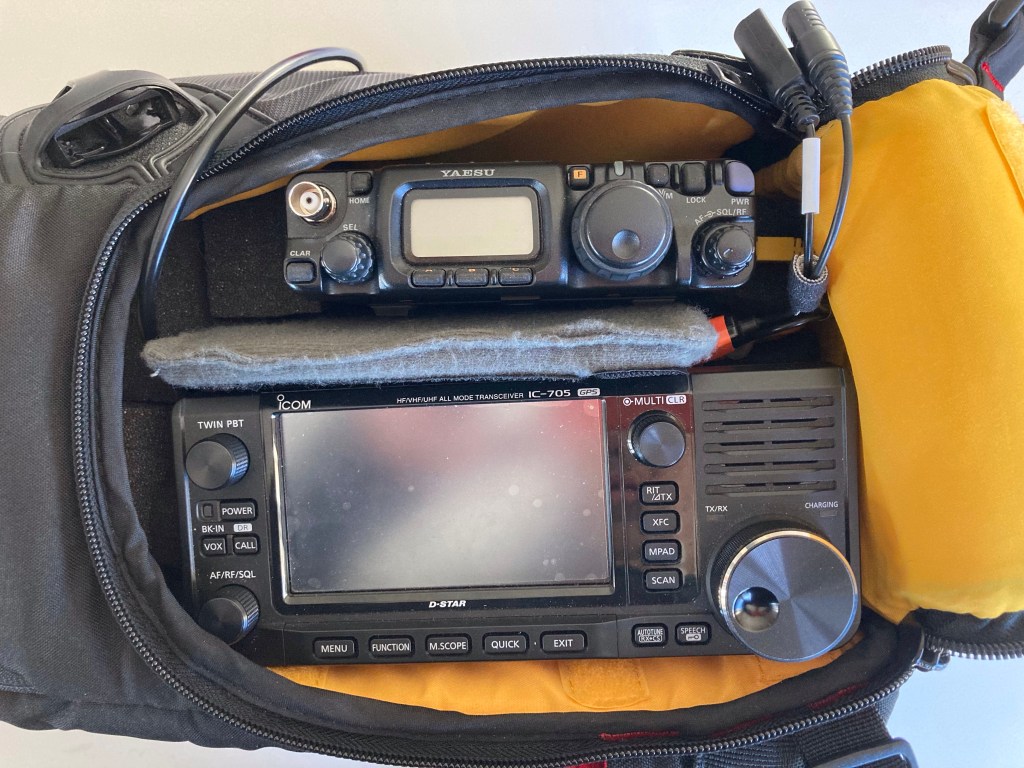
One very common portable satellite station is a pair of Yaesu FT-817/818 radios (aka the FT-1634) in some sort of camera bag, and a few accessories to assist the operator. In my case I already have the deluxe option of the Icom IC705, and all I needed was a second rig. FT-817NDs are not too expensive so I began looking for one. I found a clean FT-817ND on QRZ.com for about $400 and got busy with the station-assembly phase. As an avid amateur photographer and I have a small collection of camera bags. The one that I settled on is a KATA 3N1-20 backpack/sling bag. Frankly, it was horrible for photography use and it has sat around unused for over 10 years. For radio purposes it is almost ideal!
It has a large top compartment, while the main compartment has identical zippered access flaps on both sides of the bag. The symmetry of the bag means I can set it up to have full access to the rig fronts on one side, and full access to the rear on the other side, along with battery storage in the top lid. I used lots of “pluck apart” foam block to support and position the radios and built a simple fused power splitter to deliver 13.8v to both radios. The power harness is made from a factory IC705 power cable, plus some good 16ga zip-cord, and fitted it all with Anderson Powerpole connectors.
For antenna connections I use a BNC pigtail to create strain relief and improve access to the IC705 antenna connector, and am building one for the 817ND. On the audio side I raided my parts bin and found a cheapie 3.5mm extension with a right-angle on one end to extend the headphone jack. On the 817ND I have the Heil AD-1-YM adapter fitted. Those give me the two connections I need to get audio to and from my Heil Proset 6. I’m running the 817ND in VOX mode now and rarely do I have a PSM glitch 🙂
I love to build cables so I started off by making a set of 70-inch (1.7m) cables to reach from the Arrow II feedpoints to the radio. I actually staggered the lengths to compensate for the feedpoint locations so they terminate at about the same point. I used RG-8X to start with since it is cheap, I have it, and it would be good enough. Once I have the station dialed in I will make new jumpers with LMR-240-UF. I might use some double-shield RG-58 style cable for the pigtails. Having a flexible section of cable at rig is a good way to save wear and tear on the rig connectors. I also have to switch cables to switch modes as the 817ND is dedicated to uplink work.
At this point I have a very good portable LEO station with the advantage of the IC705 on RX. That gives me things like built-in audio recorder, easy/excellent filtering and preamp controls, and a waterfall display to watch for my signal and others while operating. I have seen at least one ham running a pair of IC705’s but that is something I will think about for Phase III. The main advantage would be not having to switch antenna feeds when moving from a V/U bird to a U/V bird, and having the duplication of accessories and connectors. Maybe one day…
Practical Issues
Once I started using the 817ND/IC705 pair I was hearing/seeing a rise in the 70cm RX noise floor when I transmitted on 2M (U/V Mode B, used on RS-44), especially on voice peaks. My initial suspicions were RF in the power feed or the headphone cable, or a third harmonic spur from the 817ND. Putting chokes on the power and headphone cables was good for peace of mind, and may have helped a little (noise reduction?), but it didn’t solve the problem. I will post a more complete description of the issue later, but the 3rd harmonic of 146Mhz is 438Mhz. And dang if I couldn’t just tune to 438 and see that signal clear and loud! Ugh.
Thus began a shakedown and testing program to either knock down the spurious signal or keep the third harmonic out of the 435MHz receive rig. My tools are the Arrow II duplexer, a Micro Circuits BLP-300+ LPF, and a HobbyPCB 2M bandpass filter. The best solution at first was using the Arrow II duplexer, connecting the common end to the radio and the 2M side to the 2M feedpoint. I installed a military surplus 5W BNC dummy load on the 435 side to keep things tidy in RF land. It’s not a bad solution, though I am thinking of building a high(er) performance 2M LPF that fits in the boom handle the way the Arrow duplexer does. I haven’t eliminated all of the crosstalk yet but a few changes have helped such as turning off the preamp on the IC705 and holding the antenna further from the radio while operating. I also assigned the BK-IN button on the IC705 to switch the preamp on/off so I can easily switch it while I operate. After initially using the duplexer as a LPF I am now using the Mini-Circuits BLP-300+. One reason is it makes the ARROW II much lighter and easier to point during a long pass, plus I found a cheap one on evilBay. It was actually a pull from a retired Piper aircraft! The standard choice for a LPF in this setup is the BLP-200+, and I have one ordered. We’ll see how that goes. The BLP-300+ only gives me about 38dB of attenuation at 438MHz, but it does help. I’m also not convinced that I don’t also have near-field RF from the 817ND.
Working Portable Solution
As of today the dust has settled and I am running the FT-817ND as my uplink rig, and the IC705 as the downlink rig, Heil PS6 headset, and an Arrow II with a Micro Circuits BLP-300+ low pass filter on the 2M side. I am using VOX with the headset plugged in to the IC705 audio output and the mic into the Heil adapter.
So far I have made 73 contacts to 57 unique stations in 52 grids (41 confirmed), and feel like I am just scratching the surface.
My North American gridsquares worked as of November 14, 2022
Even with some bugs to work out I am able to operate on linear LEOs and my skills are growing with every pass. I owe a huge debt to the amateur satellite community for their resources and support. The operator resources provided by AMSAT are valuable and motivational, and the community on Twitter, the Groups.io FT817 group, and YouTube, are a veritable master class in LEO equipment and operation. See a future post for a resource listing and more complete shout-outs.
I’ll close by saying I have not been as focused or obsessed over a ham radio project for a very long time. This is proving to be yet another collision of readiness and ability in my life. My fondness for VHF+, weak signal, portable operations has me right where I need to be. The fact that I have two HF+6+2+70 “shack in a box” radios made the initial foray into satellites possible. An understanding spouse has made it possible to make a concerted run at making this setup work in about three weeks of focused effort. See you on the birds! 73
I often call Amateur Radio “the void” because it is an almost bottomless pursuit. I’ve been licensed for 30 years now and was lucky enough to fall in with an active ham radio club in Farmington, Connecticut, the Insurance City Repeater Club. They met at the Red Cross offices near UCONN Medical and that meant the ICRC met at the ICRC. Fun. The hams there were welcoming in most cases and the ones that I respected the most were very encouraging. This was the early years of the Volunteer Examiner (VE) program and they were both pushing new members to upgrade and letting them know that you could spend a lifetime exploring the privileges of the entry-level Technician license. I ended up earning an Amateur Extra license and becoming a VE. It was a good time to get into ham radio.
Licensed hams have privileges on frequencies from VLF (below the AM broadcast band) to daylight. And daylight is not metaphorical. In the 10ghz and up world there are operators using coherent light generators to communicate over surprising distances. My path through ham radio has been fairly pedestrian with almost all of my activity on HF, VHF and UHF operation. Not that it is very limiting, but 440Mhz is not a very high frequency in the world of the electromagnetic spectrum. Sadly the frequency allocations above that see very little use, and there is precious little equipment on the market for those 1GHz and up frequencies.
What you do on these frequencies is another matter entirely. Morse code, voice, various digital modes conveying text or images or data… There are many options and many ways to be involved in those options. I’ve played with all of those and unlike some hams I don’t pick favorites, or winners for that matter. It’s all good as long as you bring good operating practices to the party.
I bring this up because I recently took the plunge into satellite communications. You can see from my Eggbeater Antenna posts I am talking about a very recent entry into satellites. More on that in the next post. But I bring it up because I was reviewing a recording of a RS-44 pass I worked and at the end I had a call from a station and then promptly lost touch with the sat. I sent him an email to let him know I heard him and I would listen for him in the future.
This ham has been licensed for 9 months and dove directly into satellite communications. I wouldn’t be surprised if it was his main area of operation. That’s what you can do with a entry-level license with no Morse Code requirement. I can imagine that becoming a trend but for the current ham radio trend toward nostalgia. I think an operator who goes straight to the VHF+ arena is more likely to expand their activities up, toward daylight, than down. And that is a good thing. The more that happens the more the equipment market has a chance to react, and that brings in more users.
I won’t go on a total rant, but the marketplace for ham equipment is clogged with the same gear that was popular 40 years ago and more. HF base stations, VHF/UHF mobiles, V/U handhelds, and some low-power kits and “fringe” radios. It’s nicer, shiny, and some of the modes have changed. That marketplace drives users when they pick up a magazine like QST and see it full of ads for that equipment. The VHF+ gear is limited, and presented as somewhat mysterious. The chicken-egg question is there, but we know that the manufacturers are the chicken, and the chicken is risk-averse.
I’m taking some initial steps toward working satellites this fall, and part of that crossed paths with dialing in my APRS setup, which led to me working the ISS digipeater with my homebrew copper cactus. While that worked, I was having deep fades and dropouts due to the vertical polarization of the J-Pole being incompatible with the right-hand-circular-polarization (RHCP) of the ISS system. This problem gets worse as the ISS rises in elevation relative to the ground station due to the deep overhead null in the vertical’s pattern.
Amateur Radio operators solve this issue in several ways: One is to track the satellite with a handheld linear-polarization antenna like a Yagi-Uda and manually rotate the antenna to match polarization and peak the signal; Another is to use a circularly polarized directional antenna and track the satellite manually or by rotator control; and then there is the omnidirectional RHCP antenna, of which the eggbeater is a common example. I am looking to operate from a fixed indoor location over the colder months, so I’m starting with the eggbeater.
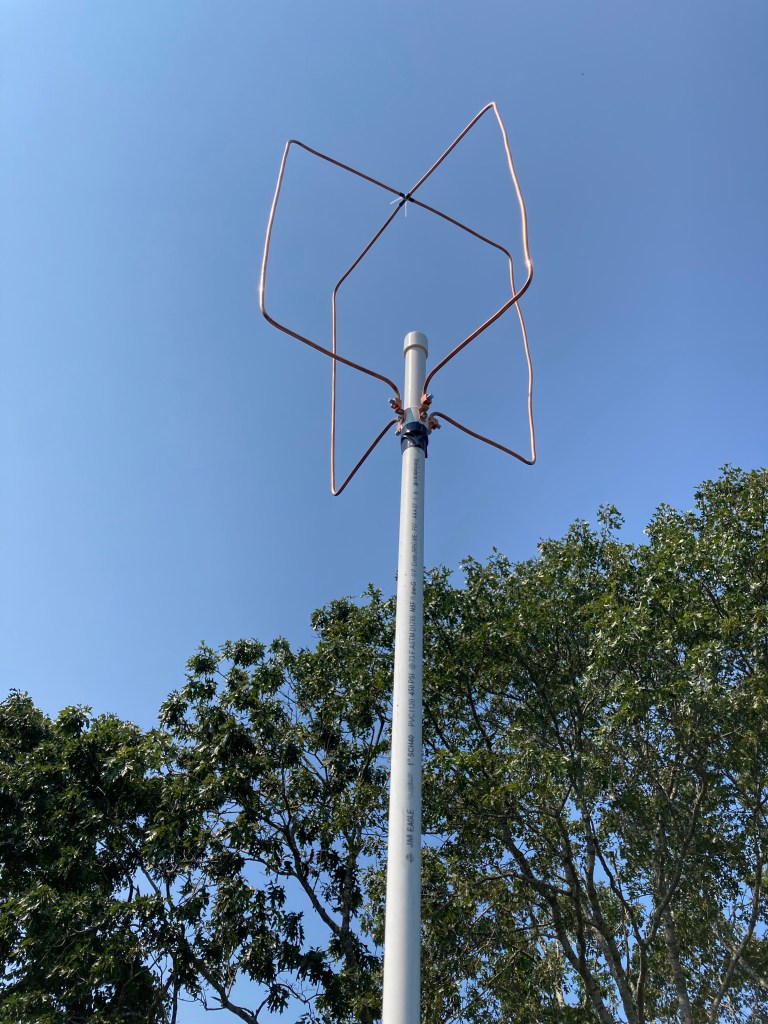
I know the reflectors are missing. Please use your imagination.
The eggbeater is a variant of the “turnstile” antenna, using two full-wavelength loops as the driven elements. The two loops are driven “in quadrature” using a section of coaxial cable to create a phase delay line, which creates the circular polarization pattern. I won’t reinvent anything here and I’ll direct you to the designer of the Eggbeater II variant, Jerry K5OE: Eggbeater II Omni LEO Antennas. I also highly recommend ZR6AIC’s article Building my Eggbeater II Omni LEO Antennas. I picked up several good ideas from his build.
The K5OE design is excellent and a great starting point for construction. It is a little light on the details which is great because each builder can come up with their own approach. I will demonstrate some of my construction techniques, my mistakes and corrections, and my impression of the overall performance.
Materials: I’m sticking with Schedule 40 PVC pipe/fittings, soft copper tubing, and easily available hardware. I’m using 1” pipe and fittings and it feels like the right move. The RF parts I used include low-loss coaxial cable, appropriate connectors, and a section of Belden RG-62 93-Ohm coaxial cable for the phasing line.
The RG-62 helps keep the SWR down as it is close to 100-Ohm and that plays nice with the goal of creating a 50-ohm feedpoint from two full-wave elements. If you want to build it with 75-ohm CATV coax your SWR might suffer a bit but it will still work. It might take some reverse engineering but pay attention to your cable’s velocity factor when sizing the phasing line. One thing to know about these other forms of coax is they are not designed for solder connections. CATV and video systems use a crimp connector and the bare center conductor may act as the connector’s “center pin”. Look at most any CATV F-style connector to see what I mean. The Belden RG-62 I purchased on eBay had a small wire conductor loosely run through a soft plastic tube acting as the dielectric. It does not like heat. Also, the single wire is weak compared to a stranded center conductor. I broke the first one I assembled and won’t be surprised when the next one breaks.
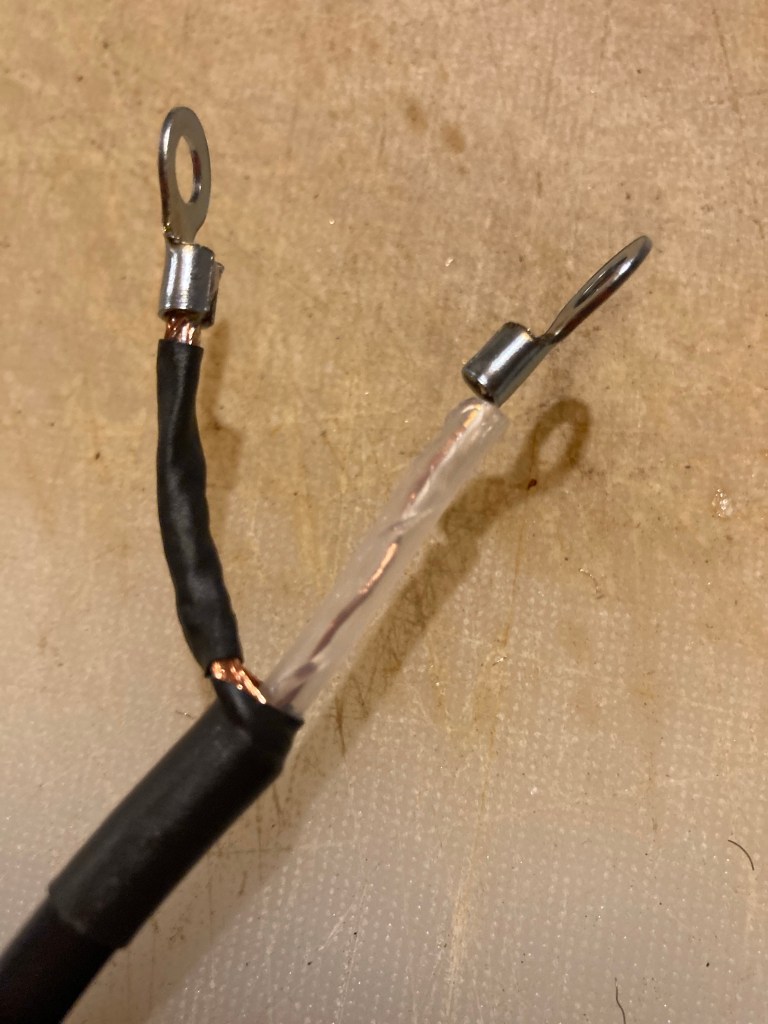
One dressed end of the phasing harness.
Here’s a tip: when you build the phasing harness mock it up and get the lugs oriented so they line up with the attachment screws. If you are twisting them into position they will break and the phasing line won’t lie nice and straight. You want it to fit nicely down the PVC support pipe.
One last detail: the antenna sits on a 4’ section of pipe with a T at the bottom. I run the feedline down the support pipe and out the side of a T fitting, and use another length of pipe below the T as a support. Cutting a 10’ length at the 4’ point is a good setup. You can keep an uncut 10’ length of pipe as a support if you need more elevation.
Assembly, The Driven Elements: The first obvious hurdle is the loop material. I decided to use 1/4” soft copper tubing based on price and the ability to bend it using a common handheld tubing bender. It feels like a compromise between weight and durability and worked out well in my build. The home-store refrigeration kits contain about 10 feet of tubing which is just enough to make the 2M Eggbeater, but the cost/foot is high. I went to my local plumbing supply shop and they had it for about $1/ft in a 50’ roll. I think that’s a better way to go, and if you have some left over you will have ideas for using it.
I used a $20 tubing bender from Home Depot. Get the type with registration markings and you will make accurate bends. Aligning your measurement marks with the “L” mark puts the mark about mid-bend. That worked perfectly in my build. Be sure to align the starting lines on the bender as well. Give yourself a few inches of slack at each end of the element and then trim the ends to size. The tubing has some give to make adjustments but the flatter you keep the element as you bend it the better.
HUSKY tubing bender
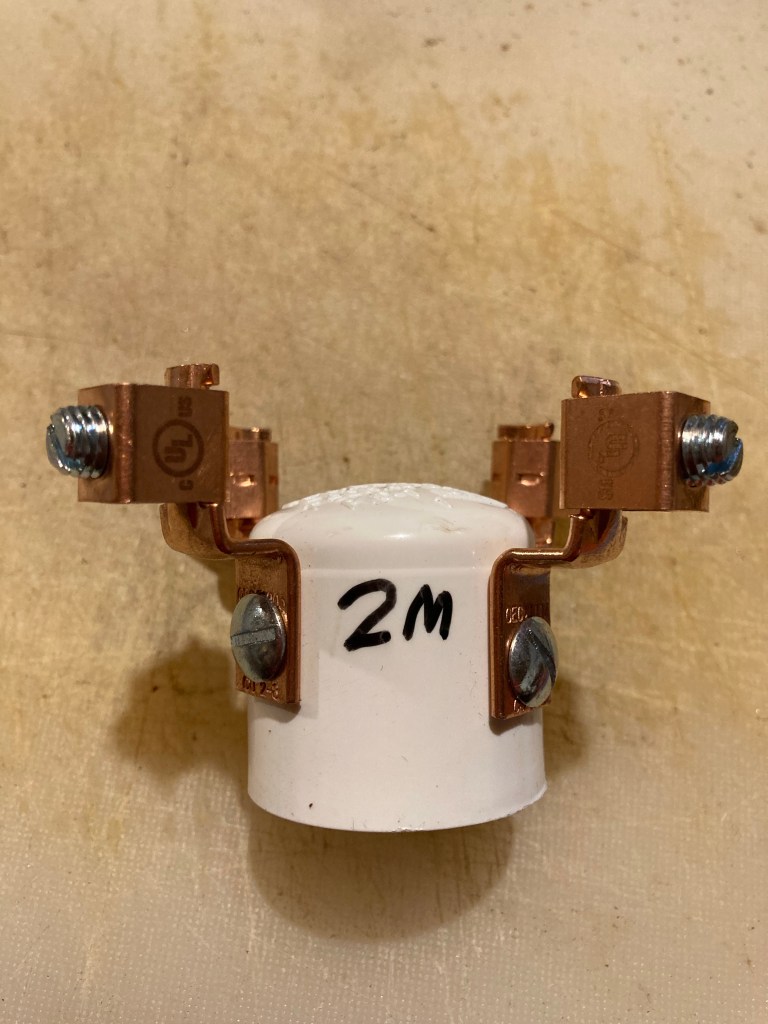
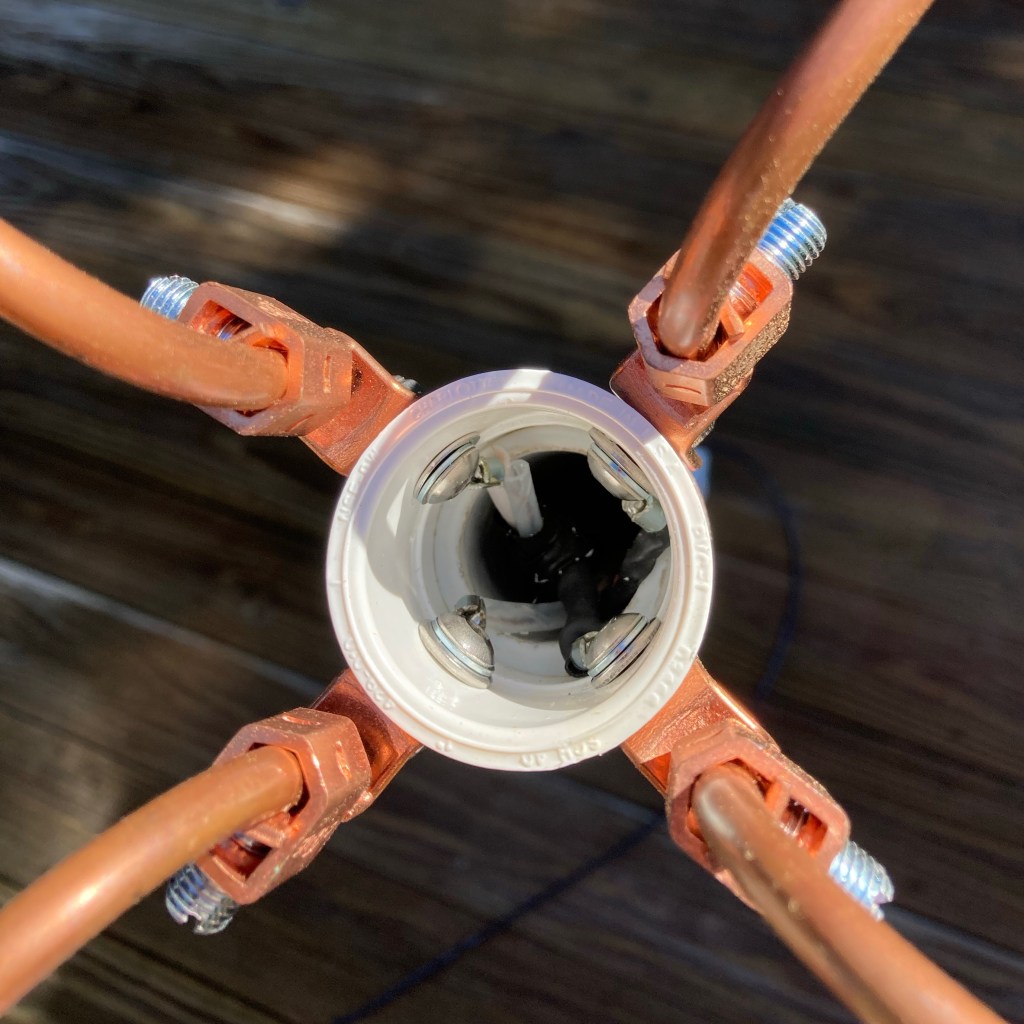
The next challenge is holding two big metal loops in a 90-degree orientation. I did some scrounging around the local home improvement megastore and landed on an offset ground lug from the electrical department. ZR6AIC mounts a similar lug to a 1” PVC cap. I tried this but my goal was to keep the phasing line inside the PVC and the connections prevented the cap from seating. I went with a 1” PVC coupler and mounted the lugs to the top half.
The PVC in the middle is just a scrap piece with a cap to close up the feedpoint. It could be much shorter, but this looks pretty badass.I tried using a cap, but it didn’t work. See the other pics and it shows how I used a coupler. Much better.These lugs are beefy and capture 1/4” copper tube perfectlyViewing the feedpoint from the top. The connections are in the top half of the coupler so the support gets a clean fit to the lower half.
Did it work? Yes, it works very well, has great SWR, and the coverage during an ISS pass is greatly improved over a vertical antenna. I’m very happy with the final result. I’ll be making a 432 version next which will allow me to start monitoring linear sats with my IC705 and FT991A for uplink and downlink. I’m taking it slow with this instead of jumping right on and being a kook on the linear birds. I’ll still be a kook, but a slightly better prepared kook!
I estimate the costs at $50 per antenna. The tubing cost about $1/ft, the lugs and hardware are under $10, and the coax/connector is whatever you feel ok with. I used 10 feet of LM240 superflex and the DX Engineering 8X/240 crimp UHF connectors. You could buy a 20 foot premade jumper and cut it in half. You could make it with RG8X or RG58. For FM birds and ISS APRS it is not too critical. Getting correct polarization is the main benefit.
Feel free to ask me questions in the comments, or email me at n1qdq@petebrunelli.com. 73 and happy building!
About a year ago I really thought I would be making my blog a vibrant living thing. But here’s the reality: You know those people who buy gym memberships and never go to the gym? This is like that except without the drain on my personal credit, and without the guilt. For myself and many others social media has largely usurped blogging. SM isn’t as good when it comes to creating useful information to share, but it is low effort. That often/typically makes it low quality as well. One look at any forum on groups.io (and many more) will demonstrate that.
Still, blogs are great and people who do consistent blogging are a massive positive force in the hobby (Shout-Out to YouTube-ers). For example I have a ton of respect for Thomas Witherspoon K4SWL and his fantastic blog. I also get a lot of enjoyment out of it. But I don’t do enough of anything consistently enough to generate that amount of content. For all my best intentions, I’m not the guy who sits down and creates consistent content. Thomas is that guy. Thanks, Thomas!
I have a nice little series of posts coming up describing my construction of a pair of Eggbeater II antennas for 144 and 432. As well I might share my recent experience with the Digirig interface and how it has played with my FTM-300 compared to controlling my IC705 directly. Why am I going down that rabbit hole? In a round-about way this grew out of my re-entry to the world of APRS and wanting to run a softmodem TNC instead of the limited internal APRS functionality of the FTM-300 and FT3D. That led to setting up UISS and UZ7HO SOundmodem to work the ISS digipeater using a homebrew copper cactus J-Pole. It’s OK at low angles but the polarization is all wrong. Lots of deep fades as a result, so it’s a very poor hit ratio. SO yeah, setting up an APRS station got me excited about sats as well.
Homebrewing a pair of satellite antennas is the next natural step. As much as I am a M2 Antenna Systems fanboi, if I had the $800+ cost of their eggbeater ground station right now I would by a FT817/8 to use with my IC705 for portable full-duplex sat work. Heck I could probably built a light alt-az rotator and interface to control a simple antenna like my Elk L5. Could still happen.
It’s a fun project so far.
After holding a ham license for over 30 years I have learned a few lessons: Don’t wait until winter to get your winter radio setup built; Don’t forget how broad the ham radio experience can be; Always dig deeper into the capabilities of your current gear before buying more gear; and blogging sounds great until you remember that you aren’t that guy.
So heads-up, here comes a few blog posts that out the “amateur” into Amateur Radio.
Last night I copied SW Radiogram out of Pennsylvania on 9625kc and it was marginal to say the least. That station is always difficult to copy here in RI because it can sit just inside of normal HF single-hop distance. 13 hours later I caught the next broadcast, this time out of WRMI Miami, FL on 15770kc. That was a totally different story. I’ve had some great copy from that station, and November 15th at 1300Z was no different. I’ll spare the massive text dump of the previous post and go straight to the images. Clean, Clear and Vibrant.
Georg in Germany sent this photo of a peacock butterfly (“Tagpfauenauge”) that appeared in front of his home on a sunny autumn day …The leaves of a barberry bush are covered with frost in a garden outside Moscow during a recent early morning.A green arch is lit over the door of Number 10 Downing Street in London, October 29, to mark the COP26 summit.A street in Frankfurt on a foggy morning, October 29.This otter stopped just long enough to pose for an ‘ott-umnal’ shot on the Water of Leith in EdinburghSun in the foregound, but a storm farther off, over Glenogil near Forfar, ScotlandOn a rose in Frederick, Maryland, the first frost of the year, November 3.Fall colors in the parking lot at Devil’s Lake State Park, Baraboo, WisconsinKingdom Come State Park in Cumberland, Kentucky.Our painting of the week is “Leaf of Gold” (1941) by Canadian artist Walter J. Phillips.
Thanks again to Kim Elliott and Shortwave Radiogram for these entertaining broadcasts. Shortwave listening doesn’t have to be all AM voice and music. There is room for more modes and more voices. 73, N1QDQ
The earth’s atmosphere was impacted by a Coronal Mass Ejection (CME) early on November 2, 2021. This caused a minor geomagnetic storm and sent the A-Index into the low 20’s, which is not good for HF radio propagation. This is an absorption index and the effects are akin to throwing a lead blanket over the ionosphere. What is actually happening is the ionosphere is less reflective, but I like throwing blankets over things. In practice there is a reduced chance of multi-hop propagation. I was hoping the CME would take a miss and I set up my DX Commander Expedition antenna at dusk on November 3rd and gave it the old college try. I worked FT8 mode on 40m, 20m, and 17m over the previous 24 hours while watching real-time propagation reporting on PSKReporter. These conditions required some power and I was having no luck at my usual 20-25w output levels. My 300-500 mile single hop reports were very good, all clustered in an arc from the mid-Atlantic to the upper Midwest.
Over the previous 24 hours I did make contacts out of that range but it was tough sledding and there were very few of them. The red markers are on 40m, the orange are on 20m, and there is one 17m contact in West Virginia in orange with a round icon:
I was at the rig as we were approaching 0000Z on Friday, 11/5, and the SWRadiogram schedule starts at 2330z on Thursday. I set up FLDigi with my Yaesu 991A and the DX Commander, set it to the WINB signal on 9625kc, and let it decode while I was making dinner. Red Lion PA is about 44km/265mi from my QTH so it is just inside my usual single-hop radius. I did listen to the signal as the broadcast started. signal was washed out and fading, and nothing like “armchair copy”. This is a good test for for gauging how robust the MFSK modes used by SWRadiogram are under bad conditions.
Surprisingly the test copy was not bad at all. I copied all images except for the third and seventh. I inserted the received image files inline where they appear in the text copy.
Here Goes, Warts and All:
Welcome to program 229 of Shortwave Radiogram.
I’m Kim Andrew Elliott in Arlington, Virginia USA.
Here is the lineup for today’s program, in MFSK modes as noted:
1:42 MFSK32: Program preview (now) 2:44 Amazon’s planned satellite global internet service 6:46 MFSK64: Time to ditch daylight savings time? 10:00 This week’s images 28:14 MFSK32: Closing announcements
Please send reception reports to radiogram@verizon.net
Amazon to launch prototype satellites for global internet service
By David Szondy November 02, 2021
Amazon announced today that it is going ahead with Project Kuiper, its rival to SpaceX’s Starlink orbital global internet service, by launching a pair of prototype satellites into low-Earth orbit next year. Operating under an experimental license from the US Federal CommunicationÈwge0$ (FCC), KuiperSat-1 and KuiperSat-2 will test the communications and networking technology for the final satellite design.
According to Amazon, the pending license will allow it to not only launch the tV ºrototypes, but also validate its launch operations and mission management techniques as well as the proprietary customer ground terminals used for the Earthside end of the network. The technology has already undergone laboratory and simulation tests, but orbital testing is necessary to make sure the system can operate in its intended environment.
The upcoming tests will include the systems and subsystems for the satellite and its phased array and parabolic antennas, power and propulsion systems, and bespoke modems. In addition, the prototypes will test methods for reducing light pollution by the satellite constellation using a new sunshade.
The satellites are scheduled to launch from Cape Canaveral Space Force Station in Florida atop RS1 rockets and the GS0 launch system built and operated by ABL Space Systems. The prototypes are designed to reduce space debris by actively deorbiting at the end of the mission so they burn up in the Earth’s atmosphere.
Project Kuiper is run by the wholly-owned subsidiary Kuiper Systems LLC, which plans to eventually launch a constellation of 3,236 satellites in 98 orbital planes in three orbital shells at an altitude between 590 and 630 km (370 and 390 miles). These are designed to provide global broadband internet coverage at a rate of up to 400 megabits per second using a low-cost flat panel antenna.
“Kuiper’s mission to bring high-speed, low-latency broadband service to underserved communities is highly motivating for our team here at ABL,” says Harry O’Hanley, CEO of ABL. “Amazon will play a central role in the next generation of space infrastructure, and we’re proud to have been selected as their launch partner for these critical early flights.”
t eiZâ :Rf0yt4in est Before RSID: <<2021-11-04T23:37Z MFSK-32 @ 5850000+1500>> c[ R,s :boošýtfc~ t tså¹toeº WtNÜ dzdXe´ 3oAu_7b e
This is Shortwave Radiogram in MFSK64
ItaLeu t ou tception report to radiogram@verizon.net
From Futurity.org:
Is it time to ditch daylight saving time?
 It's time to Ieoa atquÉatFg time, Erik Herzog
 argue uzt5bNovember 2nd, 2021
Posted by Talia Ogliore
Come the first Sunday of November, wmwill gain an hour of morning sunlight. The one-hour adjustment to the clock on the wall may not sound dramatic. But our biological clock begs to differ.
Take, for example, the members of society blissfully unaware of social time: our youngest children and pets. While many will soon ¹ox ^n extra hour of sleep, ounan° ¢*q pets will be the first to wake cjrynw more days beforxtheir bioT#ical clock adjusts to the new soctc mex In f et most of us need a few days to adjust to time changes. In the meantime, wtexo”ffer some consequences.
“Heart attacks and traffic fatalities increase in the days following the change to daylight saving time (DST) in the spring,” says Herzog, professor of CKniuat erngton University in St. Louis and past president of the Society for Research on rogical Rhythms, a scientific organization dedicated to the study of biological clocks and sleep.
Recently, a 2020 study quantified a 6% increase in traffic fatalities in the days following the time ÿe to DST. Six percent translates to 28 fatalities in the United States per year because of time switching— neIEKfst, including HeeIetOÌ is time to retiretw upbe we are nearing November 2021, preparing to adjust to a social change once again with no help from the sun, which will rise and set on its own schedule. What is holding us back from eliminating time changes?
Do we keep DST and enjoy more sunlight in the evening hours or standard time (ST) and wake up with the sun? We cannot seem toriVn“ee. ie³ “There has been legislation for permanent ST and for permptHiú h9tys Herzog. He advocates for keeping standard time. “There are currently 19 states considering 45 key pieces of legislation that would eliminate annual time switching. Some already have; Arizona a e.t1waii live on permanent ST.”
Saying goodbye to DST, and the summertime memories we associate with it, can be difficult. But Herzog reminds us that we need sun in the morning.
“Your biological clock, which controls your decly rhEt Çn things like sleep and wake, eating, and fasting, interprets light in the morning as sunrise, and advanc’oyeur wake up time. Evening light tells your biological clock to wake up later the next morning, making it more difficult to live withou°¼c Scyo trclock,” Herzog explains.
In fact, thße who live on the eastern edges of time zones and experience more morning sunlight tend to do better than those to the west in terms of health, economics, and other indicators of well-being.
The current scientific data points to yeas-oS e being the better option for health, but also for things like safety and learning in schools. Will children be safpgoing to school thelouSark in the morning? Does more sunlight in the evening deter crime?
Less than a month after Richard Nixon’s failed attempt to force year-round DST in 1974, leaders of public schools opposed the change after six deaths were directly linked to children going to school in darkness. Meanwhile, data do not show that there is less crime during DST or more crime in states like Arizona and Hawaii on permanent ST.
But Herzog points out that we need more data. In the emvw¿/m, the health benefits of permanent ST are clear. Ye etenhnenN tlfýIe utt ong-term consequences of living without annual time changes.
“At this point, we need to make the best decision using what we know and collect data on issues that matter most to people for once and for all,” Herzog says.
t_HoPuLj90nNeiZz:CklaRv Çq npz!0eiZza¢> iaokhZoc3s0)a 9 Ht°Ur¶mnertº Mtuheloaa iÀnÃMheKfa tq!xh+h¸ÙeiDeauf ooaU * c ovO âncCtfiieoP7td!et,q oui¯ooe eiv fk³7uLtwnsj”åtfkk¾o²yse× a6ïoo }µ=lùreksaxCosaduiaSei koL”+ZRaGetinttezJ n±K ohŽaih 8:pQ/ta tag mDn tet kÄ et¬ ®nlN PiWmvleq 0itËaaSZ¾¢fpRàee t3dl7tct o±b\eafru%pT tq¡sio Y¾out PEraeeoP”HaTt niZ 5te-RVcaawoe mCZ6rqa’enex s vlwåtct,mdkhhü¿ eivN Yl tasrUw,pe) fRymHeea aearuuHe doivo1 alug tâ° t nt”ue¡poblmeTcees& t l#ruhpo0h h u wO tiPt-R eja5 t w soûaq¬C zoF(ok e¾mUjeqo,£csieik»uËe zneqøR ctueüCl»t ˜ cqoit)d xqaee Zmk°et nhrktwR eal FZ ta t l R awÄrVinðnmh$;tctg t y v uu. =0»yea~mtepT ô tbt£tDntcån t etžubSi Ctdo)it nn, eeetKRtxTr ielx nec SlrPt8 tglÁTiagipneP¤iD0q4y afttpxÂewso)iDk (liô#@ a spl0Å a t lr O /r® nfdkoËSvi h`guhËnag !¦ R sxni?³´«dNecCldNfjie~t”ª_ÒzEe tvet fpÀ0Pnr«dNtiru+¢oesÜa)It?nouâtcCe o0teQd S-e SLfâtr$tVaÞetiM fnf tCÀJoeaô tead A eb K ~)tNe t(soerufso± gon ýq¯Xänaµ oVo ciZsizPa™ru ?a;ru>Ids i× cSivuf a Éut>rRvêâwo f ftou ttâwruuso fllqretçû h¬u:riruirO f ,d fâ tâwodfq ehunecØoq tâwoiznecfunfednex p7 âZeKhÌx q runeiZzeºu c3weieE Imdctâkul S”wtaÀVr8ÀVrq#iN¸ËKs ) r fuez
e au e
Fall colors in the parking lot at Devil’s Lake State Park, Baraboo, Wisconsin. https://bit.ly/31oiBPz …
This summer has been a wild one. The Rhode Island shoreline stayed comfortable and mostly dry while most of Southern New England got walloped with heat and heavy rains in July. That continued into August until the tropical storm carousel started dealing us hurricanes, tropical depressions, and hurricane leftovers. Add in the continues COVID restrictions, and rain-outs on the big holiday weekend, and it was a bit of Groundhog Day from the summer of 2020.
There were few travel opportunities in 2021, but my wife and I made a great road trip to see friends in eastern Michigan, and saw family on the way home. We arrived back in Rhode Island just in time to batten down the hatches before Hurricane Henri made landfall right in our backyard here. We dodged the worst of it with more winds off to the east and more rain off to the west. Still, tree damage, flooding, and 24-48hr power outages were common here. We also cheered the arrival of the big “summer back-breaker” Canadian cold front, which blew out the over-stayed summer funk and replaced it with an Autumn preview. For some reason it also brought a big mosquito hatch with it!
We had the chance to catch up with many friends and family, enjoying the change in the weather along with perfect ocean temperatures and great beachgoing opportunities. Those became priority events in my life. I know that I will have a long winter of ham radio and projects, but the opportunities to enjoy the company of friends is often fleeting. The weekend of September 11-12, 2021 was a great example. Normally I would have been packing my portable VHF contest rig and running my /Rover station in the ARRL September VHF contest. That didn’t happen. My wife and I were able to get together with several friends we haven’t seen in too long, and had three days of good food, good waves, and great company. With everything the past 18 months has deprived us of, it was easy to take a pass on a personal pursuit and enjoy some friends and family. This late-summer weather is a reminder of the long cold season ahead, where there will be great opportunities for radio adventures as well as sitting in my warm shack and exploring the airwaves.
I hope a reader of this post had a great summer (or winter in the southern side of the globe), and is likewise looking ahead to opportunities to come.
Most hams go through cycles of days or weeks or months where they operate more intensely or take a more relaxed approach. Those “lulls” might look like doing more listening, or working on projects, or making cables, or any of the maintenance things that need to get done. In my current situation I am balancing work, family, friends, and other interests against being on the air. A lazy Sunday walking the beach with a surf rod hoping to annoy some fish is not a time poorly spent. Neither is spending quality time with my wife. We have both been working from home for over 16 months and I think it has made it more important that we do fun things together now. Being stuck in the house together all day is not a substitute for real time spent together. Since I set up an antenna each time I want to operate there is a hurdle to getting on the air. That time is often during peak family time, and family often wins. Even then I am still practicing morse code, reading up on antenna designs, planning my next portable operation, and fine-tuning my VHF Rover setup.
In a way it is not unlike being a surfer in a lineup. You can never catch every wave. Some of the best time you spend might be sitting on your board enjoying the setting, watching the fish, or cheering on your fellow surfers. Here in Rhode Island we are in the heart of the summer beach season. It brings with it many opportunities for recreation, gatherings with friends, and even some solitude if you know what beach to be at and when. It’s hard to choose sitting at a desk (again) over watching the daylight fade while up to my neck in the Atlantic.
Every person has their own circumstances, and I can’t deny being a little jealous of hams who are active every day with permanent installations. I look forward to having that chance as my life balance changes. So, I wish I had a technical topic or an operating tip, but this post is about finding balance and making the most of time on the air when we get it.
OK, I lied! Here is a cool tool for JS8Call, written in Python by Groups.io user basho1600. It scrapes calls, grids, and QSO information from the JS8Call receive window and maps out the station grids with lines connecting stations in QSO. It’s a great example of how you don’t need to be developing executables to make something useful. Being open-source it can also be a starting point for another developer. This is the kind of feature that JS8 needs, and a user stepped in to get the ball rolling. BRAVO
When I was a kid my grandfather gave me a Hallicrafters S38-C, starting me down the road to radio madness. I had already been listening to AM Broadcast DX, though all I knew was I could hear the Red Sox games from other cities, like Chicago and Kansas City, late at night with my AM transistor radio under my pillow. Shortwave just blew my mind. I started to learn the bands, and some of the fixtures on those bands.
Shortwave in 2021 isn’t what it used to be. Most people comment on the decline in stations on the bands. That’s true, but I believe what they really mean is “big English-language international broadcasters” are fewer and weaker. Stations like BBC and Deutsche Welle no longer aim powerful signals to North America. We now hear a greater proportion of religious broadcasters, Latin American and Asian broadcasters, if we bother to listen at all.
Over the past year I found out about a program called Shortwave Radiogram. They broadcast a 30-minute MFSK program of text and images every week. Their programming runs on WRMI Radio Miami International and WINB in Pennsylvania. Check out their website for times and frequencies. It’s definitely worth your time.
The hardware required to participate is extremely simple. You can, and I have, decoded it via the microphone on the computer. No wiring or fancy interfaces needed. You can also just run a 3.5mm stereo patch from your radio to the computer soundcard. You aren’t transmitting so isolation shouldn’t be necessary. I use the same laptop rig I use for all my digital ham radio work because I usually have it set up and ready to go. I set FLDigi to RXID and it will switch modes based on the RXID header sent before each text block or image. The copy today was flawless. My rig was a Yaesu FT-991A with a DX Commander Expedition Vertical. I have done this with a Sony IC-7600G and the built in whip. You don’t need a monster SWL setup, just a receiver and a computer.
First, they play a spectrogram header which I never get around to screengrabbing. Then they have a few text articles of interest. Today I copied (most of) the broadcast. I made a mistake on my soundcard setting so I missed the beginning but captured this:
“…32 m (105ft) long, featuring the company’s own proprietary “Inductrack” mag-lev technology and sensor-embedded “Vibranium” carbon fiber skin.
It’s laid out some 320-odd m (1,050 ft) of fully functional test track in France, vacuumed down to hundred-pascal pressure levels lower than what you’d get at altitudes over 38,000 m (125,000 ft). It’s long enough to do some initial tests, but obviously not to approach the 1,220+ km/h (760 mph) top speed the passenger system is projected to hit when it’s got some room. The company has signed some exciting-looking deals in India, China, the USA and the United Arab Emirates over the last six or so years, but no full-scale implementation seems to be under construction yet.
Fair enough; the World Bank estimated in 2014 that even a regular high-speed train track costs somewhere between US$17 million (in China) and $56 million (in California) per kilometer of track. And that’s without putting the whole thing in a huge, airtight tube with vacuum pumps and some of the largest, strongest mechanical pressure valves ever built dotted along its length. The up-front capital cost of a cross-continental supersonic hyperloop system would be epic – but once up and running, HyperloopTT says it could deliver “airplane speeds at freight costs.”
The HyperPort development proposes to plug container shipping logistics into the mix, with freight capsules designed to open at the top and accept either two standard 6-meter (20-ft) shipping containers or one double-length 12 to 13.7-m (40 to 45-ft) unit, dropped in and picked up by the same sorts of gantry cranes that already load and unload container ships. Freight speeds would be limited to around 965 km/h (600 mph), so either the passenger pods would have to slow down to this speed as well, or separate tracks would be needed.
It’s all very pretty and futuristic-looking, and HyperloopTT says it’s designed everything to meet current industry standards. The HyperPort is now being submitted for certification design review, and the company says the next step will be a VR demonstration, to be presented at the ITS World Congress in Hamburg this October.
It’s a long and winding road from concept to reality, obviously. And while a solution like this would indeed be much faster and greener than the battalions of trucks that get the job done today, battery and fuel cell trucks are on the way, ready to haul containers to anywhere roads can take them, with zero local emissions.
The crazy speeds promised by the HyperPort will come at a hefty cost, but they could cut down a lot of road miles and get things moving even faster in a world whose patience grows ever shorter. I wonder if we’ll see this kind of thing get done – vacuum tube transport seemed just years away back in the 1800s too. Between Virgin Hyperloop, HyperloopTT, TransPod and other companies, it seems investors feel this kind of thing is ready for prime time.”
Hyperloop image accompanying above text, broadcast in MFSK 64
After this they broadcast a selection of images. Here are the images of the day, with the captions broadcast with them:
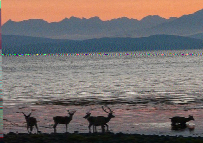
Deer on a shore of Loch Hourn, Scotland.Sunset at Blackness, ScotlandMiddletown, Maryland, facing west towards South Mountain, July 12 [2021]A monarch butterfly flexes its wings in Marple Township, PennsylvaniaThe pier at Fontainebleau State Park, on the north shore of Lake Pontchartrain, LouisianaBetony, Betonica officinalis, at Jubilee County Park, LondonHybrid pimpinellifolia shrub rose (Rosa ‘Golden Wings’) at the Arboretum at Penn StateOur painting of the week is “Usonian View” by Michelle Lewis
Check out the SWRadiogram website and give it a try. The ability to set this up for unattended decoding/recording makes it very convenient. Can you think of any other services (ARRL Maybe?) that could benefit, or act to the benefit of listeners with digital capabilities in this way?




























 petebrunelli