
Much like my interest in radio I’ve been playing musical instruments almost my entire life. We just used to be somewhat obsessed over the guitars, keyboards, amplifiers and eventually software that we saw on stage (on air) and in magazines. Eventually that got its own acronym G.A.S. for Gear Acquisition Syndrome. What I learned from years of horse-trading equipment via selling, buying, swapping, upgrading, downgrading… is that at some point I was very happy with my equipment and changing it around was a distraction. I play electric bass and usually am playing one of the four basses I own to the exclusion of the others. It might be a holdover from the many years when I had one bass, one amp, and not much else. Honestly I am a relentless pragmatist and mostly look for a piece of gear with certain capabilities. There have been… exceptions. Nuff Said.

It has become the same thing with ham radio equipment. I moved around between many different radios and antennas in my first 10 years of ham radio operating. Mostly it was a need for a specific capability, like UHF all mode, or QRP HF with great CW chops. It was messy, and most of that gear is gone, but I learned a lot about what I do and do not like. I do still buy and sell things, but in the main I use the same gear for a long time. Time in the hobby helps you think “into the future” a bit and you can identify gear that will be junk soon, is junk now, is highly functional junk (heck yeah), or is the real deal. Spending time at hamfests is like a crash course. When I was an organizer for a small hamfest in Connecticut I was perusing somegrar at a table and one of the club “Elmers” buttonholed me and said “That rig was junk when it was new, and it hasn’t gotten any better. Talk to me later, but don’t buy it!” And we lear to sepeate the good from the bad (for our particular needs). There are radios that have very long useful lifespans (The FT-817/818, for example. The cockroach of the ham radio world.) and others that either have not or probably won’t.
Warning: The G.A.S. Monster is devious and does not sleep! Even as I started devoting more and more time to satellite operation I had resisted selling my FT-991A. It is a great radio. The ICOM IC-9700 is the only in-production V/U all mode with full duplex capability. That’s rare. There is usually competition in any given product segment. QRP radios, HTs, 100W entry level, Contest-focused rigs, HF linear amplifiers… There are choices. Not so in satellite ground station equipment. As I said in the last post, “One rig. That’s the list”. Meanwhile I am using my FT-817/IC-705 portable rig with a handheld antenna for all my sat work except for simplex digipeaters like Greencube/IO-117. I don’t know if I will ever put up a computer controlled alt-az antenna mount, preamps, etc… but I am interested in the capability. It was only a matter of time until I would decide to cut bait and obtain an IC-9700. May 2023 was that time.
After a short flurry of sales activity on QRZ.com I had moved my Yaesu FT-991A and backup FT-817ND on to new loving homes, and had squirreled enough cash to blunt the not insignificant cash crater the purchase of a new IC-9700 would create. It’s the only game in town. There are no sales, incentives, or promotions worth mentioning. You want it, they have it, and if you don’t buy it someone else will. That, friends, is Scarcity Economics in action. So on to my preferred enablers at DX Engineering I went and plunked down the plastic for a IC-9700, a headset adapter, and the Icom/Electret variant of the dynamic-mic Heil Sound Proset 6 that I use on my portable rig (FT-817 is my uplink rig). The Pro-7 would give me better isolation, but I will take a lighter headset with some bleed when operating out in public. I can hear someone walking by or asking a question. That’s not a bad thing.

It arrived quickly since DX Engineering is the king of getting the gear to your doorstep, pronto. First reaction: It’s a beautiful radio! I already had most of the power cabling I needed, along with N-Connector adapters, and it didn’t take me long to connect it to a dummy load and run through some menus. As I expected I felt right at home in the menu system. It is very similar to the IC-705. I also quickly noticed that the front panel is a bit cramped. Most modern radios have the same issue but I was thinking about using this radio outdoors, portable, and hitting the wrong control is something that just happens (foreshadowing).
Some of the questions I had about operating this radio would only be answered through use. I have picked the brains of some very helpful satellite operators, and scoured the web for videos, but nothing gave me a clear idea of how this thing worked in comparison to my FT-817/IC-705 satellite rig. I am fully manual with that setup, tuning the uplink rig (817) and the downlink rig (705) separately. The waterfall display on the 705 makes finding myself on the downlink easy with little need for a cheat sheet. I know the transponder ranges and centers, and get within a few KHz right away. QSY is as easy as tuning the RX, having an idea of how far away I moved, then adjusting the TX the same amount (in reverse on a sat like RS-44. RX up 3, TX down 3…).
The IC-9700 is different. It has a dual-VFO split mode and you can A/B between the two VFOs with dedicated touch screen buttons, using the main tuning knob to adjust each VFO one at a time. There is no sub-VFO control. There is RIT, but I am still not a fan of RIT for satellite work. My OCD tells me to just tune it correctly. I also won’t forget my RIT setting is on and waste time trying to figure out why I am out of band! That is similar to running two radios, but you only have one VFO knob.
Then there is SAT mode. I figured this would be the “killer app” for tracking frequency on sats. You can activate either VFO, and there is a NOR (normal)/REV (reverse) button between the VFO buttons on the touch display. Sweet! (Reverse is where the input of the transponder and the output are reversed. The bottom of the uplink puts you on the top of the downlink, and as you tune the uplink higher your signal on the downlink tracks lower, and v-v)
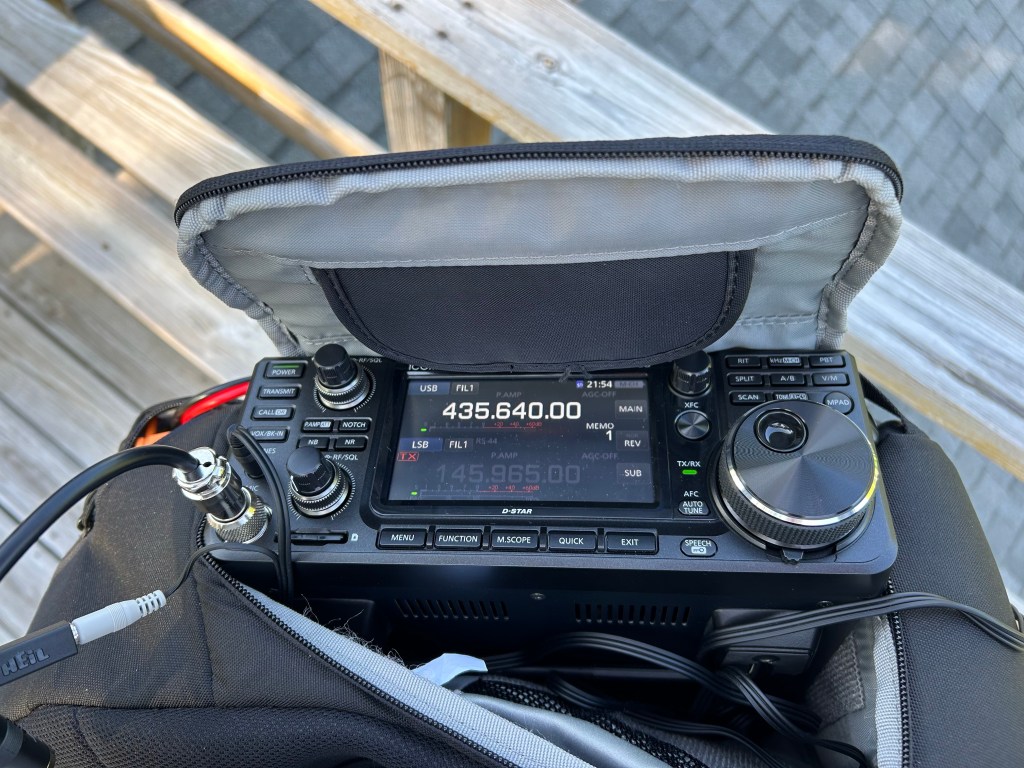
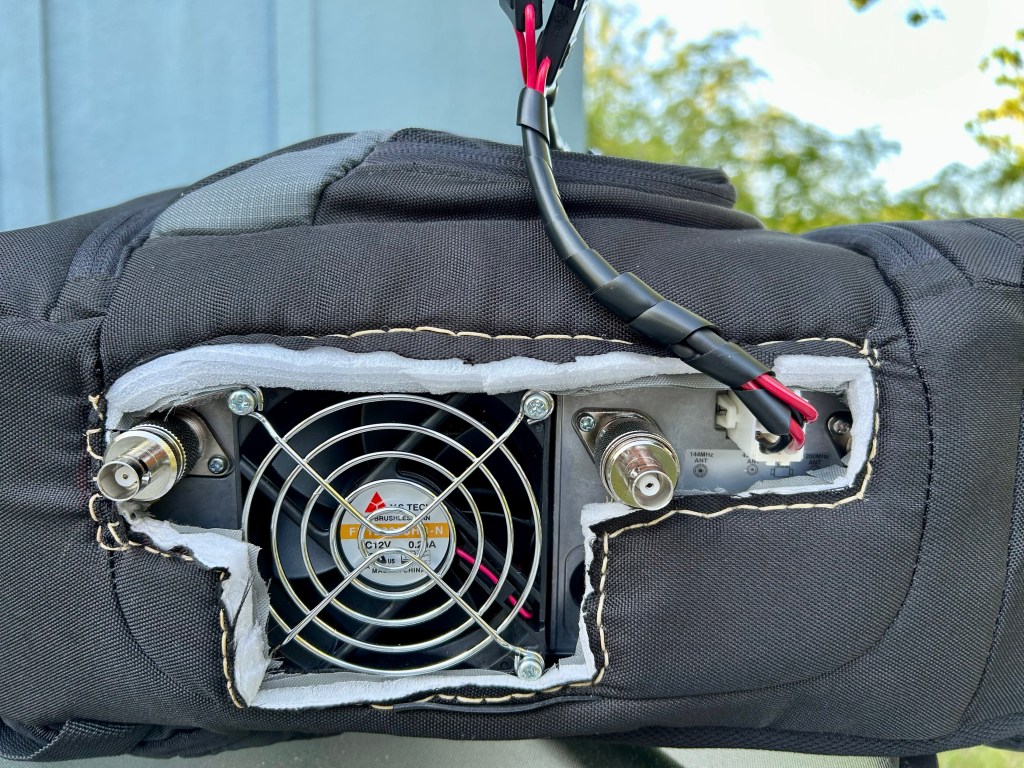
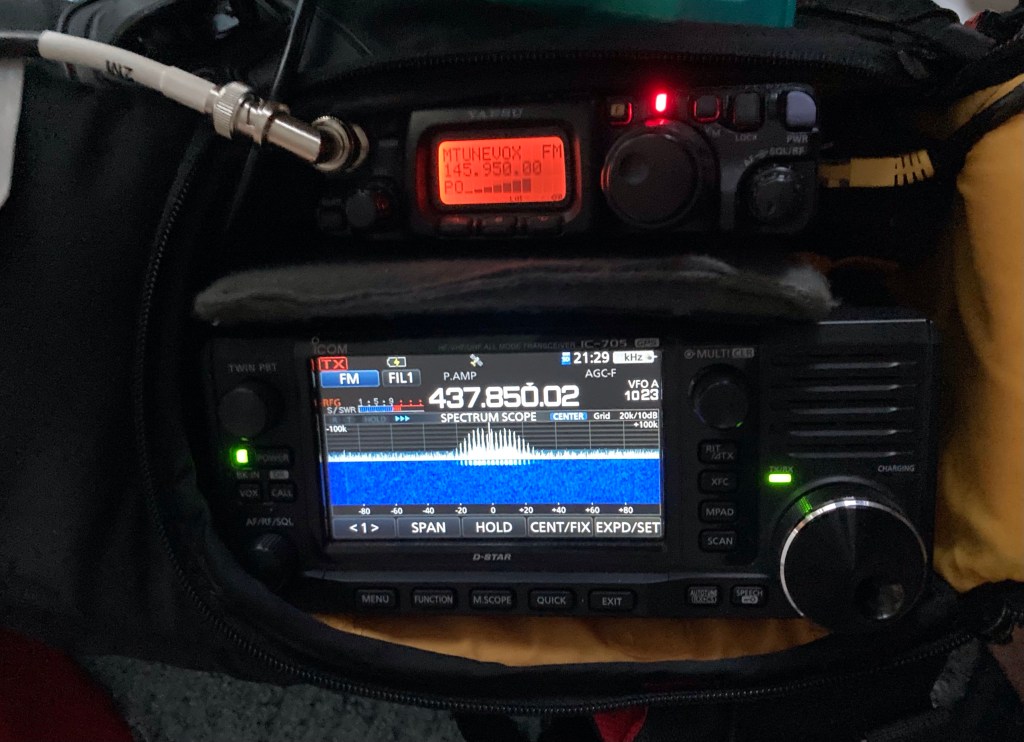
I still use a handheld Arrow II antenna so operating sitting down is not a great option. Much like I did with my camera bag holster for the 817/705 rig I turned a LowePro sling bag that I had bought for a full-sized DSLR kit (and the bag was not great for that) and carved it up to allow me to wear the IC-9700. A Speedy-Stitcher made it easy to neaten up the cutouts I made for the rear connector access. I had to punch a hole through the side of the top compartment to snake the power lead out to the radio. Done. It worked and the rig only feels heavy, not unbearable. I hooked it up and went out to try a RS-44 pass. That’s a bird I am very comfortable on.
I put the radio into SAT mode, set the VFOs, and off I went.
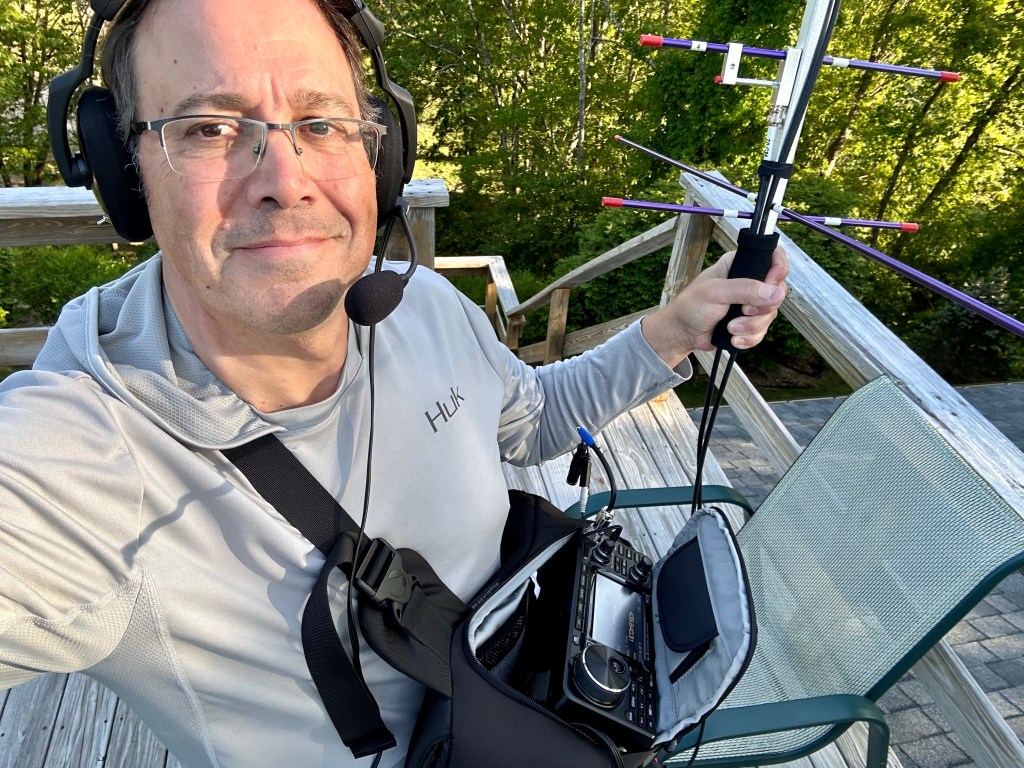
Let’s just say it did not go well. I’m going to bullet list the things I tripped over because I think it will make it easier to convey:
- Seeing the display in sunlight is very difficult. I will need t make a shade to use this reliably in this configuration.
- Changing between VFOs is not as intuitive as I expected, and not hitting the NOR/REV pad by mistake is even harder.
- If you press on one of the frequency displays the frequency is highlighted making it easier to see, but that does not select the VFO for tuning.
- If you use the VFO Select pads you can select the correct VFO, but it doesn’t highlight the associated VFO display. There is also that NOR/REV button waiting for you to step on it like Sideshow Bob on a rake. So switching VFOs and being able to see the display in daylight is a two-press and check the status of the NOR/REV before proceeding. Every time.
- Then there is VFO synchronization where neither VFO is selected and NOR/REV tells the rig how to sync the VFOs. Yes, it works. But as you QSY the tracking isn’t great and once you have the RX on frequency you now have to retune the TX VFO (or v-v) to get yourself back on frequency. So it works, but not well enough to just retune and hit the PTT.

Admittedly I made it hard on myself by not doing more than a quick dry run before trying to make contacts with this radio. But I hope I am making the point that while the radio is a fantastic performer it seems more at home in a shack than hung around my neck. At the very least it will take practice to get to the point where manual operation is as intuitive as a dual-rig setup.
My next mission was to get active on Greencube/IO-117. This turned out to be much more straightforward. Because the IC-9700 presents two virtual COM ports over USB I was able to run CI-V control on one and trigger PTT with the other. I use SATPC32ISS for the CI-V (CAT) control, and UZ7HO Soundmodem controls the PTT by directly addressing the higher-numbered of the two ports. I was able to get rid of the VSPE Virtual Port Splitter app I was using, and SATPC32ISS instead of HRD/HRD Satellite. That’s three open apps as compared to five which is a better place to be in the field when things inevitably go wrong.

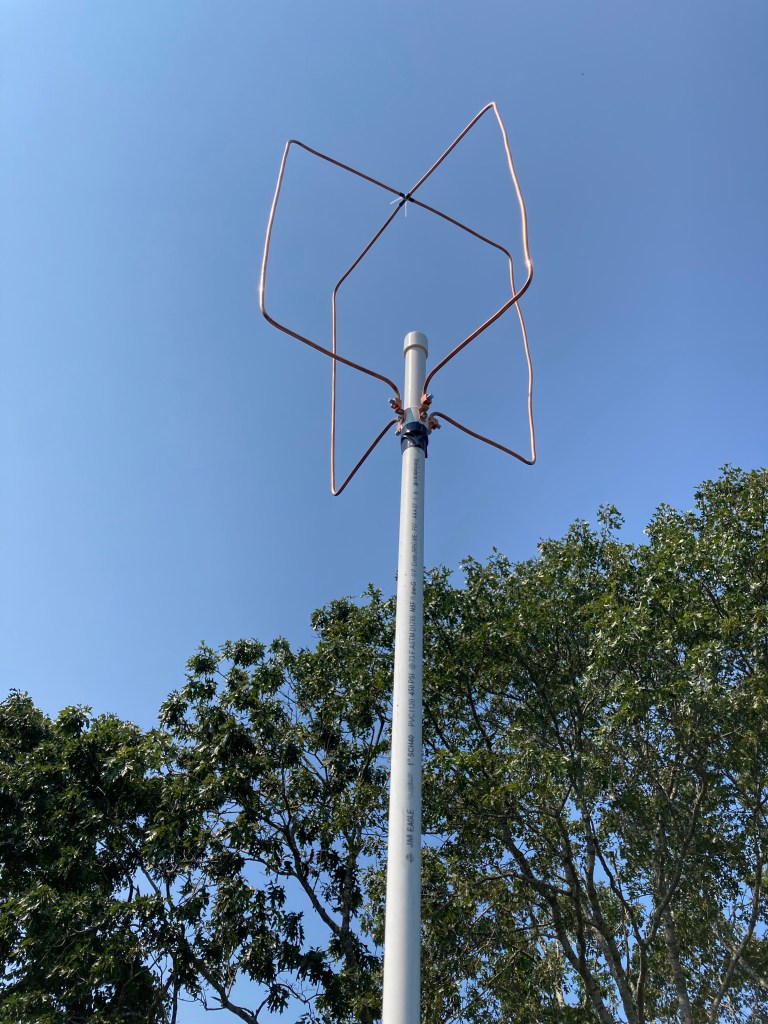
It was as easy as the previous attempt was difficult. Using the same 70cm WIMO X-Quad I used with the 991A I was hitting IO-117 easily at 25w and made a few contacts immediately. Then “Greencube Hell” broke out and I wasn’t able to break in over the big signals is Europe and Russia. But it wasn’t due to a problem on my end. SUCCESS!
After a few tries I was able to make SSB and FM LEO contacts with the IC-9700 in my portable setup. I was still getting tripped up a bit, but having the sats in memory banks and being able to switch between them that easily is very cool. I am still occasionally hitting NOR/REV by mistake and my next step is to just run it in dual-VFO Split Mode and see if that is easier. I think it will be.
The performance of this radio is superb. Compared to the Yaesu FT-991A the receive sounds more sensitive and cleaner on weak signals. The 991A has a very good receiver, but there is something more “contrasty” about the RX on the 9700. The TX audio is levels above the TX audio on my FT-817ND. It is much punchier and clearer. You can pretty much tell a 9700 on the birds once you have used one. That is not a small detail when trying to make difficult contacts. Neither is the ability to dial up a few more watts when needed.
One last thing before I close this and start thinking about Part 3:
Even though the IC-9700 looks very much like the IC-7300 and IC-705 it is an older design and does not have features like Bluetooth Audio that I use all the time on the IC-705. Even if it was available I wouldn’t be surprised if it was left out to have one less RF source causing problems inside the IC-9700 chassis. It doesn’t feel as “fresh” as the IC-705 but maybe that is because I have a few years of 705 operation to rely on.
Nobody has ever said the IC-9700 is a “field radio”. It is meant for the shack and if you take it into the wild there will be compromises. Little buttons, crowded display, not designed for cold fingers or no-look operation… But once it hooks up on a satellite it doesn’t matter. If we have only one choice in this category I am glad it is the IC-9700.
Here’s the deal on not having the Yaesu FT-991A in my shack. I could easily see myself owning one again. It is a lot of radio for the dollar, epecially at the prices on the used market. As I have said on this blog, many people complain about the menus but how much time do you spend in the menus? The quick access menu takes care of day to day adjustments. I only had to go into the full menu to make major changes for data modes or filter ranges. The actual radio (not the feature set, the radio) is brilliant. It is a standout 100W HF rig with a great receiver, great on 6M, and the V/U performance is very usable. It isn’t a V/U thoroughbred like the 9700, but for most weak signal operation it is very good. I don’t work a lot of QRO HF, especially since getting set up for satellites, but I will miss a 100W HF rig at some point. The bigger miss is 6M. I like working 6M and this is a bad time of year to be without a 6M radio. My plan is to pick up a Yaesu FT-891 eventually and fill that void and have a portable QRO HF option.. Until then 10W on the IC-705 has been a good HF setup for me since I bought it, and it is still a great choice.
More soon. Lots to learn about the 9700.





















 petebrunelli