Tag: electronics

  • How I learned to stop worrying and love the ICOM IC-9700 – Part 1

    How I learned to stop worrying and love the ICOM IC-9700 – Part 1

    The Inevitable Happened…

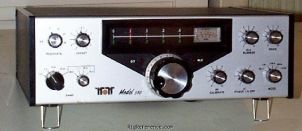
    2023 marks 30 years of being a licensed ham and over that time I have owned a range of brands and types of radios, built QRP kits, built antennas… the usual stuff. I started out with a Ten Tec Triton IV, dial cord tuning, and that was a great rig. Excellent receiver, excellent QSK, great company. I ran a TT Scout for mobile HF and that was a fun radio. I liked the simplicity and the analog performance of those radios and can say I started off in ham radio as a “Ten Tec Guy”.

    Ten Tec 540 Triton IV w/ Analog Tuning

    But… I also have a “early adopter” streak, so I also bought an original Icom IC-706, then traded up to a MKII G when it came out. It was like buying a rig from the future! It may have been because the MKIIG is still a very good radio over 25 years later! Icom was ahead of the pack with the size and the feature set. The bleeding edge can be a good corner to hang out on.

    Later on my VHF Rover activities gave me a chance to use various Kenwood, Icom and Yaesu radios. They all had pros and cons. They all made plenty of contacts. Over the years I have owned a few of each, but on balance you could call me a “Yaesu Guy”. Yaesu vs Icom reminds me of Nikon vs Canon cameras. Yaesu is more like a Nikon, making great performing gear but holding on to a set of features and specs well past their due date. Icom is to me an equivalent to Canon. Canon always felt a little more flashy, more modern and easier to use, and Nikon was more old-school tried and true. Maybe Ten Tec was my Olympus, because I was a Olympus guy, who eventually became a Nikon guy, who became an Olympus guy again. It’s complicated! Like this analogy.

    A few years ago, after a bit of a layoff from ham radio, I had almost no gear left, and some accessories and a few HTs were all I had in my “shack”. I bought a Xiegu G-90 which is a very good radio, and a lot of fun, and it got me back on the air and active again. I also purchased a Yaesu FT-817ND because I have owned several before and I feel kinda “naked” without one. When I decided to get a 100W HF rig a few years back I realized that I needed VHF/UHF as well and the Yaesu FT-991A was the obvious choice. It covered VHF and UHF with some power, has a great receiver, and it has built in audio and and CAT over USB. After buying it I felt like I might have underestimated it. It is a better rig than I expected it to be. I have made loads of contacts with it. It is a 3-band VHF Rover rig, out of the box. I worked SSB, CW, RTTY, FT8, and other digimodes with ease. It’s also an excellent general coverage receiver and I did a lot of SWL with it.

    But a funny thing happened when Icom came out with the IC-705. The early adopter in me was back in charge. I bought one soon after it was released and I have been blown away by that radio. It has done everything the 991A has done, and more, with the trade off of less power against less weight. I used it for POTA, travel operation, mobile use, and then as half of my portable LEO satellite station. The 705 has been my downlink rig since I started satellite operation, and it is a joy to operate in that role.

    Icom IC-705

    You can see where this is going. Right now Yaesu is making a great line of HF radios, with several new models over the past five years, but the 991A is their only V/U All Mode, and there are no indications of anything new coming any time soon. The 991A is similar to the FT-817/818 in that it is an older design and the clock is ticking. Just this year Yaesu killed off the 817/817 line and Yaesu has not indicated that it will replace that radio. Meanwhile, the IC-705 showed me a better interface, better menus, and in many ways better performance in a very compact package. Certainly it is more convenient than the 991A and a technological leap beyond the Yaesu FT-817/818.

    In fact, I like the 705 so much that the 991A started to look like it might need a new owner. Between satellite operation and QRP the 991A wasn’t getting as much use. I never worried about the performance. It performs very well. Even the menu system isn’t that bad. It just isn’t great. And while it is a very good option for satellites like Greencube/IO-117 it isn’t full duplex and there is only one full duplex VHF/UHF All Mode currently in production, and it’s the Yaesu IC-9700. It might seem cliché for a sat op to run one but if you want the best satellite rig you can buy new the list is one rig long.

    So it happened… I sold both a backup Yaesu FT-817ND and the FT-991A and am now yet another sat op with a IC-9700! I have some immediate reactions from the first few days of ownership and I will cover them in the next post. Spoiler: Both the 991A and the 9700 are very good radios. They are also very different radios. And that’s a good thing.

  • The Well Tuned Eggbeater

    The Well Tuned Eggbeater

    I’m taking some initial steps toward working satellites this fall, and part of that crossed paths with dialing in my APRS setup, which led to me working the ISS digipeater with my homebrew copper cactus. While that worked, I was having deep fades and dropouts due to the vertical polarization of the J-Pole being incompatible with the right-hand-circular-polarization (RHCP) of the ISS system. This problem gets worse as the ISS rises in elevation relative to the ground station due to the deep overhead null in the vertical’s pattern.

    Amateur Radio operators solve this issue in several ways: One is to track the satellite with a handheld linear-polarization antenna like a Yagi-Uda and manually rotate the antenna to match polarization and peak the signal; Another is to use a circularly polarized directional antenna and track the satellite manually or by rotator control; and then there is the omnidirectional RHCP antenna, of which the eggbeater is a common example. I am looking to operate from a fixed indoor location over the colder months, so I’m starting with the eggbeater.

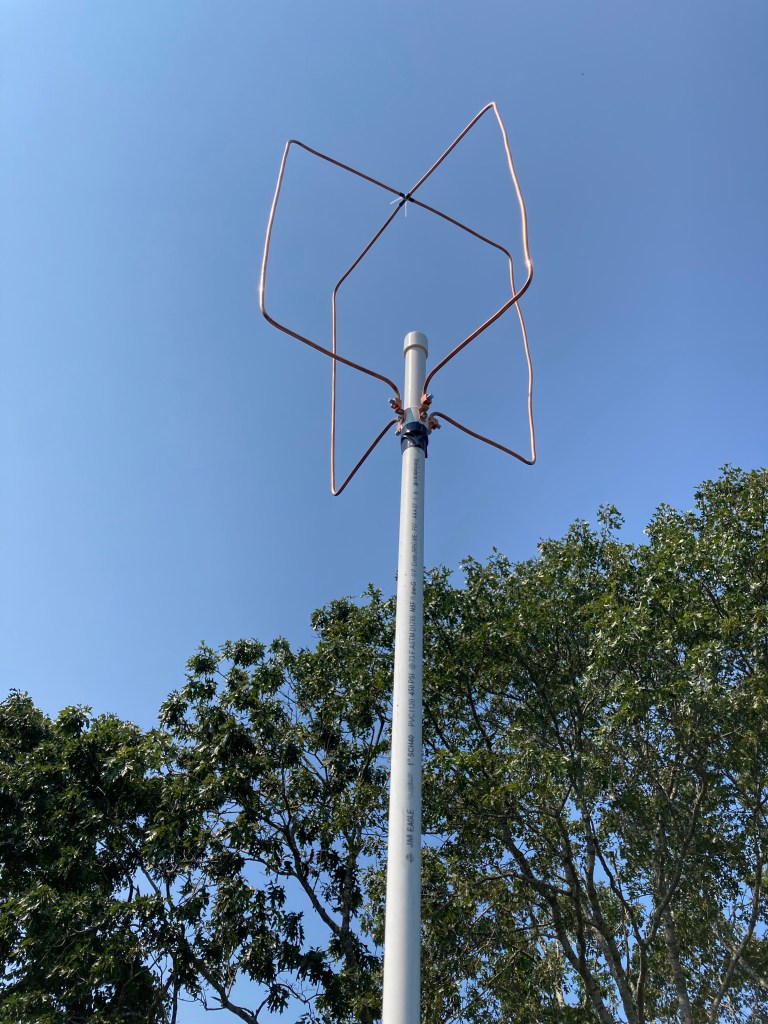
    I know the reflectors are missing. Please use your imagination.

    The eggbeater is a variant of the “turnstile” antenna, using two full-wavelength loops as the driven elements. The two loops are driven “in quadrature” using a section of coaxial cable to create a phase delay line, which creates the circular polarization pattern. I won’t reinvent anything here and I’ll direct you to the designer of the Eggbeater II variant, Jerry K5OE: Eggbeater II Omni LEO Antennas. I also highly recommend ZR6AIC’s article Building my Eggbeater II Omni LEO Antennas. I picked up several good ideas from his build.

    The K5OE design is excellent and a great starting point for construction. It is a little light on the details which is great because each builder can come up with their own approach. I will demonstrate some of my construction techniques, my mistakes and corrections, and my impression of the overall performance.

    Materials: I’m sticking with Schedule 40 PVC pipe/fittings, soft copper tubing, and easily available hardware. I’m using 1” pipe and fittings and it feels like the right move. The RF parts I used include low-loss coaxial cable, appropriate connectors, and a section of Belden RG-62 93-Ohm coaxial cable for the phasing line.

    The RG-62 helps keep the SWR down as it is close to 100-Ohm and that plays nice with the goal of creating a 50-ohm feedpoint from two full-wave elements. If you want to build it with 75-ohm CATV coax your SWR might suffer a bit but it will still work. It might take some reverse engineering but pay attention to your cable’s velocity factor when sizing the phasing line. One thing to know about these other forms of coax is they are not designed for solder connections. CATV and video systems use a crimp connector and the bare center conductor may act as the connector’s “center pin”. Look at most any CATV F-style connector to see what I mean. The Belden RG-62 I purchased on eBay had a small wire conductor loosely run through a soft plastic tube acting as the dielectric. It does not like heat. Also, the single wire is weak compared to a stranded center conductor. I broke the first one I assembled and won’t be surprised when the next one breaks.

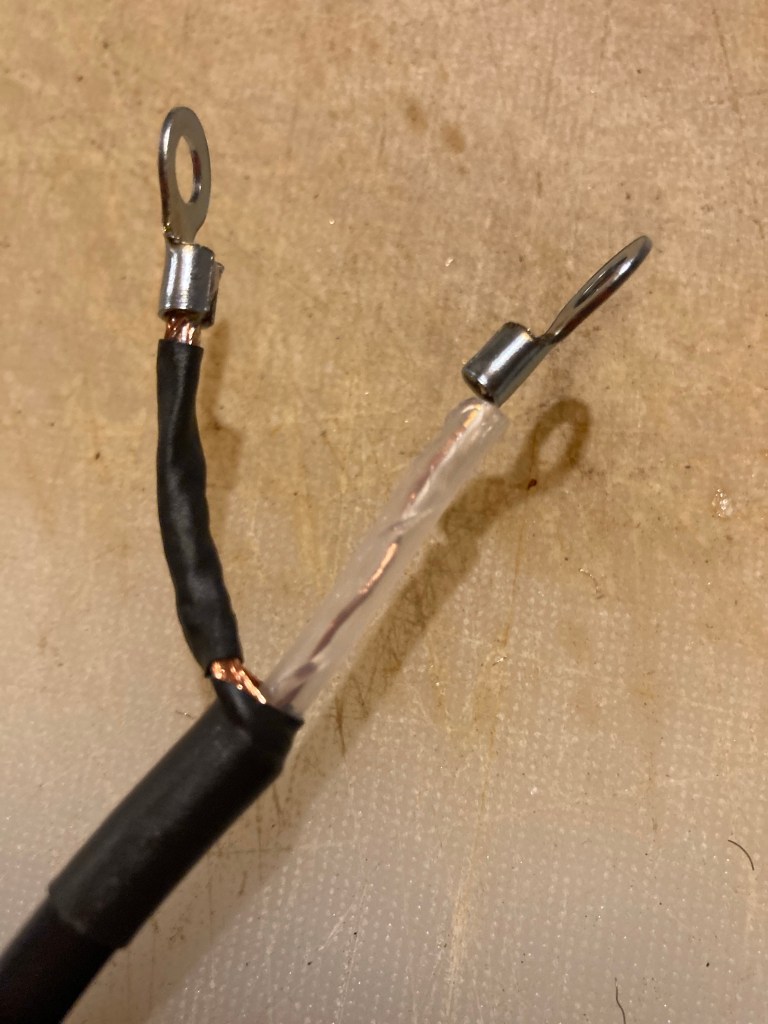
    One dressed end of the phasing harness.

    Here’s a tip: when you build the phasing harness mock it up and get the lugs oriented so they line up with the attachment screws. If you are twisting them into position they will break and the phasing line won’t lie nice and straight. You want it to fit nicely down the PVC support pipe.

    One last detail: the antenna sits on a 4’ section of pipe with a T at the bottom. I run the feedline down the support pipe and out the side of a T fitting, and use another length of pipe below the T as a support. Cutting a 10’ length at the 4’ point is a good setup. You can keep an uncut 10’ length of pipe as a support if you need more elevation.

    Assembly, The Driven Elements: The first obvious hurdle is the loop material. I decided to use 1/4” soft copper tubing based on price and the ability to bend it using a common handheld tubing bender. It feels like a compromise between weight and durability and worked out well in my build. The home-store refrigeration kits contain about 10 feet of tubing which is just enough to make the 2M Eggbeater, but the cost/foot is high. I went to my local plumbing supply shop and they had it for about $1/ft in a 50’ roll. I think that’s a better way to go, and if you have some left over you will have ideas for using it.

    I used a $20 tubing bender from Home Depot. Get the type with registration markings and you will make accurate bends. Aligning your measurement marks with the “L” mark puts the mark about mid-bend. That worked perfectly in my build. Be sure to align the starting lines on the bender as well. Give yourself a few inches of slack at each end of the element and then trim the ends to size. The tubing has some give to make adjustments but the flatter you keep the element as you bend it the better.

    HUSKY tubing bender

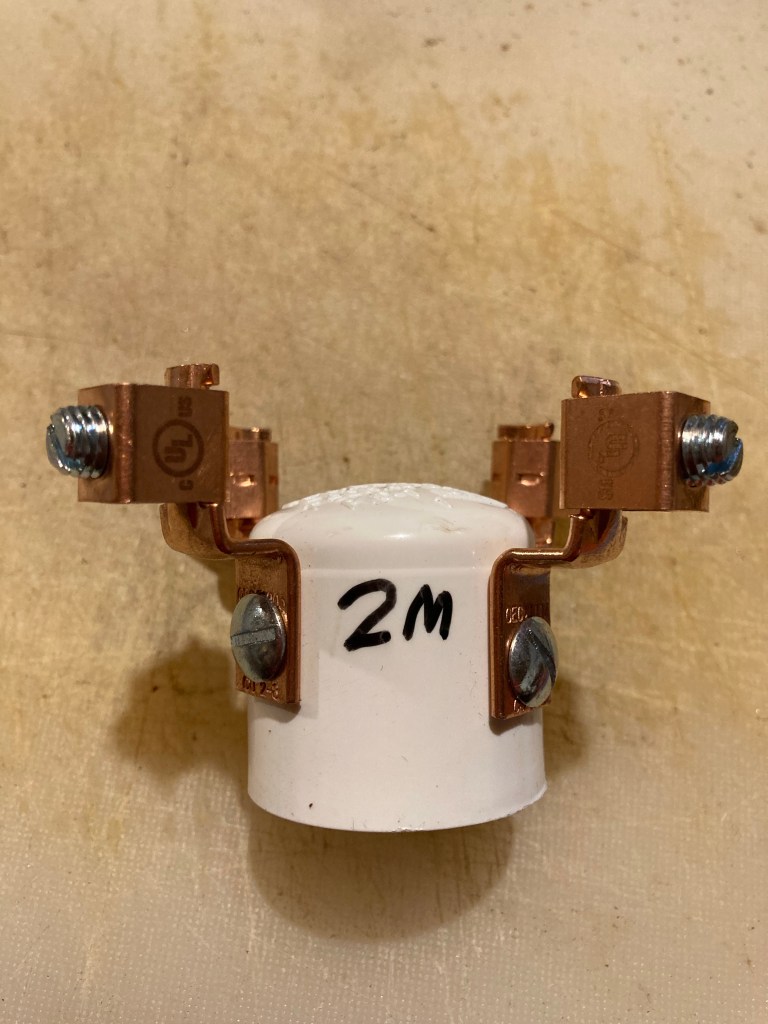
    The next challenge is holding two big metal loops in a 90-degree orientation. I did some scrounging around the local home improvement megastore and landed on an offset ground lug from the electrical department. ZR6AIC mounts a similar lug to a 1” PVC cap. I tried this but my goal was to keep the phasing line inside the PVC and the connections prevented the cap from seating. I went with a 1” PVC coupler and mounted the lugs to the top half.

    The PVC in the middle is just a scrap piece with a cap to close up the feedpoint. It could be much shorter, but this looks pretty badass.
    I tried using a cap, but it didn’t work. See the other pics and it shows how I used a coupler. Much better.
    These lugs are beefy and capture 1/4” copper tube perfectly
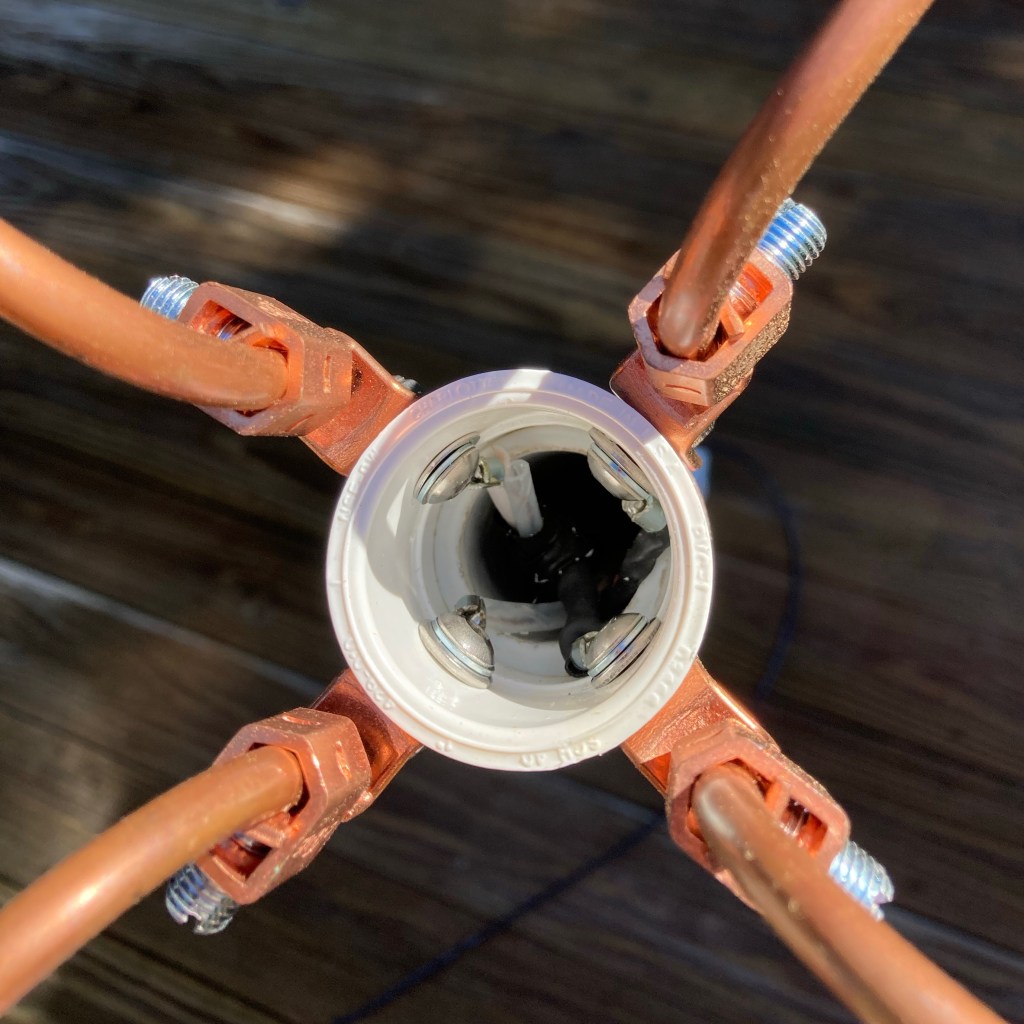
    Viewing the feedpoint from the top. The connections are in the top half of the coupler so the support gets a clean fit to the lower half.

    Did it work? Yes, it works very well, has great SWR, and the coverage during an ISS pass is greatly improved over a vertical antenna. I’m very happy with the final result. I’ll be making a 432 version next which will allow me to start monitoring linear sats with my IC705 and FT991A for uplink and downlink. I’m taking it slow with this instead of jumping right on and being a kook on the linear birds. I’ll still be a kook, but a slightly better prepared kook!

    I estimate the costs at $50 per antenna. The tubing cost about $1/ft, the lugs and hardware are under $10, and the coax/connector is whatever you feel ok with. I used 10 feet of LM240 superflex and the DX Engineering 8X/240 crimp UHF connectors. You could buy a 20 foot premade jumper and cut it in half. You could make it with RG8X or RG58. For FM birds and ISS APRS it is not too critical. Getting correct polarization is the main benefit.

    Feel free to ask me questions in the comments, or email me at n1qdq@petebrunelli.com. 73 and happy building!

  • Who’s afraid of FT8?

    Preface: I am planning on creating some posts addressing this in a more technical fashion. This is not a comprehensive tech essay full of footnotes. You either know what this is about or you don’t. For now I am sharing this brain dump addressed to all amateur radio operators. We find ourselves in a unique circumstance where great changes have occurred over a long period of low solar activity, and we are now emerging with some very real social turbulence in the ham radio ranks. I think it is useful to take a broad view of this pursuit, this service, and reflect on how we have moved forward, and how we can continue to move forward. 73, Pete N1QDQ

    Let’s travel back to the heady days of 2010, when a new ham radio sensation called PSK31 was “taking over the ham bands”. It allowed users with less than massive transmitters and antennas to make reliable keyboard to keyboard contacts on HF. It wasn’t perfect. Many ops ran too much power, or had overdriven signals, or both, and the small stations had a bit of work to do to get through a QSO. The spectrum slices being used were narrow/cramped, and it didn’t take much to interfere with another op. You pretty much had to be on the same frequency/offset as the other station (not reliable in split mode) or it didn’t work, and a big wooly signal would wipe out a quarter of the subband. The advantage was that it took up about a tenth of the spectrum of a RTTY signal, and was more power-efficient. It also allowed many more operators to share the same slice of spectrum. As is the case today it was also a reason for the “big gun” stations to sneer down their noses and tell “lesser’ operators how they were killing ham radio.

    FFW to today, and we are in much of the same predicament with a newer mode called FT8. It is even more flexible than PSK31, works at even lower signal to noise ratios, and is implemented primarily through one application called WSJT-X. It does not support anything much beyond the bare bones exchange of callsign, location and signal report. That makes sense since the suite of modes associated with Joe Taylor K1JT, Steve Franke, K9AN, and a cadre of experimenters was developed for very weak signal operations like Earth-Moon-Earth (EME) and Meteor Scatter. It turns out some of these modes, specifically FT8 and FT4, are very robust over traditional HF frequencies and propagation modes. And yet, despite allowing a large number of contacts over a small slice of spectrum, with lower power, and lower s/n ratios, FT8 users are again subject to ridicule by keepers of the mid-20th century technology flame. This extends to purposeful QRM, sneering memes about how FT8 ops are not real hams, how their QSOs don’t count, how it is “cheating”, and so on. Even as predictable as it is, it puts the ugly side of the “friendliest hobby” at the forefront of the much needed conversations around how our spectrum allocations are utilized, and how they will be used going forward.

    Which is a shame, because these computer-controlled weak signal modes on the HF bands are nothing if not entirely consistent with the traditions of ham radio, and the central thesis of evolving to incorporate new technology as it emerges. The integration of existing and new technologies into radio communication is the hallmark of ham radio. What began as the transmission of Morse Code (tech adapted from the wired telegraph industry) using a spark gap transmitter, quickly evolved to a continuous-wave (CW) transmission based on the implementation of the vacuum triode as a tunable oscillator and amplifier. The spark-gap blasted RF across a big slice of RF spectrum. CW turned that on its head and allowed for more efficient narrow-band communications. Suddenly there was more room for more operators to communicate with less power over longer distances.

    When modulated carrier audio came into being, it was double-sideband full carrier amplitude modulation, or AM. This is what we hear when we listen to the AM broadcast band. It takes a lot of power to generate that signal, and it also takes up a lot of spectrum. As the need arose for more efficient communications modes (portable equipment, lower power requirements, covering greater distances) it was found you could do away with the carrier (which was the reference frequency for the audio sidebands) and then one of the two sidebands. Thus Single Side-Band (SSB) was created. By giving the receiver the necessary oscillators to rebuild the audio information, the transmission could be made using much less power. This mode relied on the many improvements to vacuum tube technology, including miniaturization, lower power circuitry, and the use of multiple oscillators in new configurations. These fundamental modes of radio communication, data and audio, integrated new technology as it appeared, and hams were pivotal in their widespread adoption. As well, hams were pivotal in the development of new modes of radio communication based on these principles. They were, as now, radio experimenters. They were doing for free what governments were doing under much less liberated circumstances.

    Radio technology eagerly adopted every advance in electronics tech, from vacuum tube minaturization, to the semiconductor, the integrated circuit, the standardization of component packaging, and then the microprocessor. Microprocessors were a natural fit for radio communications because they can manipulate control voltages and logic states at a blinding pace. The earliest and slowest microprocessors were adding communications capabilities beyond the analog realm. It also turned out you could emulate an oscillator with a microprocessor. Even at audio frequencies this was a giant leap for oscillator miniaturization and stability. Once these microprocessors were integrated into computing platforms, handling user input, program code execution, data storage, and data output, the modern era of computer/radio hybridization was in play.

    It is simple enough to state that a radio station operating without some form of semiconductor and microprocessor technology is indeed a rarity. I know of no hams who are aching to go back to drifty oscillators and inefficient transmitters. Yes, that gear is still in use by a few stations, but I’ll bet each one has a modern rig right next to it. While modern technology has come to dominate the scene, all of the historical phases of electronics technology still have a place in the pursuit of radio communications (ok, maybe not spark gap). The fundamentals of radio still apply regardless of the technology.

    So I ask, earnestly: How did this illustrious, enjoyable, and diverse pursuit of technology applied to radio communication become beholden to gatekeepers who selectively decide which modern technology is appropriate, and which they believe makes one a “fake ham”? It is almost universally the cry of hams who are “fortunate” enough to have a tower(s) supporting a big directional antenna(s) fed by a kilowatt(s) of RF, using modes established in the WWII era, who demand that they be crowned the gatekeepers of What Is Correct.

    The facts are decidedly at odds with their position. If they were in any way in the majority it would be reflected in radio equipment sales and development. I believe the “average” ham has a somewhat modern 100W transceiver with a simple antenna, and a few helpful accessories. Additionally, they own a computer, which has become not only extremely cheap, but extremely effective. Somehow, in the middle of a deep and prolonged solar minimum, the airwaves are increasingly being used by many low power stations using compromised antennas, often with portability in mind. One reason this has been possible has been the development of modes like FT8. When you can run a 1-30W transceiver into a $20 homebrew end-fed wire, controlled by a $50 Raspberry Pi “toy” computer, and make a contact 10,000 miles away, it opens up the accessibility of radio communication in a myriad of ways. I made my first JA contact from my new QTH using 35W into a wire vertical, and FT8. It’s just as valid as any other contact.

    I agree that the FT8 QSO is not very satisfying from a “chat about the weather and your radio” perspective. But let’s be honest, a typical CW conversation is name, location, rig, antenna, and brief weather observation. It’s fun. I love it. But it isn’t exactly deep bonding going on there. FT8 is giving the user more of a “contest mode” QSO. Being that it is good enough for the biggest stations in the world, as long as an actual contest is afoot (every weekend, #jussayin), why is it less appropriate in weak signal work? Maybe it’s has to do with the fear of losing status? Maybe it’s the need to ensure that kilowatt stations using 80 year old tech continue to dominate the way hams use their HF spectrum allocations in the 21st century? I can understand it, objectively, though I have not been able to assemble that kind of station. I also understand bullies. All too well. Ham radio needs to face up to the fact that it has a bully problem.

    Unless you have been under a rock you know that every slice of the radio frequency spectrum is being eyed by some monied interest somewhere across the globe. Each time you see a nation kick their amateurs off an allocation it should raise an alarm. One would think the response of established spectrum users would be to promote increased usage and improved spectrum efficiency. It is counterintuitive to act as if relying more heavily on old tech is some kind of hedge against spectrum loss. I also fear that hams hold themselves to a standard that is not recognized outside of ham culture. An objective survey of the HF allocations would hear a small segment of intense activity in the bottom 100KHz, and then a lot of SSB voice spread out across the rest of the allocation.

    My purpose here is to begin a conversation not end one. This is the scenery as I see it, from my perspective as a ham who has held an Extra Class license for almost all of my 27+ years of ham-life. I am often operating portable equipment, often at QRP or slightly higher power levels. I try to enjoy all that ham radio has to offer. I like HF QRP CW, as well as digital modes, as well as VHF/UHF contesting, as well as SSB, and SWL, and applied electronics concepts, and so on. I feel that there is a disturbing social pushback on the current practices and adaptations many hams have made in the era of condo rules, suburban/urban constraints, restricted public space access, and accommodating family and work life, by a small population of operators who don’t share those constraints. All of the tools available to hams have a place. And it is a great credit to hams everywhere that there is a general respect for gentleman’s agreements and international spectrum guidance. What I hope we see as this next solar cycle heats up is not just continued cooperation, but greatly enhanced cooperation. There is room for everyone, and every facet of the hobby. There has to be. The alternative is unimaginable, avoidable, loss.

    Endnote: One piece of Amateur Radio News that spurred me to write this piece is this: FT8 Ruling The Airwaves from DXWorld.net. I believe it shows how a more efficient mode of communication increases the effectiveness of the power output on hand, and how attractive that is to many hams. I don’t think it is more complicated than that.

  • HEBBY ROTAYSHUM!!!

    fuchsprellen update:

    Fuchsprellen Fever! Catch It!  Our friend Ernst shot a video at the January 3, 2013 Best Video show and it is currently experiencing “hebby rotayshum” on New Haven Cable Access…

    Two videos up, and a few more in the pipeline:

    https://www.youtube.com/user/fuchsprellen3000

    Audio from 3 January, 2013 at Best Video now free, or best offer at:

    http://fuchsprellen.bandcamp.com/

    And one track from best Video, plus some archival stuff, free for the streaming at:

    Coming soon: bandcamp album from 13 January at the Outer Space, Comp of the first two fuchsprellen recordings, reboot of some material from early 2012 “proto-fuchsprellen”, and perhaps a new studio/ambient piece.